

THE MURDER OF INNOCENTS - Part 5
This article is free to read - please share freely. Your help enables us to continue providing this independent research. Details on how to support are at the end.
Disclaimer: We are not medical doctors, and this article does not constitute medical advice. It is for entertainment purposes only. Please speak to your qualified doctor or consultant if you need medical advise.
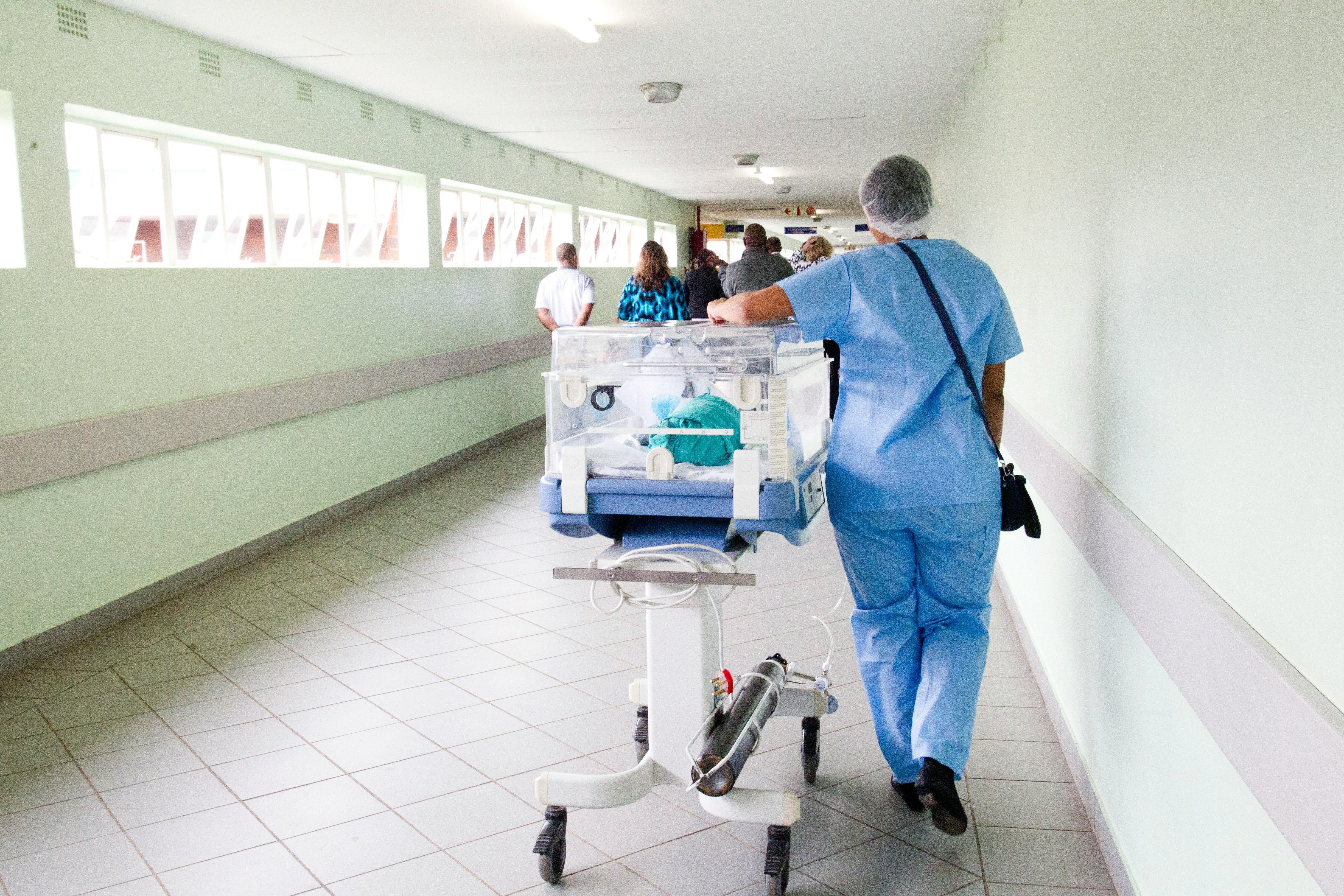 Clusters of unexpected and unexplained baby deaths have plagued the UK in recent years and these are being brought to our attention.
In order to understand why this is happening, we first need to understand why so many babies are being born extremely prematurely. That will hopefully give us some clues as to why well babies are suddenly collapsing in hospital settings around the country, and why treatment protocols that usually work perfectly well, sometimes fail to save infants.
The Office of National Statistics has a wide range of datasets, but they are often fragmented. So we have to piece information together from multiple datasets. There are so many gaps, omissions, and changes in the way data is logged, broader national patterns in these clusters may well have been missed.
This chart shows how many babies died under the age of one year, as a percentage of total babies born per year, in England and Wales from 1980 to 2022. Stillborn babies have been included in the figures. Data on miscarriages is not available.
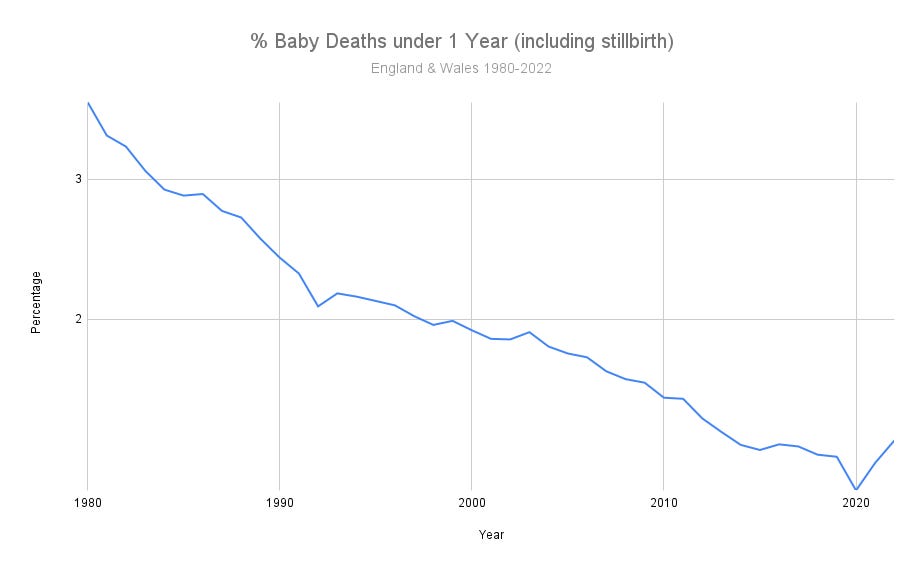
Office of National Statistics - Birth Characteristics
At first glance it looks fairly normal with a generally downward trend. The infant mortality rate reduces sharply from the start of the 1980s, but in 1986 it starts to rise slightly. A sharp rise in infant mortality then appears in 1993, following by more rises in 1999, 2003, 2016, 2021 and 2022. With advances in foetal medicine, pre- and postnatal care, it is hard to make sense of figures that go completely against the downward trend of the previous 20 years.
Pre-Pregnancy and Pregnancy Conditions
Pregnancy should be a time of celebration and anticipation of a new addition to a family. Instead increasingly it is becoming a time of anxiety and worry. Expectant mothers are treated as if midwives and clinicians are actually expecting things to go wrong.
A long list of antenatal screening checks are discussed in the early days. These are carried out using blood tests, urine tests, ultrasound scans, even amniocentesis. They check for a wide range of conditions from neural, congenital and blood defects, to infections, so-called sexually transmitted diseases and serious conditions of pregnancy. Pregnant women are poked and prodded endlessly to ensure they don’t have one life threatening condition or another.
A surprising number of expectant women today do have one or more conditions and these seem to be on the increase. According to Diabetes UK, 1 in 20 pregnant women are now diagnosed with gestational diabetes.
High blood pressure is found in 1 in 10 pregnancies and can be a warning sign that a pregnant woman could develop pre-eclampsia and/or cardiovascular issues during pregnancy. Serious conditions that would put both the mother’s and the baby’s lives at risk.
Better screening has enabled clinicians to reduce the incidence of serious outcomes. But little attention is paid to the cause of increases across the board, and of course the dramatic drop in national fertility. The blame for conditions may be put down to the standard western diet, genetics or fate. This regardless of an increasing trend for pregnant women to consciously lead a healthy lifestyle before and during pregnancy.
Until two weeks ago we were uncertain exactly how early labour was triggered. Now we are sure there are at least two chemicals which could be playing a significant part throughout. Working in chemical synergy, they could be implicated in many conditions that develop during pregnancy, premature births and in the sad sudden collapse and deaths of babies. They can even be implicated in the pre-pregnancy conditions that make some women’s pregnancies higher risk.
Though everything in the clinicians’ and nurses; power is done to save sick and premature infants, it seems at times that they are fighting against the odds.
High Levels of Metals
Throughout The Boom Review’s research we have talked about hair, urine, blood and atmospheric dust testing positive for high levels of metals, including arsenic.
What we were not aware of until recently was that high hair-based readings of some essential metals were likely NOT the result of high levels of cell death from exposure to arsenic alone.
Through comparison of tests from rain water drinking, and non-rain water drinking canines, we have established that the very high levels of calcium, sodium, potassium and magnesium are probably the result of them being dispersed, along with other metals, in the atmosphere.
These particles are inhaled, absorbed through the olfactory bulb in to our brains, through the lung walls, and through our guts in to the bloodstream and central nervous system. Not only that, but high amounts of calcium and other metals are being added to our food as ‘fortification’, carriers, softeners and preservers etc.
The very high levels in hair tests are a sign that our systems are overloaded, and calcium seems to be at the top of that list.
This means that all the pregnant women around us are also being exposed to these metals. Metals that could be undermining their ability to carry their babies to full term.
According to Tommy’s and Bliss, two pregnancy websites, preterm births earlier than 37 weeks in the UK, have risen from 7.4% of all babies born in 2020, to 7.9% of all babies born in 2022. According to Statista in 2015 7.6% of births were preterm in the UK.
What does exposure to arsenic mean for pregnancy?
When we breathe arsine gas in to our bodies, it converts to different arsenic forms. One of these forms is arsenate. Arsenate looks very much like phosphate and unfortunately the body can’t really tell the difference between the two. This means that when the body is making new proteins, cells, bone, or carrying out processes that need phosphate, arsenate might be used by accident.
Arsenate might look like phosphate but it behaves quite differently. So the proteins and molecules that accidentally use arsenate stop working. It can also be integrated in to the phospholipid building blocks that make up all the cell membranes. Cells that have these poorly fitting arsenate lipids in them are much weaker than normal cells and can break very easily.
Phosphate prevents labour - Calcium starts it
During pregnancy the body produces hormones and molecules to make sure that the baby stays safe and snug in the womb as it grows. Two phosphate based molecules (‘cyclic adenosine monophosphate [cAMP] or cyclic guanosine monophosphate’) constantly work to keep the uterus muscle relaxed (quiescent). They physically prevent calcium being released from the cells
Calcium is a charge-carrying molecule. That means it is very energetic when it is released from the cells in to the blood stream. It makes neurons in our nerves fire, is in charge of making our muscles contract and is a secondary signalling molecule in the process of starting labour. It can also do damage to red blood cells and other structures if there is too much of it.
We believe that the mechanism for triggering unexplained early labour is very likely from the gradual or sudden release of calcium due to loss of phosphate. Slow loss of phosphate could be caused by chronic exposure to arsenic and increasing levels of calcium. Sudden release of calcium could also be caused by external factors such as an increase in atmospheric pressure or other mechanical influence (to be discussed in the next article).
In a study looking at bone-making minerals traveling through umbilical cords of developing babies, researchers found that as the gestational age of the baby increased, levels of transferred phosphate, magnesium, and alkaline phosphatase dropped, but calcium levels continued to increase.
This finding of reducing phosphate over gestation of a baby is supported by another paper looking specifically at phosphate and pregnancy conditions including preterm birth. Correia-Branco et al (2020) found that phosphate levels in amniotic fluid reduced with gestational age, but they ALSO found that a reduction in phosphate levels in amniotic fluid in the second trimester of pregnancy was associated with preterm birth.
This supports the theory that arsenate could be displacing and reducing phosphate stores over time in the mother and baby. Women who had pre-existing diabetes mellitus and were also diagnosed with preeclampsia, had high levels of urine phosphate, suggesting they were loosing high amounts for some unexplained reason. Women with preeclampsia without existing diabetes, however, seemed to have no change in levels.
There also seems to be very little research on low phosphate conditions in pregnancy, other than in those with an X-linked condition that predisposes them to low phosphate.
So why do we think that phosphate is being lost to arsenate and causing innumerable issues in pregnancies and triggering preterm labour?
Phosphate Testing
We checked which tests can be used to identify phosphate in samples. The Correia-Branco study used malachite green dye. Linge et al in 2001 found that arsenate could interfere with the colour reaction by phosphate in this test. The same was found with Ammonium Molybdate Solution in a paper from 1959 by Clabaugh et al.
According to the Clabaugh paper, in order to have a true and accurate measurement of phosphate, the laboratory needed to first separate it away from silicate AND arsenate. This is because the shape of all three molecules are VERY similar. Meaning a laboratory would have to know that a sample had the possibility of having arsenate and/or silicate in it in order to know that they had to separate it.
Are laboratories across the NHS taking all of the blood samples received from pregnancy screening and separating the phosphate from any arsenate and silicate present before they test them? Because arsenic is never tested for in the NHS unless acute poisoning is suspected due to work or industrial exposure, it is very unlikely.
The shear ramifications of a ‘normal’ phosphate reading on the urine dipstick or in blood results potentially not being that normal at all, because the presence of arsenate in being disguised within the phosphate, is enormous!
Those researching dropping phosphate levels in pregnancy do not seem to have found a connection with arsenate yet, at least not publicly. Most papers summarise that arsenic affects the placenta and foetus but simply don’t say how.
If this is the case, all consultants are dealing with pregnant patients with one arm tied behind their back and a blindfold on. Their understanding of the cause of many pregnancy conditions will be incorrect, therefore their treatment protocols may be flawed, and their advise to pregnant mothers would be incomplete or even incorrect.
It is hardly surprising that premature infants themselves often suffer from low phosphate. This occurs especially in those infants of a very low birth weight according to this paper from Spanish researchers, Lozano et al. But this critical connection is being lost in the rush to administer treatment to sometimes very very sick babies.
If a failing placenta or amnoitic fluid for preterm babies were tested, would it also show levels of arsenate?
How does Arsenic actually cause Preterm Labour?
Circulating arsenate will begin to affect how many of the calcium-blocking cAMP molecules can be produced. Wherever arsenate is picked up instead of phosphate, that molecule WILL NOT WORK. The more arsenate, the lower the number of functioning calcium-blocking molecules there are.
Arsenate will also reduce the amount of cAMP-dependent protein kinase (PKRA). The PKRA stops calcium from activating the two proteins that create muscle contractions in the uterus. Reduced PKRA will allow phospholipase C to form Inositol, which in turn allows calcium to be released and labour contractions will begin.
Consultants often give calcium-channel blocking drugs to mothers who have gone in to preterm labour, so the calcium stays in the cells and hopefully labour stops or slows, buying them some time for the baby.
There are a number of problems here too.
In the last paper we laid out how calcium channels can be interfered with by arsenic. Arsenite, the other inorganic form of arsenic, is able to stick to disulfide bonds inside calcium gateways. These gateways tell the cell when and how much calcium to let in or out and are usually governed by Zinc, which can also be lost where arsenic is present.
Taking the findings on atmospheric dispersal of arsine gas and calcium, let’s assume that
1) arsenite is interfering with calcium channels
2) arsenate is interfering with the molecules needed to stop labour
3) arsenate is embedding in the cell walls and weakening the integrity of the placenta, amniotic sac and uterus
4) the pregnant mother is being exposed to more arsine gas and calcium carbonate from the air
5) the pregnant mother is eating a normal western diet with multiple sources of natural calcium, calcium carbonate and other forms of calcium.
Calcium overload
Calcium channels are in every mucus membrane of the body: the nasal passages, olfactory bulb, mouth, throat, lungs, windpipe, oesophagus, stomach, small intestine, large intestine and of course the reproductive system.
So if all of those surfaces have been exposed to arsine gas and already have arsenite embedded in calcium channels, they will have absolutely NO control over how much calcium they let in and out. The UK diet is already extremely high in dietary calcium compared to other countries. We could easily eat between 1.5 to 2 grams of calcium in a day.
If our gut and lung walls are unable to regulate all of this ingested and inhaled calcium because of arsenic, we could easily become overloaded, whether pregnant or not.
According to this paper by Liu Yee-Chien and Huang Hairnet written in 1996, in an experiment exposing Chinese hamster ovary to calcium ions after treatment with arsenite, the researchers demonstrated that calcium ions were accumulated in the ovary cells. The amount of calcium accumulated was dependent on how much arsenite the cells were exposed to. The higher the arsenite the more calcium toxicity the cell acquired.
As all cells have calcium channels that can be equally exposed to arsenite, ALL affected cells have the potential to accumulate high levels of calcium if it were wandering freely in circulation.
The researchers ALSO found that treating the cells with calcium channel blockers, which are often used to prevent contractions and the threat of preterm birth, actually further increased the amount of calcium pushed in to the cells and cellular toxicity.
The cells would be bulging with calcium in an effort to stop labour, but many of the cell membranes would also be contaminated with arsenate making them weak. At some point during exposure to a combination of arsine and calcium, the cells would simply start to burst.
If there was enough contamination with arsenite, enough calcium overload and enough phosphate loss nothing would be able to stop preterm labour.
On a more positive note Liu Yee-Chien and Huang Hairnet found that reducing overall calcium levels naturally, or through chelation therapy, could reduce the amount being stored in the cells. This in turn prevented cell loss by reducing the physical stress and calcium/arsenic induced toxicity.
Testing both arsenate levels in urine and blood, and intracellular calcium would be incredibly helpful to clinicians dealing with preterm labour cases.
The introduction of arsenic testing as part of standard screening in all expectant mothers would also help to forecast the likelihood of pregnancy conditions and preterm labour more accurately and allow for early, patient-lead natural measures to be taken. Arsenic urine tests, whilst not infallible, could be used routinely or as soon as a mother suspects she has been exposed and is experiencing symptoms of toxicity.
And lastly the importance of plenty of phosphate in the diet cannot be stressed enough. Pregnant women need to be certain that what they are putting in their bodies will not provide them with too much calcium at the expense of phosphate, particularly where arsenic needs to be considered.
Removal of calcium carbonate fortification of foods and livestock feed and reducing or stopping liming of crops would all be positive steps towards achieving a return to nutritional balance. Expectant mothers would instead be relying on natural combinations of calcium and phosphate in dairy and meat produce, to defend themselves and their unborn children against a potentially lethal combination of arsenic toxicity and calcium overload.
In the next article we will look at what happens to a preterm baby who has been exposed to arsenic and excess calcium carbonate.
Thank you to our Admin Team
Photo by Hush Naidoo Jade Photography on Unsplash
If you would like to support our fundraising you can take out a full monthly or annual subscription on Substack or you can make a one off contribution or join one of our membership levels here on BuyMeACoffee. Every bit of support is greatly appreciated and helps us continue delivering essential research and alerts. Thank you!