
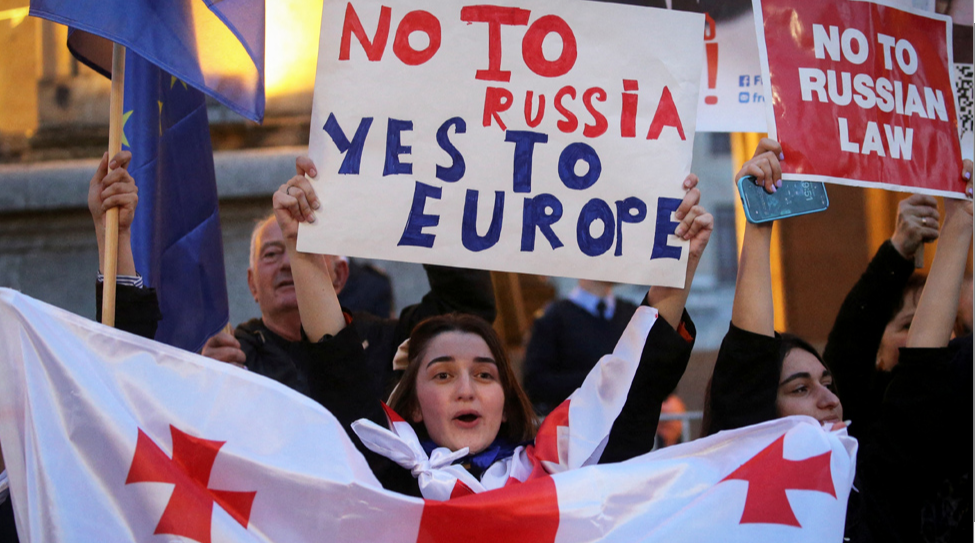
Above: Georgians protest the 'Russian Law' Source: Getty
Foreign Agents Laws
When you hear these words, any democrat should have their hackles raised. Foreign agents laws are a canary in the coalmine for authoritarianism. They allow governments to label NGOs, news services or political rivals as ‘foreign’, ‘alien’ and an external threat. This leads to the justification of political repression.
Imagine these laws as a facilitator: once passed and accepted, the next step is often direct action against the targeted groups or individuals. If authoritarianism is a bullet, then these laws could be seen as a piece of primer cap — the spark that has to be lit to let the bullet fly.
Below are three examples of such laws: what they were, and what they did to the countries.
Russia
If the UK is the mother of parliaments, then Russia is the mother of foreign agent laws. First enacted in 2012, the laws mandated that NGOs receiving foreign funding and engaging in “political activity” must register as foreign agents.
The use of words here is key. ‘Agent’ in Russian is synonymous with espionage, dirty tricks and undue influence. When an NGO, media organisation or individual is labelled as such, the Russian regime is unsubtly saying that this organisation is working against the Russian state.
Under the law, “Foreign Agents” — which can be individuals or organisations — must do the following:
Register with the Ministry of Justice as a “foreign agent.”
Label all publications and content with a legal disclaimer.
Submit quarterly financial reports and annual audits.
File detailed activity reports describing how funds are used.
Maintain special ruble bank accounts for income from assets (since late 2024).
The penalties and restrictions are severe:
Prohibited from political candidacy (since May 2024).
Banned from advertising or monetising via ads (since March 2024).
Banned from the Civil Service, teaching and similar positions.
Subject to frequent inspections, audits and police raids.
Face criminal penalties for non-compliance, including fines and imprisonment.
Risk reputational damage and social stigmatisation due to the “foreign agent” label.
The effect on civil society has been drastic. As of 2025, at least 151 organisations in Russia have shut down since the label was introduced, 108 explicitly citing the law as a reason.
Two key cases include:
The Memorial Human Rights Centre, dedicated to documenting Stalin’s crimes, ordered closed by Moscow City Court in December 2021. Earlier this month, Russians unveiled a cheap reproduction of a bas-relief of Stalin in the Moscow Metro.
The Russian Committee for the Prevention of Torture, disbanded in June 2022 after being labelled a “Foreign Agent.” Its head, Sergei Babinets, said on Telegram:
“We don't want to continue working by being labelled 'foreign agents.' We consider this term an insult and slander. Despite the obvious importance of our mission, the authorities have been trying for many years to portray it as foreign and harmful.”
“The authorities are sending a signal that torture is becoming (or has already become) a part of government policy.”
Given the horrifying reports from Ukrainian POWs and the murder of civilians and journalists in Ukraine, this grim reality seems all too true.
Now, 13 years after their initial adoption, the laws have been amended and expanded to cover nearly anyone. This is by design: the Kremlin uses them as a tool to label political enemies and legitimise repression.
Thirteen years in, Russia has become a state where one can face years in prison for holding up a blank piece of paper; a state with manuals on the best methods to torture prisoners of war; a state where civil society no longer exists. The foreign agent law was but one step on the rocky road from flawed liberty to total autocracy — but a significant one.
Georgia
There was enormous hope in Georgia. It was angling firmly towards democracy and the West. The Russian invasion of 2008 appears to have finally reversed that progress. ‘Georgian Dream’, the party claiming to control the country, passed their own ‘Foreign Agents’ law in May 2024, a few months prior to elections riven with allegations of fraud, intimidation and rigging.
They rose to power not on the back of supporting Russia — a third-rail issue in Georgian public life — but by arguing they were the only party that would avoid war and a repeat of the 2008 Russian invasion, coupled with the usual populist anti-LGBT and culture war rhetoric.
Unfortunately, it worked. They managed to get their claws into institutions, turning them against the people of Georgia. It is now illegal to protest, and facial recognition software allegedly provided by China is used to issue enormous fines to protestors — often double the monthly average wage.
The foreign agents law was one step along this road. Speaking to Al Jazeera, Eka Gigauri of Transparency International said:
“This bill is just a symptom; this is about Russian influence, hybrid war, a generational fight.”
Obligations for Registered Foreign Agents
Register officially with the Ministry of Justice if more than 20% of funding comes from abroad.
Label all public communications (e.g., articles, statements) as issued by a "foreign agent."
Submit annual financial declarations detailing sources of foreign funding.
Provide detailed reports on activities and expenditures.
Allow government audits and inspections of financial records.
Disclose sensitive personal data (if requested) about staff or associates, including political or religious affiliations.
Prohibitions / Restrictions
Failure to register or provide required documentation may result in:
Fines up to 25,000 GEL (~€8,700).
Monthly recurring fines for continued non-compliance.
Misreporting or concealing information can also lead to penalties.
What is perverse about this law is that it targets any NGO or media organisation receiving more than 20% of its funding from foreign sources, including donations or profits.
According to a source I spoke with from Georgia, this even included an animal shelter.
Note also how similar this is to the Russian law above.
Hungary
Hungary is beginning to slip down the unpleasant road towards authoritarianism. The Protection of National Sovereignty Act, enacted in December 2023, is a foreign agents law in all but name.
The law is designed to monitor and investigate organisations engaged in:
“influencing democratic discourse and state and social decision-making processes … carried out in the interest of another state and, irrespective of its legal status, of a foreign organ or organisation and natural person if they can harm or jeopardise the sovereignty of Hungary.”
Under the law, the Hungarian government can monitor:
NGOs, media organisations and individuals receiving foreign funding.
Entities perceived to be influencing public discourse or decision-making in a manner that could “harm or jeopardise the sovereignty of Hungary.”
Somewhat broad.
Obligations for Entities Under the Law
Register with the newly established Sovereignty Protection Office (SPO).
Disclose detailed information about funding sources and activities.
Submit to investigations conducted by the SPO, which may involve:
Access to financial records.
Scrutiny of digital communications.
Investigations by Hungary’s secret services.
Prohibitions and Penalties
Hefty fines: up to 25 times the amount of foreign funding received.
Forced closure: organisations may be shut down if fines are unpaid within 15 days.
Criminal charges: individuals, including election candidates, accepting foreign funds could face up to three years in prison.
More than 100 Hungarian NGOs issued a joint statement objecting to the law. An excerpt:
“A country where people are not able to represent their own interests is not a democracy. In a place where civil society organisations cannot operate freely, our most basic rights are not being respected. There is no freedom in a country where citizens are accused of serving foreign interests if they speak their minds on public affairs.”
Hungary is becoming more strident in its anger towards Ukraine. Viktor Orbán’s government has aligned with the likes of Fico and Vučić against Europe and with Putin.
As can be seen from Georgia and Russia, this law is a step along a grim path. Or, as the above statement concludes:
“Power ignores its own citizens when, behind all criticism, it wants to silence those actively engaged in public life — whether they are civil society activists, journalists or local residents speaking out because of a factory next to their house.
But any legislation should be enacted, and the right-to-right intent cannot be abolished by law. There will always be committed people ready to defend democracy, the rule of law and human rights. As research confirms, Hungarian society continues to believe it is the task of NGOs to formulate criticism.
Hungary needs citizens ready to act, to engage, to prepare civil society organisations and local communities. Without them, there is nothing left but the tyranny of power and the bleakness of autocracy.”
These are but three examples. Others can be found in Nicaragua, India, El Salvador, China, Belarus, Iran and Syria.
There are strong arguments for combating non-democratic foreign influence in democracies — but those are for another piece.
Until then, my friends, when you see “Foreign Agents Laws” being discussed, proposed or legislated, first ask: “Why?” Then, if the answer is unsatisfactory: fight.
Remember: Democracy is Non-Negotiable