

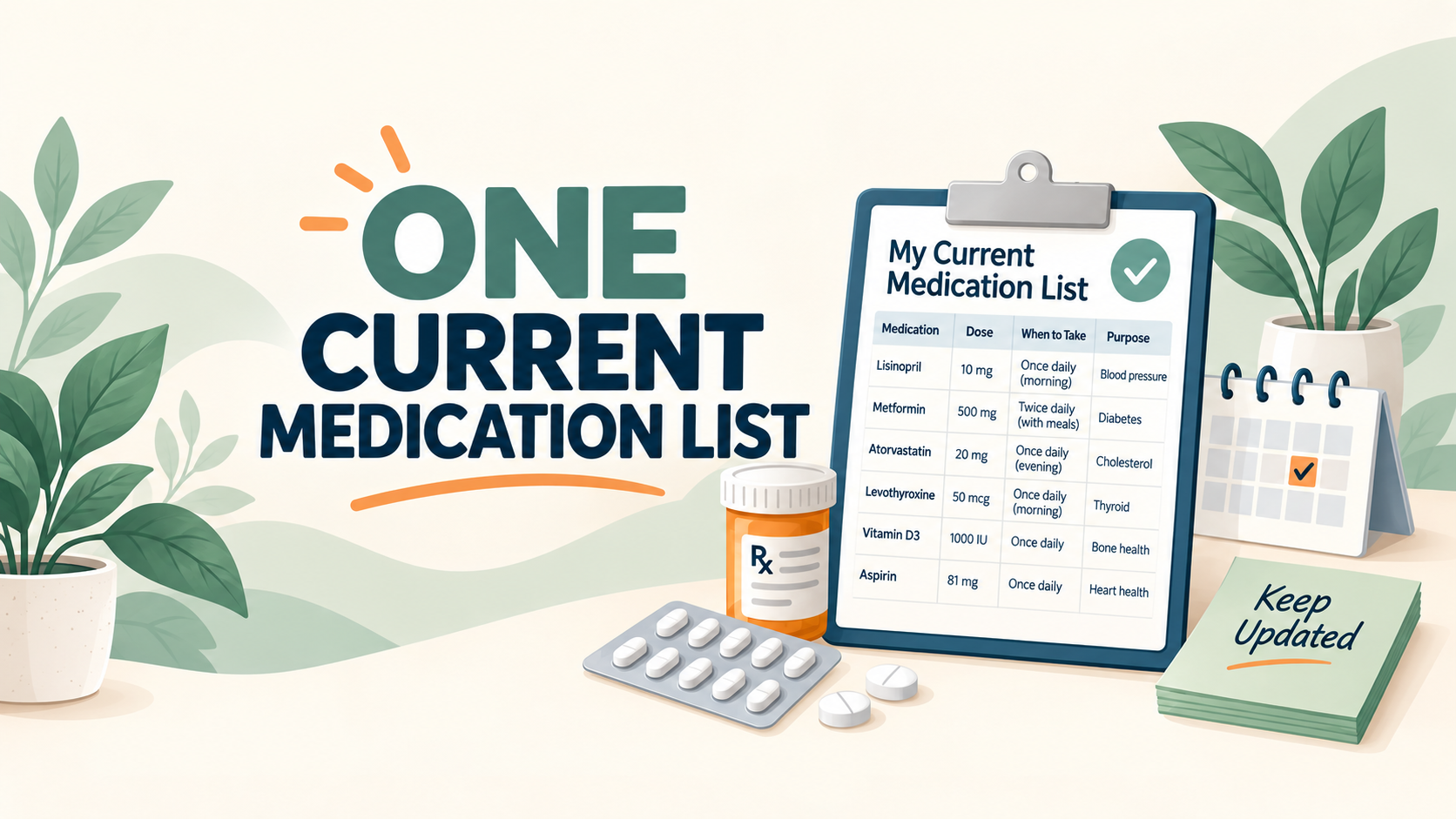
A medication list for aging parents is only useful if you can trust that the version in front of you is the current one.
 Hi dear friends, 💛
Medication information has a funny way of multiplying.
There’s a list in Mom’s purse.
Another one from the last doctor’s visit.
A pharmacy printout.
A note on the refrigerator.
And somewhere in your phone, a message saying, “The doctor changed that one last week.”
The goal is not to create the most detailed medication spreadsheet imaginable.
It is much simpler:
Keep one clear current list, know where the information came from, and update it when something changes.
FDA recommends maintaining a list that includes prescription medicines, over-the-counter medicines, vitamins and supplements, and updating it when a medicine, dose or instruction changes.
That gives us a very practical place to start.
What belongs on a medication list
A useful list should help your parent, family and health professionals identify what your parent is currently taking.
For each medication or supplement, record the information exactly as it appears in the current instructions or reliable source.
That may include:
medication or supplement name
strength
current instructions
what it is taken for, if known from the current record or clinician
prescribing clinician, where relevant
date the information was last checked
FDA specifically recommends including medicines, OTC products, vitamins and dietary supplements — not only prescriptions.
One small but important distinction:
A family medication list records current information. It does not decide what someone should take.
If anything is unclear, conflicting or appears to have changed, that belongs with the doctor or pharmacist.
One current list is better than several competing ones
This is where organization matters almost more than formatting.
Imagine finding three medication lists in a folder.
One is dated January.
One has no date.
One looks newer — but you are not quite sure.
Suddenly the existence of three “organized” lists has created a new problem:
Which one do we trust?
I prefer a simple rule:
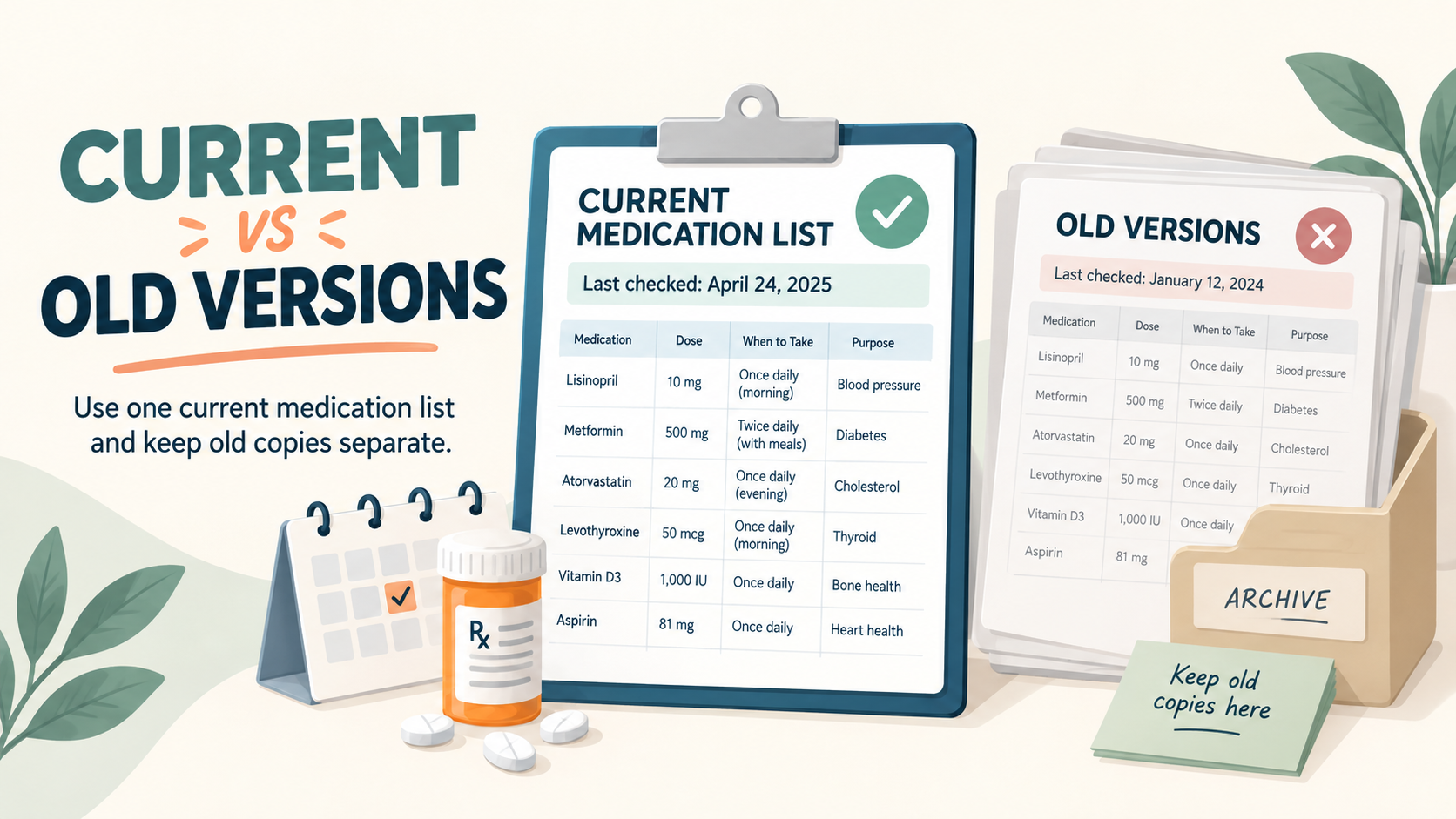
CURRENT
The version the family is actively using.
HISTORY
Older versions retained only when there is a reason to keep them.
Do not leave an outdated copy sitting beside the current one without clearly marking it.
You can keep history without allowing history to masquerade as current information.
That same principle appears throughout good family-care organization: current information first; accumulated information second.
If you haven’t read it yet, my Caregiver Checklist for Aging Parents explains how medication information fits into the first layer of organizing care.
Add a “last verified” date
This is one of the simplest improvements you can make.
At the top or bottom of the list, add:
Last checked: __________
That does not guarantee that the list is medically accurate forever.
It simply tells the next person:
“Someone actually reviewed this on this date.”
That is very different from finding a neat-looking page and wondering whether it was filled in three years ago.
Information can become outdated quietly.
A date makes that visible.
Keep changes separate from the master list
Suppose a medication changes after an appointment.
A common mistake is to scribble corrections all over the master page:
new dose here, old dose crossed out there, note in the margin, arrow pointing to another note.
Very quickly, the “current list” becomes a history lesson.
Instead, use two different jobs:
Current Medication List
What is current now.
Medication Changes Log
What changed, when, and where the updated information came from.
For example:
September 18 — medication instructions changed after appointment — updated from visit summary.
The changes log explains the history.
The master list stays easy to read.
That separation is also useful when another family member needs to understand what happened without decoding crossed-out handwriting.
Before an appointment, check the list — don’t rebuild it
A doctor’s appointment should not require reconstructing the medication story from scratch.
A day or two before the visit, look at the current list and ask:
Has anything changed?
Has anything been stopped?
Was anything added?
Are there OTC medicines, vitamins or supplements missing?
Is there anything the parent wants to ask about?
Is this the version we want to bring?
NIA advises bringing a medication list that includes prescription medicines, OTC medicines, vitamins, herbal remedies and supplements, including dose and schedule, to medical appointments.
The goal here is not to “correct” the medication plan yourself.
The goal is to arrive with information that is easier to discuss.
Keep Questions Separate from Medication Instructions
This is another little organizational trick I love.
Suppose your parent says:
“Do I still need to take this one?”
Or:
“I think this makes me sleepy.”
Do not rewrite the medication directions based on the conversation.
Instead, create a separate section:
Questions for doctor/pharmacist
For example:
Ask whether this medication is still current.
Clarify the new instructions from the last visit.
Ask about a possible side effect.
Confirm whether an OTC product should remain on the list.
This keeps two very different things separate:
what the current instructions say
and
what still needs clarification.
That separation protects the usefulness of the list.
Make the list easy to find
A perfect list that nobody can locate is not doing much work.
FDA recommends keeping a copy available and sharing the list with health professionals and trusted caregivers where appropriate. It suggests options such as a paper copy, a phone copy or another format that is easy to maintain and carry.
For family organization, choose whatever system the older adult is comfortable with.
That might mean:
a printed copy in the care organizer
a PDF saved in a known family folder
a photo on the parent’s phone
a copy carried with other essential health information
You do not need five systems.
You need one dependable current source — plus a sensible backup if your family wants one.
And always respect your parent’s privacy and preferences about who should have access.
Don’t Turn the List Into a Dosing System
This boundary matters.
A medication organizer can help a family record current information.
It should not silently become a homemade clinical system.
Avoid using it to:
decide medication changes
calculate new doses
interpret side effects
determine whether a medication should be stopped
replace instructions from the prescribing clinician or pharmacist
NIA advises checking with a doctor before stopping a prescription medicine, and FDA recommends consulting health professionals when questions arise about medication use.
Our job here is organization.
Clinical decisions stay with qualified professionals.
Build a maintenance habit, not a prettier form
This is really the heart of the article.
The biggest problem with medication lists is often not that they are ugly.
It is that they become stale.
So instead of endlessly redesigning the page, attach the update to real events.
Review the list when:
a new medication is prescribed
instructions change
something is discontinued
a new OTC medicine or supplement is added
there has been a relevant appointment
someone notices that the list and current instructions no longer match
FDA explicitly recommends reviewing and updating the list when prescriptions, dosage or other medication information changes.
That means your system does not need constant maintenance.
It needs change-driven maintenance.
Much easier.
Where the medication list fits into the bigger care system
Medication information rarely lives alone.
It connects to appointments.
Providers.
Pharmacies.
Questions.
Refills.
Changes.
Follow-up.
That is why a good caregiver planner should not make you enter the same medication information into five different sections.
My previous article, What to Track in a Caregiver Planner, explains how to keep the whole family-care system useful without turning it into another job.
The medication list should be the current source.
Other pages can point back to it.
That reduces duplication — and reduces the chance that two pages quietly start telling different stories.
A simple five-minute medication-list check
If you already have a list, you can improve it today without starting over.
Take five minutes and check:
1. Is this clearly the CURRENT list?
2. Is there a “last checked” date?
3. Are prescriptions, OTC medicines, vitamins and supplements represented?
4. Are old versions clearly separated from the current one?
5. Are unresolved questions written separately instead of mixed into the instructions?
If you can answer yes to those five things, you already have a much more usable system.
How I handle this inside The Aging Parent Care System
Medication organization is one of the areas I deliberately separated into several jobs inside The Aging Parent Care System:
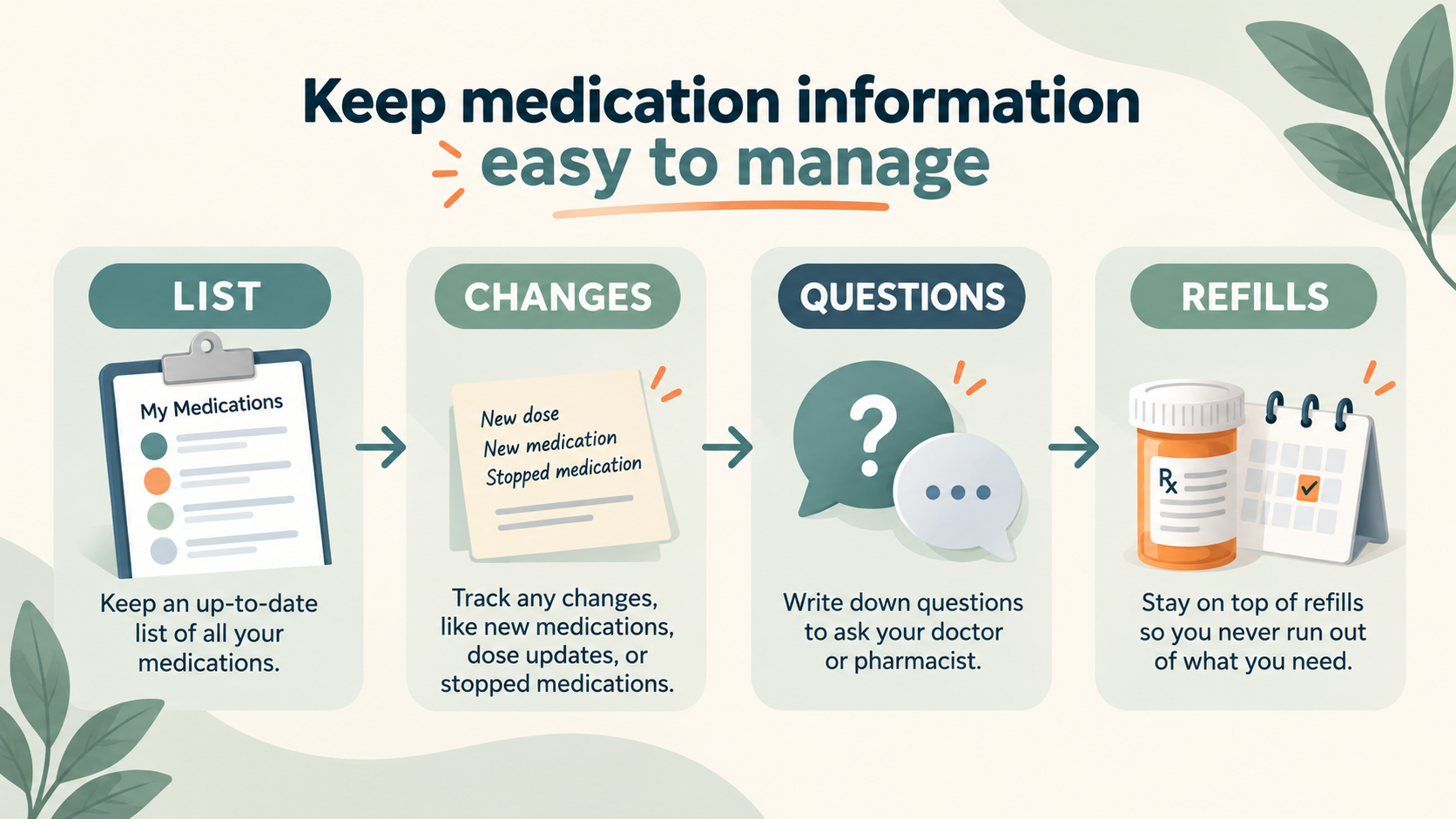
a current master list, individual medication details when needed, a changes log, refill/renewal tracking and a place for questions to take to a clinician or pharmacist.
The reason is simple:
one page should not try to be the current list, the history, the question sheet and the refill tracker at the same time.
Separating those jobs makes each one easier to understand and maintain.
But whether you use my system or your own notebook, the principle stays exactly the same:
one current source, clear updates, and questions kept separate from instructions.
The list does not need to be perfect. It needs to be current
A medication list is not useful because it looks impressive.
It is useful because the parent, family and health professionals can understand what it says and know when it was last updated.
That is the standard I would aim for:
clear enough to use, simple enough to maintain, current enough to trust as an organizational record.
And that is one less complicated thing your family has to keep rebuilding from memory.
If you help an aging parent, what is hardest to keep current — the medication list itself, recent changes, or remembering which questions to ask at the next appointment? 💛
With warmth,
Tamara
Makeup of the Soul ✨