

If your habit disappears as soon as life gets busy, you may not need more discipline. You may need to find the part of the system that fails first.
 Hi, my lovely friends! 🌿
Perhaps you know this sequence.
On Sunday, you choose a new habit. On Monday, the plan feels clear. By Thursday, life has eaten the time slot, the tracker has an empty square, and your brain has turned one missed day into a full personality review.
Why can’t I stay consistent with habits? Why do I always stop? Where is my self-discipline?
But the problem may not be your character. It may be much more specific - and much more repairable.
Consistency is not a perfect streak
A streak records whether an action happened. It does not tell you whether the plan can survive a late meeting, poor sleep, caregiving, low energy or an ordinary difficult day.
In a 12-week habit-formation study, 96 people chose a new eating, drinking or activity behaviour and repeated it in the same context. The time required to approach automaticity varied enormously - from 18 to 254 days. One missed opportunity did not materially derail the habit-formation process.
That matters.
Missing a day is not the same as losing everything you have practised. The more useful question is not, “How do I become a person who never misses?” It is:
“What will help me return at the next realistic opportunity?”
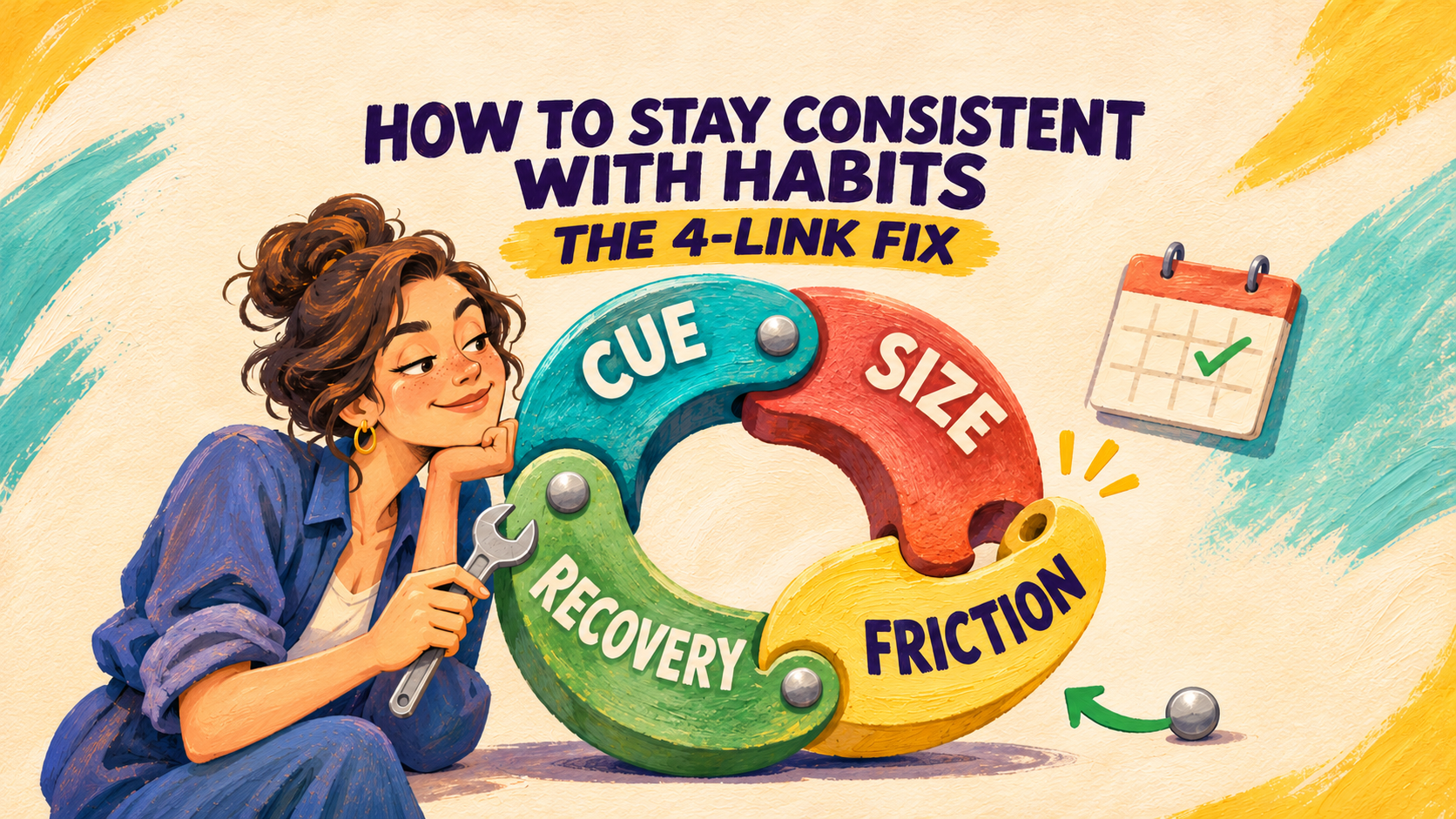
To stay consistent with habits, identify which part of the system breaks first: the cue, the size of the action, the friction around starting or the recovery plan after a miss. Repair that one link, choose the next realistic cue and repeat a version that fits your current capacity. Consistency is not the absence of interruption. It is having a reliable route back.
Find the place where consistency actually breaks
When motivation fades, we often try to produce more motivation. That helps only when motivation is the real problem.
Usually, the failure happens further upstream.
1. The cue is unreliable
If you remember the habit only when the day is almost over, you do not yet have a discipline problem. You have a reminder problem.
A useful cue is attached to something that already happens: after breakfast, when you close your laptop, after you put the children to bed, or at a realistic time in a location you can actually access.
In two studies examining context stability, repeating a behaviour in a more stable context predicted stronger automaticity and better goal attainment.
The cue does not need to be clever. It needs to return.
2. The habit fits your best day
A plan built for your most energetic Monday is not yet a plan for your real week.
This is where all-or-nothing thinking quietly enters:
If I cannot exercise for 30 minutes, it does not count.
If I cannot write the whole section, I may as well wait.
If I cannot complete the full routine, today is already lost.
Instead, prepare three legitimate sizes before the difficult day arrives:
Full - the version that meaningfully moves the result forward
Small - a shorter version for limited time or energy
Minimum - the smallest real action that keeps the return path open
The minimum version is not there to replace your goal forever. It prevents one overloaded day from making the next attempt feel like a complete restart.
3. Starting contains too many hidden steps
Sometimes the habit itself is not difficult. Entering it is.
You have to find the notebook, charge the device, choose the workout, clear the desk, remember the password and negotiate with the phone that is already in your hand.
That is friction.
Do not ask only, “How much effort does the habit take?” Ask:
“What happens in the first two minutes before the habit begins?”
Prepare one item in advance. Remove one decision. Make the first action visible. Add a little friction to the distraction that normally wins.
Self-discipline becomes easier when the useful action is simpler to enter.
4. There is no plan for the missed day
Many habit systems explain how to begin. Very few explain what to do at 8:40 p.m. on the day when the plan did not happen.
Without a return rule, a missed action quickly becomes a verdict:
I have ruined the streak.
I knew I would not keep this up.
I will start properly on Monday.
Recovery deserves its own plan.
Ask:
What changed on the missed day?
Which link failed - cue, size, friction or recovery?
What is my next realistic cue?
Which version will I use when it arrives?
What one adjustment would make returning easier?
A missed day can still produce useful information. It shows you where the plan needs support.
Try this with one real habit
Suppose you want to write regularly.
Your first plan says: Write for 30 minutes every evening.
Now make it usable:
Behaviour: open the document and work on the current section
Primary cue: after placing the dinner dishes in the sink
Full version: 30 minutes
Small version: 10 minutes
Minimum version: open the document and write one honest sentence
Friction repair: keep the document pinned and the phone outside the room
If-then plan: if the evening is disrupted, write the minimum version after breakfast
Return rule: after a miss, use the next available cue instead of waiting for Monday
Notice what changed. You did not become stricter. You removed several daily negotiations.
This is the thinking behind How to Stay Consistent With Habits: A Free Printable Self-Discipline Workbook. The free 12-page printable and fillable workbook helps you diagnose the weakest link, build full, small and minimum versions of one habit, and create a realistic return plan for busy or interrupted days.
It is available in both A4 and US Letter editions.
Self-discipline should not become a character trial
Habits can support action, but they are not the whole story.
A 2024 review of habit research cautions against treating habit as either necessary or sufficient for lasting behaviour change. Intentions, health, resources and changing circumstances still matter.
Low capacity, illness, burnout, caregiving demands or attention difficulties are not proof of weak character. If difficulty with energy, sleep, mood, attention or everyday functioning is persistent, it deserves appropriate support - not a harsher productivity system.
The purpose of a habit plan is to reduce avoidable friction. It is not to turn every hard day into evidence against you.
Build a plan that knows how to return
If you want to apply this method to one habit instead of trying to remember every piece, begin with How to Stay Consistent With Habits: A Free Printable Self-Discipline Workbook.
Choose one observable behaviour. Run the diagnostic. Build the three sizes. Then treat the next seven days as an experiment, not an examination of your worth.
Which link tends to fail first for you: the cue, the size, the starting friction or the return after a miss?
With warmth,
Tamara ✨
Makeup of the Soul