

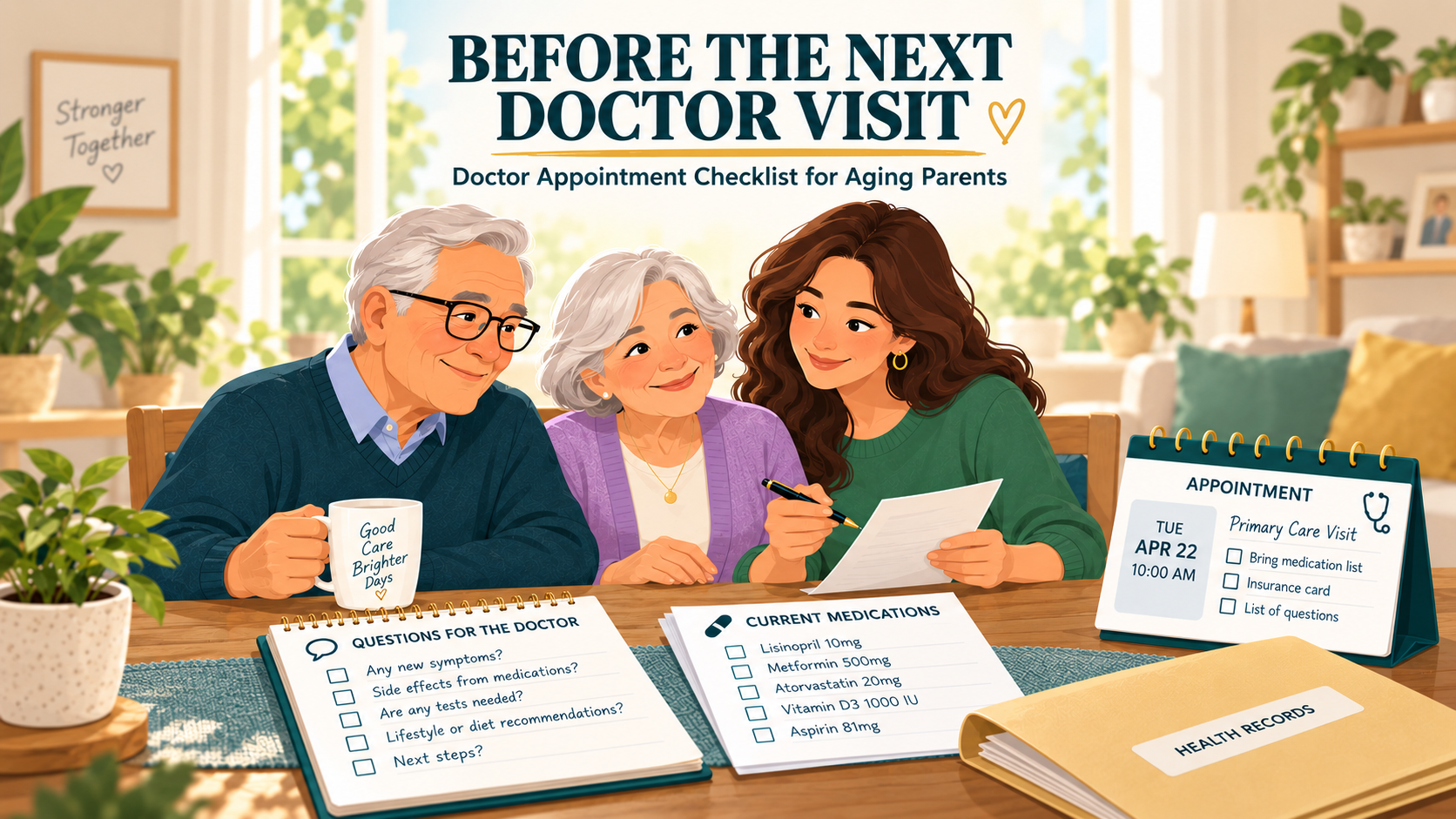
A doctor appointment checklist for aging parents can stop the most important question from being remembered five minutes after you leave the office.
 Hi dear friends, 💛
Doctor appointments can be surprisingly difficult to organize.
Before the visit, you remember six things you want to discuss.
Then the appointment starts.
There are forms, questions, new information, unfamiliar words, a conversation about medications — and suddenly the one thing Mom really wanted to ask has completely disappeared from everyone’s mind.
The answer is not to arrive with a ten-page script.
A much simpler system works:
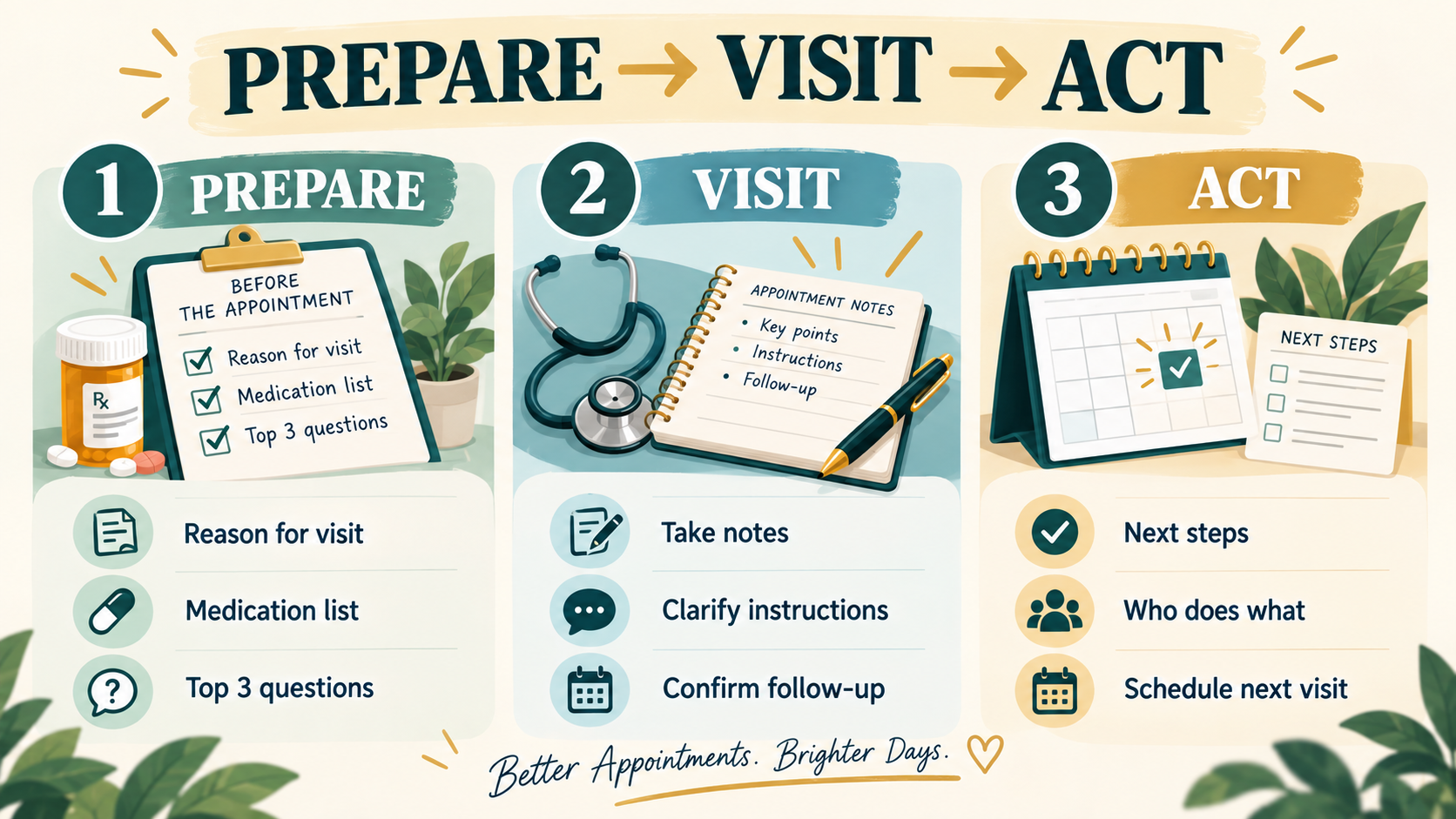
PREPARE → VISIT → ACT
Prepare the important information before you go.
Capture the important points while you’re there.
Turn whatever comes next into clear follow-up actions afterward.
That is the whole job.
PREPARE: Know Why You’re Going
Start with one sentence:
What is this appointment for?
That sounds obvious, but writing it down helps separate the main reason for the visit from the twenty other things circling in everyone’s head.
Then add the practical details:
date and time
provider
location
reason for visit
who is going
anything the office asked you to bring
The National Institute on Aging recommends preparing information and questions before a medical appointment and prioritizing the most important concerns so they are discussed early rather than left until the final minute.
So if there are five things to discuss, ask your parent:
“Which one matters most to you today?”
Put that one first.
Bring the Current Medication List
Do not rebuild the medication history in the parking lot.
Bring the current medication information your parent already uses.
NIA recommends bringing a list of prescription medicines, over-the-counter medicines, vitamins, herbal remedies and supplements, including relevant dose and schedule information, to the appointment.
This is exactly why keeping one current medication list matters.
If you have several old copies floating around, the appointment is not the ideal moment to decide which one is right.
I covered that system in Medication List for Aging Parents: Keep It Current.
The important distinction:
bring the current information — don’t make medication decisions yourself.
Questions about changes, instructions or side effects go onto the question list for the clinician or pharmacist.
Write Down Recent Changes
Before the visit, ask:
What has changed since the last appointment?
You are not trying to diagnose anything.
You are simply collecting observations that your parent may want to discuss.
For example:
a new concern
a change in sleep, appetite or energy
a fall or significant incident
a medication change
a new provider or treatment
a new difficulty with an everyday activity
NIA recommends telling the doctor about changes noticed since previous visits and bringing concerns that matter to the older adult.
Keep observations factual.
Instead of:
“I think this means…”
write:
“Mom has mentioned feeling unusually tired in the afternoons for the past two weeks.”
Observation first.
Interpretation belongs with the clinician.
Keep Questions Short
A good appointment question list should be usable.
Not a page of tiny writing.
Not twenty-seven questions nobody will reach.
Write the important ones first.
For example:
What do we need to understand about this change?
Is any follow-up needed?
Has anything changed in the current instructions?
Who should we contact if another question comes up?
When should the next appointment happen?
NIA encourages patients and caregivers to write down questions and concerns before a visit and prioritize them.
I like a simple rule:
Top 3 first. Extras below.
If the appointment is short, you have still protected the questions that mattered most.
VISIT: Let Your Parent Lead
This part matters enormously.
When you accompany an aging parent to an appointment, it is easy to become the person answering everything.
You know the dates.
You remember the medications.
You have the notes.
And suddenly the conversation is happening between you and the doctor while your parent is sitting beside you.
Whenever possible, resist that.
NIA advises companions to let the older adult answer questions themselves unless help is requested, keep them included in the conversation and respect their privacy.
Your role can be:
rememberer, note-taker, question-holder, clarifier.
It does not have to become:
spokesperson for another capable adult.
Before you go in, you can even ask:
“Would you like me mostly to listen and take notes, or is there anything you want me to help explain?”
That tiny conversation can make the whole visit feel more respectful.
Take Notes, Not a Transcript
During the appointment, capture what your parent may need later.
Useful notes might include:
what was discussed
new instructions
questions answered
tests or referrals mentioned
follow-up requested
next appointment
anything you need to clarify later
NIA recommends taking notes on the doctor’s recommendations because written notes can help the older adult and caregiver remember what was discussed and share relevant information later.
You do not need to transcribe the entire conversation.
Think:
What will we need after we leave?
That is what earns a place on the page.
ACT: Turn Notes Into Next Steps
This is the part many appointment organizers forget.
The visit ends.
You come home.
The notes go into a folder.
And three weeks later someone remembers:
“Weren’t we supposed to call somebody?”
A visit is not finished when you walk out of the office.
It is finished when the follow-up is clear.
After the appointment, create a short action list:
Action — Owner — Due / Next Check
For example:
Schedule referral — Maria — this week
Call pharmacy — Dad — tomorrow
Check portal for test scheduling — Anna — Friday
Add next appointment to calendar — Tamara — done
This is not about assigning medical authority.
It is simply practical coordination.
If your family is still building its basic organization system, my Caregiver Checklist for Aging Parents gives a simple starting layer for contacts, medications, appointments, documents and family responsibilities.
Separate Facts From Questions
After a medical visit, three different kinds of information can easily blur together:
What the clinician said
What the family observed
What the family still wants to ask
Keep them separate.
For example:
Visit note: Follow-up requested in six weeks.
Family observation: Dad has been needing more help getting to appointments.
Question: Should we ask whether telehealth is an option for some follow-ups?
That separation keeps your notes much easier to understand later.
It also prevents an observation or family assumption from accidentally being remembered as a clinician’s instruction.
A One-Page Appointment Flow
If you want the simplest possible version, use just three boxes.
BEFORE
Why are we going?
What changed?
Current medication list?
Top three questions?
DURING
Key notes
New instructions
Tests or referrals
Follow-up
AFTER
What needs doing?
Who owns each task?
When will we check it?
That is enough for many visits.
PREPARE → VISIT → ACT.
Not perfect documentation.
Just a clear path through the appointment.
Keep the System Connected
Appointments do not exist in isolation.
One visit may create:
a medication change, a new referral, a test, a pharmacy question, a follow-up task or another appointment.
That is why I built The Aging Parent Care System so appointment preparation, visit notes and follow-up actions connect to the rest of the family-care information instead of sitting in a separate pile.
The point is not to make more paperwork.
It is to make the information from one appointment easier to carry into whatever happens next.

The Best Checklist Is the One You Use
You do not need to arrive at every appointment looking like the administrative department of a small hospital. 😄
One current medication list.
A few recent observations.
Three important questions.
Something to take notes on.
And a clear follow-up list afterward.
That can be enough to make the whole experience calmer and much easier to remember.
Most importantly, the organization should support your parent’s voice — not replace it.
Save this checklist before your parent’s next appointment so you don’t have to rebuild the list from memory when the day arrives. 💛
With warmth,
Tamara
Makeup of the Soul ✨