

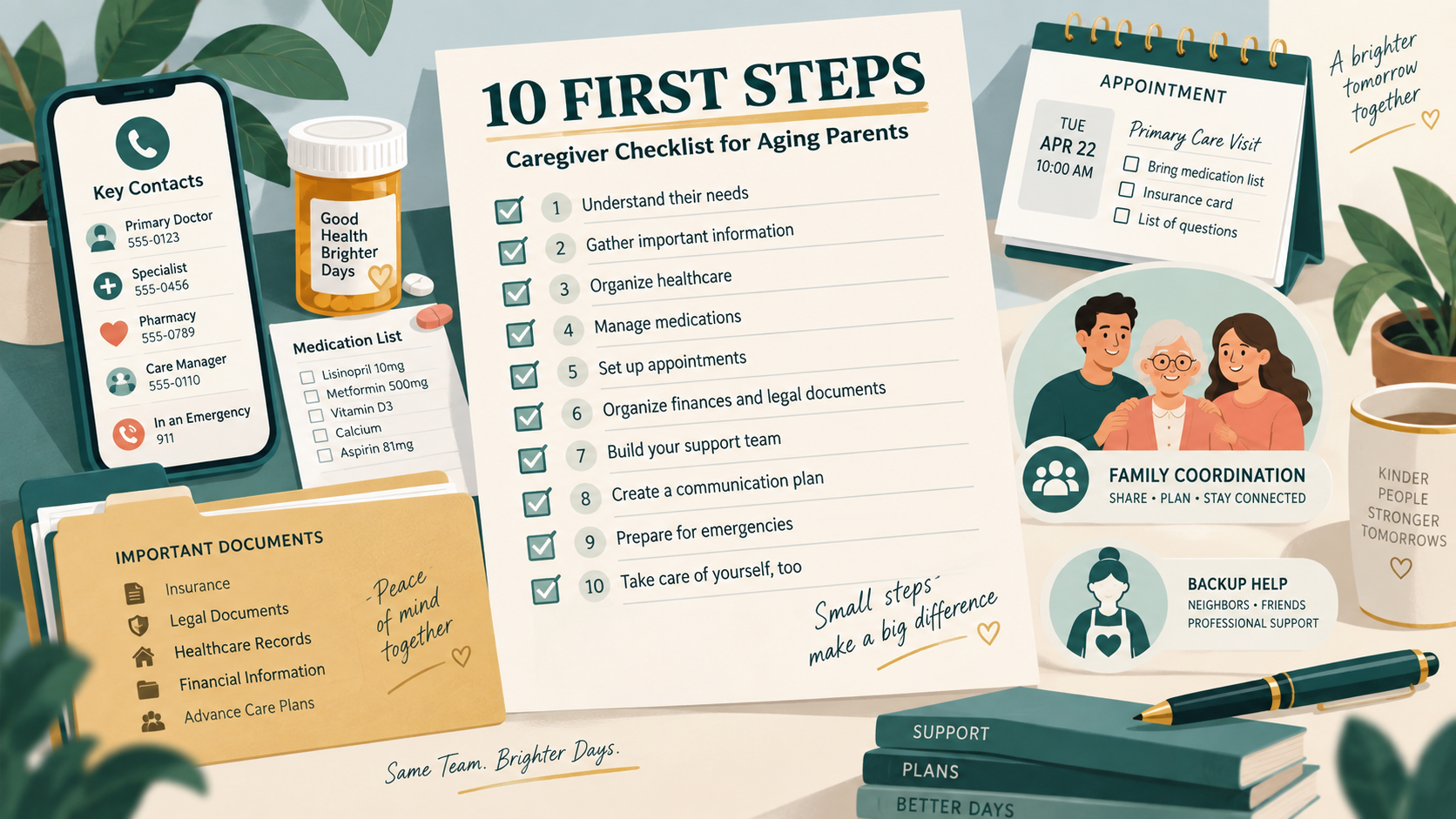
A caregiver checklist for aging parents should make the next week easier — not give you 47 more boxes to tick.
 Hi dear friends, 💛
When you realize your mom or dad needs a little more help, it’s very easy to go into full organization mode.
You start thinking about medications, doctors, documents, appointments, insurance, groceries, transportation, family schedules — and suddenly “getting organized” feels like another job.
It doesn’t need to.
A useful caregiver checklist for aging parents should help you answer one simple question:
What would make everyday care easier to understand and coordinate right now?
The National Institute on Aging recommends tackling caregiving one task at a time, and its caregiver worksheets cover practical areas such as shared responsibilities, medications and important paperwork.
So instead of trying to complete an entire caregiver binder in one weekend, start with these ten things.
Start with what you may actually need this week
If you read my guide Caring for Aging Parents Without Overwhelm, you already know my favorite rule:
Critical first. Complete later.
This checklist puts that idea into practice.
1. Write down the key people to call
Start small.
Who might you realistically need to contact this week?
Your parent’s primary doctor, current specialist, pharmacy, a nearby family member, a trusted neighbor or anyone providing regular support.
Add a short description beside each name.
Not just:
Susan — 555-…
but:
Susan — neighbor — usually checks in when family is away
Context makes a contact list much more useful.
2. Identify the current medication list
You do not need to build a complicated medication-management system.
You do need to know where the current medication information is.
The National Institute on Aging includes medication tracking among its caregiver worksheets and recommends keeping information about prescriptions, over-the-counter medicines and supplements available for the older adult’s care team.
If there are several old lists, label or archive them clearly so nobody mistakes an outdated version for the current one.
Medication decisions and changes, of course, belong with the appropriate doctor or pharmacist.
3. Put the next appointments in one place
For now, forget the entire medical history.
What is happening next?
Write down:
the date, the provider, the location and the reason for the upcoming visit.
If your parent has questions they want to ask, keep those with the appointment rather than hoping somebody remembers them in the waiting room.
NIA recommends preparing important information and questions before medical visits and keeping the older adult involved in the conversation.
4. Make a simple document-location map
You do not need to photocopy every legal, medical and financial document.
Sometimes the most useful information is simply:
What exists — and where is it?
For example:
Health insurance information — blue folder in desk
Advance directive — original stored with attorney
Identification documents — secure home file
A location map reduces searching without turning your everyday organizer into a collection of unnecessary sensitive information.
If you want the bigger picture first, my article Aging Parents: What to Organize First explains the main information categories families are likely to need.
5. Write down what changed recently
This one is easy to miss.
Did your parent start seeing a new provider?
Was an appointment moved?
Did transportation arrangements change?
Did a family member take over a task?
Was a service added or stopped?
You do not need to interpret what a health change means.
You simply want a clear record of practical changes so the family does not have to reconstruct them later from texts and memory.

6. Note the everyday support that is already happening
Caregiving is not only medical.
NIA describes caregiving as including things such as transportation, meals, household tasks, appointments, medication coordination and important paperwork.
So write down the ordinary support that already keeps the week running.
Who buys groceries?
Who drives to appointments?
Does someone help with cleaning?
Is there a meal delivery?
Who checks on the dog if Mom is away overnight?
These details may seem too small to record — until somebody else needs to step in.
7. Clarify who currently handles what
Families often develop responsibilities without ever formally discussing them.
One person schedules appointments.
Another handles transportation.
Someone orders groceries.
Someone calls every evening.
Write it down.
This is not about assigning equal workloads. People have different schedules, distances, abilities and relationships.
It is simply about making invisible responsibilities visible.
NIA specifically recommends identifying and sharing caregiving tasks among family and friends and reviewing those arrangements as circumstances change.
8. Choose one backup person
Now ask:
If I could not do my usual part for a few days, who could help?
A backup person does not automatically become a medical or legal decision-maker.
This is about practical continuity.
Who could make a phone call?
Drive to an appointment?
Find the contact list?
Understand what is already scheduled?
Even one identified backup is better than a system that exists entirely inside one person’s head.
9. Record important communication needs and preferences
Good organization should help your parent participate more easily.
Does your parent use hearing aids or glasses?
Do they prefer written appointment reminders?
Is there a language preference?
Do they want a particular family member involved in certain conversations?
How do they prefer people to contact them?
These are not small details.
They can change how easy it is for your parent to stay involved in their own care.
When family members accompany an older adult to medical visits, NIA advises allowing the older adult to answer for themselves when possible and respecting their privacy and wishes.
10. Create one “start here” page
Finally, bring the essentials together.
One page.
Not the whole history.
Not every document.
Just the information somebody should be able to find quickly:
Key contacts
Current medication-list location
Next appointment
Important document locations
Current support arrangements
Family roles
Backup contact
Anything important that changed recently
That page becomes the front door to the rest of your system.
Your checklist is allowed to be incomplete
This may be the most important part.
If you complete five of these ten steps today, your family is already more organized than it was yesterday.
You can add the rest gradually.
A caregiver checklist is useful because it helps you decide what deserves attention first — not because every box has to be checked by Sunday night.
In fact, a smaller system that stays current is usually more useful than an enormous binder nobody wants to update.
Give changing information somewhere to live
Once you have the basics, the next job is not collecting more information.
It is keeping the important information understandable.
Appointments change.
Medications change.
Family availability changes.
Services begin and end.
That is why I prefer thinking of caregiving organization as an ongoing system rather than a one-time project.
NIA makes a similar practical point in its guidance on shared caregiving: whatever format a family uses, information should be accessible to the people involved and reviewed and updated as needed.
That one habit — update what changed — can prevent a neat-looking folder from quietly becoming useless.
A ready-made version of the same idea
This “critical first” approach is also built into The Aging Parent Care System.
Rather than asking families to fill out everything before the system becomes useful, it starts with the information that matters most and then supports three stages:
START → MAINTAIN → HAND OFF
So if you prefer a printable + fillable structure instead of building your own pages from scratch, The Aging Parent Care System gives these details one organized place.
But the principle is useful whether you use my organizer, a notebook or a simple folder:
Start with what somebody would genuinely need to find.
Then stop.
You can organize the rest when it becomes useful.
Ten boxes are not the goal
The goal is not to become a perfect caregiver.
It is not to document every detail of your parent’s life.
And it certainly is not to take control away from them.
The goal is simpler:
less searching, fewer details trapped in one person’s memory, and a clearer way for the family to help when help is actually needed.
With warmth,
Tamara
Makeup of the Soul ✨
If you know someone who has recently started helping an aging parent and keeps saying, “I don’t even know where to begin,” share this checklist with them. 💛