

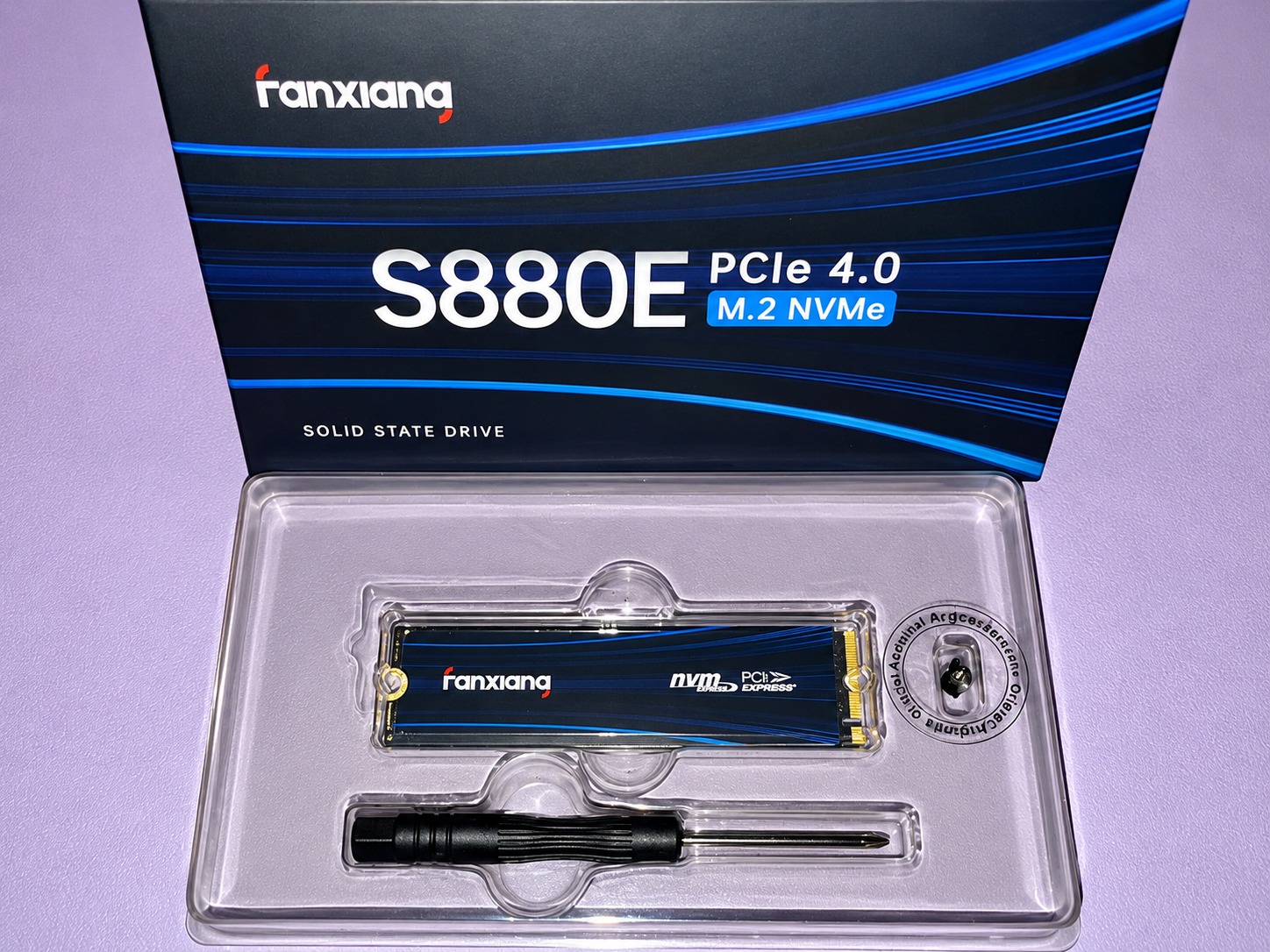
Fanxiang is a Chinese storage manufacturer based in Shenzhen that sells SATA and NVMe SSDs, USB flash drives, and RAM. Its products generally target buyers looking for affordable alternatives to Samsung and Western Digital. The Fanxiang S880E is a PCIe 4.0 NVMe SSD available in 500GB, 1TB, 2TB, and 4TB capacities. On paper, the 500GB model offers sequential read speeds of up to 6,300MB/s and write speeds of up to 3,100MB/s, which sounds promising for a budget gaming PC or everyday desktop.
If you are considering buying the S880E, the advertised speeds tell only part of the story. Its NAND type, write cache, and lack of dedicated DRAM affect how it performs during large file transfers and demanding workloads. Here's what you should know before spending your money on it.
What Fanxiang says, and what it doesn't
Fanxiang describes the S880E as using high-quality 3D NAND, but its official product page doesn't clearly identify the memory type, controller, NAND manufacturer, or endurance rating. The 500GB model uses QLC NAND without dedicated DRAM, and those details are worth considering when comparing it with similarly priced SSDs.
Fanxiang advertises read speeds of up to 6,300MB/s and write speeds of up to 3,100MB/s. Its also lists an endurance rating of 300TBW, which represents the amount of data that can be written over the drive's rated lifespan. QLC NAND stores four bits per cell, allowing manufacturers to offer higher capacities at a lower cost, but it generally has lower write endurance and slower sustained write performance than TLC NAND.
The S880E uses a pseudo-SLC (pSLC) cache of approximately 105GB to achieve its advertised write speeds. While the cache has available space, the drive can handle writes much faster than its native QLC memory allows. Once the cache fills up, write speeds can drop to around 200MB/s. This is common among budget SSDs, and it shouldn't be a dealbreaker if you mostly install games, run applications, and transfer smaller files.
The drive uses a Maxio MAP1602 controller without dedicated DRAM. Instead, it relies on Host Memory Buffer (HMB), which allows the SSD to use a small portion of your computer's RAM to store mapping information. This helps keep manufacturing costs down, although it lowers performance.
The S880E also ships without a heatsink. Fanxiang sells the S880ER variant with a heatsink, which may be worth considering if you're installing an SSD in a system that needs additional cooling.
Windows PC performance
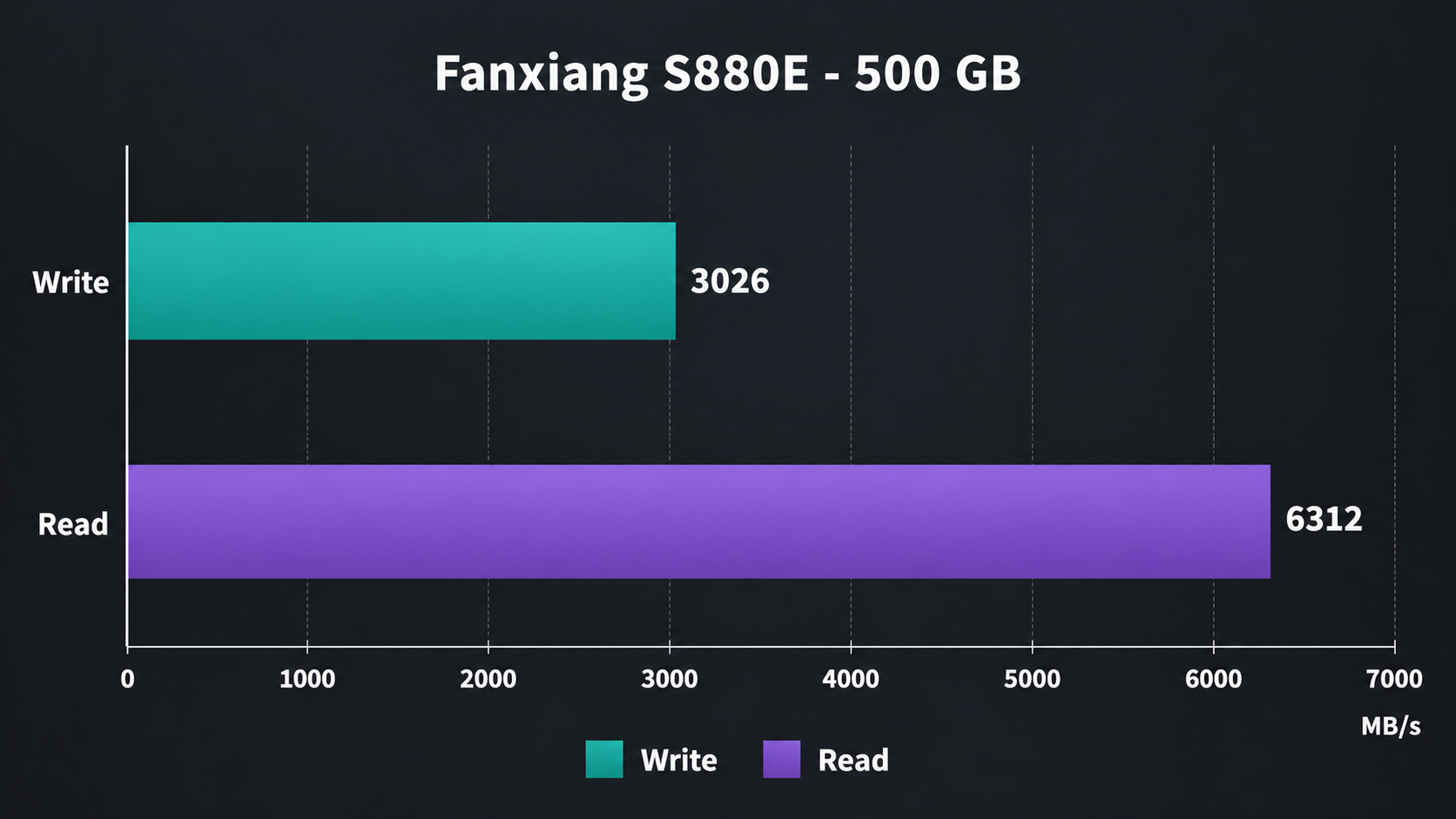
On my Windows 11 test PC, the Fanxiang S880E achieved sequential read speeds of 6,312MB/s, slightly exceeding the manufacturer's advertised figure. Sequential write speeds reached 3,029MB/s, around 2.3% below the advertised 3,100MB/s. These results are close to the specifications and show that the drive can deliver the advertised level of performance under suitable conditions.
For everyday use, that means fast boot times, responsive application launches, and quick game loading. If you're upgrading from a SATA SSD or a hard drive, the S880E can be a substantial improvement, provided your system supports PCIe 4.0.
Large file transfers are where the drive's limitations become more apparent. Once you write more than the available 105GB cache can accommodate, speeds may fall to around 200MB/s. Splitting transfers into smaller batches and allowing the cache time to recover can help, but it won't turn the S880E into a drive designed for sustained heavy writing.
NAS and RAID
I wouldn't buy the Fanxiang S880E for a NAS RAID array that handles sustained writes or frequent rebuilds. During a rebuild, the drive may need to write large amounts of data, quickly exhausting its pSLC cache and causing write speeds to fall toward its native QLC performance level. A single slow drive can extend rebuild times and affect the overall performance of the array.
The lack of dedicated DRAM can also affect performance under certain workloads, while the drive doesn't provide enterprise-grade power-loss protection. These limitations matter when choosing storage for a NAS that runs continuously or handles important data. The S880E can still work as a boot drive for a NAS operating system, provided the workload is light enough and the platform supports it.
I would also avoid using it as an SSD cache for a write-heavy NAS, or as primary storage for databases, virtual machines, and camera recordings that continuously generate data. For these applications, a TLC-based SSD with dedicated DRAM and an appropriate endurance rating is a better purchase. Spending more upfront can be worthwhile when sustained performance and predictable behavior matter to your workload.
Should you buy the Fanxiang S880E 500GB?
I would recommend the Fanxiang S880E 500GB only if it's meaningfully cheaper than comparable TLC SSDs. Its sequential read performance is competitive on paper, and it can serve as a budget drive for everyday computing, game storage, and other read-heavy workloads. If you're building an affordable PC and don't regularly transfer large files, its QLC NAND and limited write cache may be reasonable compromises. If the price difference between the Fanxiang S880E and a comparable TLC SSD is only $10 to $20, I'd choose the SanDisk Optimus GX7100. Although it also lacks dedicated DRAM and uses a host memory buffer, it uses TLC NAND instead of QLC, which makes it a better option for sustained writes. For a difference of just $10 to $20, I'd rather spend a little more on the SanDisk.