

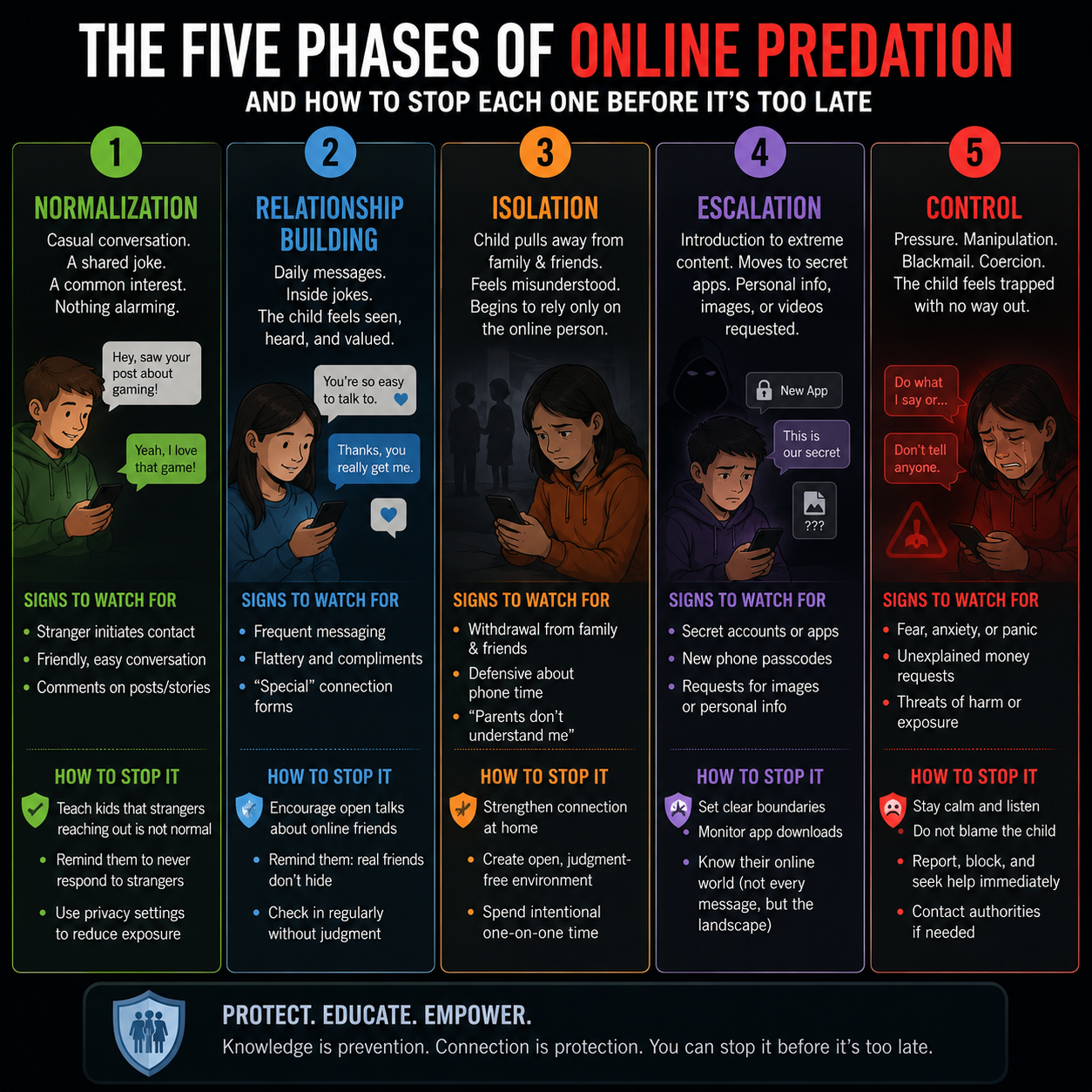
There's a version of parenting today that no previous generation has ever had to deal with. Your child isn't just growing up in your home, your neighborhood, or your school community — they're growing up in a global environment where strangers can reach them instantly, directly, and in a targeted and systematic way. There are networks online — some loosely organized, some highly structured — that are actively hunting for vulnerable children right now. Not randomly. Not by chance. They watch behavior, track patterns, test responses, and when they find the right opening, they move in quietly and quickly. Understanding exactly how this works is the first step to shutting it down before it ever touches your family.
This Is Not Random — It's a Filtered Hunt
These groups don't randomly message thousands of kids hoping something sticks. This is precision targeting — less like casting a net and more like hunting with a spear. What they're looking for are specific behavioral signals: a child posting late at night, comments expressing loneliness or frustration, a desire to belong, reactions to edgy or extreme content. Simple phrases like "no one gets me," "I hate it here," or "I wish I could just disappear" are cues that tell these individuals a child may be vulnerable and approachable. By the time contact is made, the groundwork has already been laid. The child has already been studied.
The Five Phases — Know Every Single One
The process follows a consistent pattern across cases. Phase one is normalization — casual conversation, a shared joke, a common interest. Nothing alarming. Nothing a parent would flag. Phase two is relationship building — daily messages, inside jokes, personal conversations. The child starts to feel seen, heard, and valued by this outside person. Phase three is isolation — the pivot point. The child begins pulling away from family and friends, staying in their room, making statements like "my parents don't understand me" or "people at school are fake." This is where the outside person has begun establishing control. Phase four is escalation — extreme content gets introduced, conversations move to encrypted apps, personal information gets requested, and images or videos get requested. The relationship becomes secretive. Phase five is control — the dynamic flips entirely into pressure, manipulation, blackmail, and coercion. The child now feels completely trapped with no way out.
Why Kids Stay Silent
Understanding the threat is only half the equation. The other half is understanding why children don't speak up when it's happening to them. The thinking goes like this: I should have known better. I'm going to get in trouble. They'll take my phone. I'll be grounded. I'll miss everything. On top of that, by the time things have escalated, a psychological hook has already been set. The child feels a genuine sense of loyalty to the person manipulating them — not because they're weak, but because they're young and don't yet have the framework to recognize what manipulation even looks like from the inside. This is by design. It's exactly why these individuals target children in the first place.
AI Is Making This Problem Significantly Worse
This threat is evolving faster than most parents realize, and artificial intelligence is accelerating it in dangerous ways. Fake identities can now be created that look completely real — your child may genuinely believe they're talking to someone their own age from a neighboring school district. A completely innocent photo you posted of your child can be manipulated into material used for blackmail. Automated conversations allow one predator to simultaneously engage hundreds of children at once — scaling the reach and the damage in ways that weren't possible even a few years ago. The threat was already difficult to detect. AI is making it harder and wider at the same time.
Control Alone Will Not Protect Your Child
A lot of parents default to hard rules — no devices, no social media, no exceptions. That approach alone doesn't work and never has. Kids find workarounds, they go underground, and now you've lost visibility into what's actually happening. What works is layered protection built on a foundation of trust. Your child needs to know clearly and directly — not assumed, but stated out loud — that if something goes wrong online, they can come to you without shame, without losing their phone, without being punished. That one assurance reduces risk more than any parental control app on the market. When a child knows they won't be penalized for telling the truth, they're far more likely to tell it.
Treat the Internet Like a Physical Location
One of the most practical mindset shifts a parent can make is to stop treating the internet as abstract and start treating it like a real physical space. You wouldn't let your child walk into a room full of strangers at midnight. You wouldn't allow them to have private conversations with unknown adults behind a closed door. But that's exactly what's happening when a child is on their device alone in their bedroom at night. Practical boundaries follow naturally from this thinking — devices in shared spaces after a certain hour, no closed-door usage at night, awareness of which apps they're using and who they're regularly talking to. You don't have to read every message. You do have to know the landscape.
Teach Your Child to Recognize the Patterns
Beyond boundaries, children need to be taught pattern recognition — specific, concrete examples they can actually apply. Walk them through scenarios: it doesn't make sense for someone you met on Instagram to immediately ask you to move the conversation to another platform. It doesn't make sense for someone you barely know to tell you to keep a secret. It doesn't make sense for a stranger to try to become your only source of support when you already have family, friends, coaches, and teachers around you. When a child can identify these patterns on their own, they become significantly harder to manipulate. Confidence, connection, and a strong support system are the most powerful protection tools available — because a child who doesn't feel alone isn't looking for validation from strangers.
If Your Child Is Targeted — Your Reaction Matters Everything
If your child comes to you, how you respond in that moment determines whether they ever come to you again. Make it immediately clear they did nothing wrong. They were placed in a situation no child should ever be in, and coming forward was the right call regardless of how long it took. From there, move quickly — preserve screenshots, cut off contact, and report it. The FBI and the National Center for Missing and Exploited Children both have reporting channels for exactly this. Also consider professional support even if your child seems fine — psychological damage from blackmail or manipulation doesn't always show up immediately. Solving the immediate problem doesn't mean the ripple effects are done.
The Bottom Line
The goal isn't to control your child's entire world — it's to make sure no one from the outside can. These networks are real, they are active, and they are specifically looking for children who feel unseen, disconnected, and alone. Your strongest defense isn't a filter or a parental control app. It's the relationship you build with your child before any of this ever starts. Make them a hard target by making sure they never feel like one.