
Awareness Is Not Paranoia
Personal safety is not about walking around scared, nervous, or suspicious of everybody. That is not awareness. That is stress wearing a cheap disguise. Real awareness is calm. Real awareness is practical. Real awareness is simply paying attention long enough to notice when something does not fit the environment.
Trained military operators, including elite units like Delta Force, are taught to read public spaces differently than the average person. They are not just looking for the loudest person, the angriest person, or the person who “looks dangerous.” Instead, they are trained to spot behavior patterns. They look for small signals that may show a person is preparing to act violently before anything actually happens.
For everyday people, this does not mean you need to act like you are on a battlefield. It means you can borrow the practical part of that mindset: walk into a space, quickly scan, notice what looks normal, notice what does not, and then make smart choices.
The Real Skill Is Pattern Recognition
The human brain is powerful when it learns what to look for. Pattern recognition is the ability to notice when something is out of place. It is not about judging someone’s race, clothes, age, or background. It is about comparing behavior against the normal flow of the environment.
For example, in a coffee shop, most people are ordering drinks, talking, scrolling phones, typing on laptops, or waiting in line. In a grocery store, people are shopping, looking at shelves, pushing carts, checking labels, or moving from aisle to aisle. In a gas station, people are pumping gas, going inside, checking their phones, or getting back into their cars.
When someone’s behavior does not match the setting, that is when your awareness should quietly turn up a notch.
The Behavioral Gap: What They Show vs. What They Hide
One of the most important ideas in threat detection is the “behavioral gap.” This means the difference between what a person is trying to present and what their body is actually revealing.
A person may be trying to look calm, casual, or invisible, but their hands, posture, eyes, clothing, or movements may tell a different story. That gap matters. People preparing for violence often have to manage two things at once: the action they are planning and the image they are trying to present to others.
That is hard to hide completely. The body leaks information.
Cue #1: Hands Tell the Truth First
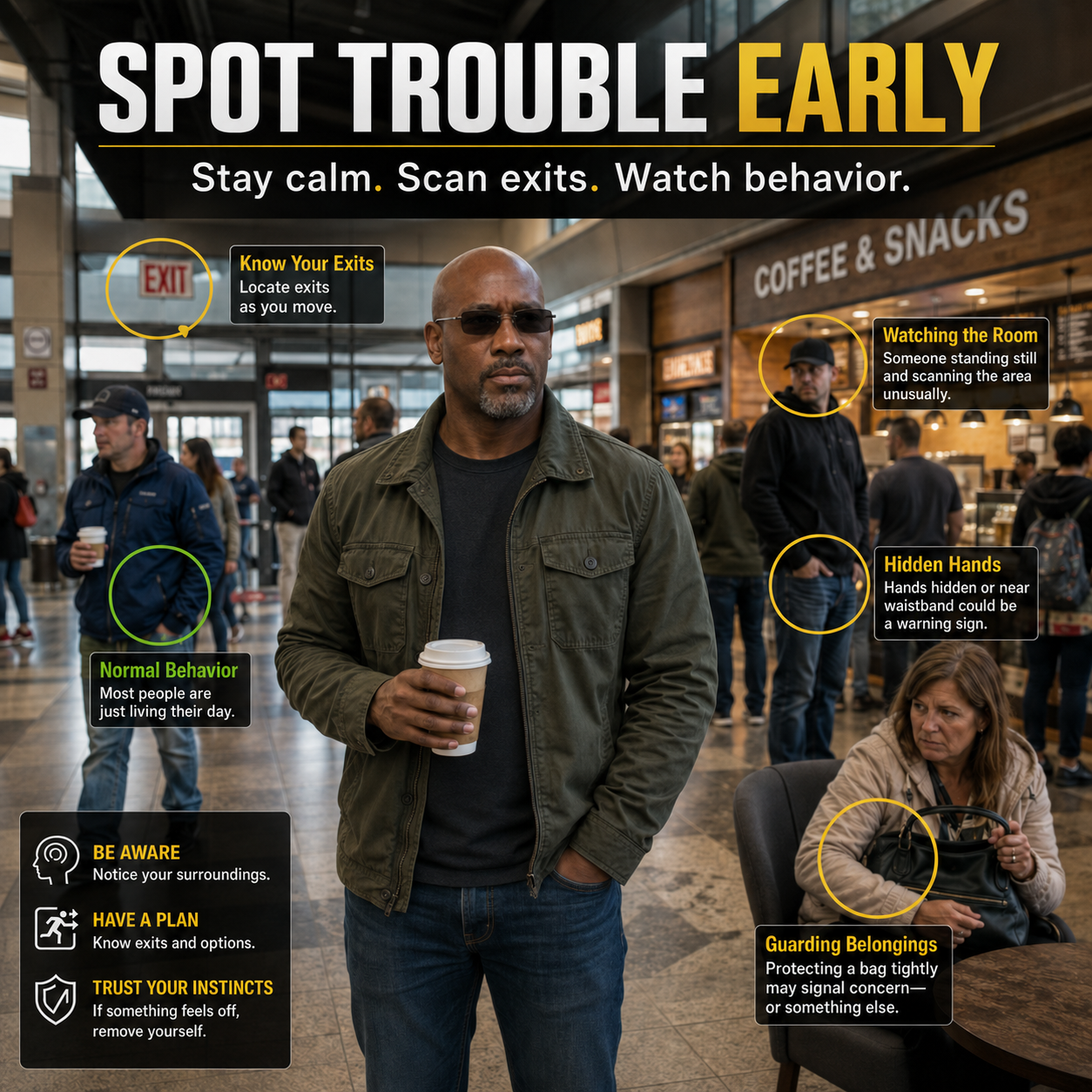
The first thing trained people often look at is the hands. Why? Because hands are usually what cause harm. Hands grab, strike, push, pull, hold weapons, hide weapons, or signal movement. If you cannot see someone’s hands, you are missing one of the biggest pieces of safety information.
In normal relaxed environments, people use their hands naturally. They hold drinks, scroll phones, eat food, adjust clothing, gesture while talking, carry bags, or rest their hands casually. But hands that are hidden for no clear reason can be a warning sign.
This does not mean every person with hands in their pockets is dangerous. Context matters. But if everyone else’s hands are visible and one person is keeping theirs concealed, guarded, tense, or fixed in one place, that deserves a quiet mental note.
What to Look for With Hands
When scanning hands, do not stare people down. Just let your eyes sweep naturally. Look for hidden hands, stiff hands, clenched fists, tight knuckles, tense forearms, or someone repeatedly touching one area of their body like their waistband, pocket, jacket, or bag.
A person may touch a concealed item to make sure it is still there. This is sometimes called a “security touch.” It can be a quick pat, tug, press, or adjustment. Again, one touch does not automatically mean danger. But repeated touching of the same area, especially when paired with nervousness, staring, or unusual stillness, deserves attention.
In plain English: hands are the headline. Read them first.
Cue #2: Stillness Can Be Louder Than Movement
Many people think a dangerous person will always look nervous, loud, angry, or jumpy. Sometimes that is true. But another possible warning sign is unusual stillness.
Most people in public spaces are doing something. They shift their weight, look at signs, check their phone, sip a drink, talk to someone, adjust their seat, look around casually, or respond to what is happening around them. A person who is unnaturally still may stand out because they are not participating in the normal rhythm of the room.
This type of stillness is not peaceful relaxation. It can look like someone is locked in, watching, calculating, or waiting for a moment.
Look for the Watcher
A “watcher” is someone who seems disconnected from the social flow around them. They may not be shopping, eating, talking, waiting normally, or moving naturally. Instead, they may be scanning entrances, exits, security cameras, staff, crowds, or certain individuals.
Their eyes may move slowly and methodically instead of casually. They may seem more interested in the room’s layout than anything happening in the room. This is the kind of behavior that should make you quietly ask yourself: “What is this person focused on?”
You are not accusing anyone. You are simply gathering information.
Cue #3: Mismatched Gear Can Reveal Intent
Another clue is mismatched gear. This means clothing, bags, or objects that do not fit the weather, location, or situation.
For example, a heavy coat on a hot day may be worth noticing. Oversized clothing that seems to hang strangely around the waistband may be worth noticing. A large bag that someone refuses to set down, even when it would be normal to do so, may be worth noticing.
The key word is “mismatched.” You are looking for something that does not fit the baseline of the environment.
The Bag That Gets Too Much Protection
A person’s relationship with their bag can tell you something. Most people set bags down, place them beside a chair, sling them casually over a shoulder, or carry them normally. But if someone is holding a bag like it is the most important thing in the world, that may be unusual.
If a person keeps gripping it tightly, repositioning it, checking it, protecting it from being touched, or refusing to let it leave their body, that behavior can be a signal. It may be harmless. It may be valuable property. Or it may be something else.
You do not need to know the answer right away. You just need to notice the anomaly.
Cue #4: The Greyman Inversion
The “greyman” idea is about blending into the environment so well that nobody notices you. In personal security, blending in can be useful. But the “greyman inversion” happens when someone tries too hard to appear invisible.
That over-performance can become noticeable.
They may dress too perfectly average, move too carefully, avoid eye contact too deliberately, or act so neutral that it feels fake. Their behavior may not have the relaxed randomness of a normal person. Instead, it looks like they are performing “normal.”
That performance is the signal.
Natural Behavior vs. Performed Behavior
Real natural behavior has small imperfections. People scratch their face, shift their feet, look at their phones, talk, make small mistakes, look bored, check the time, or get distracted. Normal people do normal messy human stuff.
Performed behavior often looks overly controlled. The person may seem too calculated, too blank, or too intentional. They are trying to disappear, but the effort itself makes them stand out.
That is the part trained observers notice: not the person’s appearance, but the mismatch between the person and the environment.
The 30-Second Investment
You do not need to scan every room like a secret agent. You just need a simple 10-to-30-second habit when you enter a new space.
When you walk into a restaurant, gas station, store, airport, lobby, park, rest stop, or event, pause mentally and let your eyes casually sweep the space. You are not trying to intimidate anybody. You are not trying to act suspicious. You are simply getting the lay of the land.
Think of it like checking the weather before stepping outside. You are reading the environment.
Step One: Find the Exits
Before you even focus on people, notice the exits. Where did you come in? Where else could you leave? Is there a side door, emergency exit, hallway, stairwell, gate, or open path?
This matters because if something goes wrong, you do not want your brain trying to solve the map for the first time during panic. Knowing your exits ahead of time gives you options.
Options are survival currency.
Step Two: Scan the Hands
After you notice the exits, scan hands. Not faces first. Hands.
Look for who has visible hands, who has hidden hands, who keeps touching the same body area, who has clenched hands, who appears physically tense, and who seems to be guarding something.
Again, this is not about staring. It is a casual sweep. A trained eye does not need to burn holes through people. It simply notices.
Step Three: Look for the Watchers
Next, ask yourself: “Who is participating, and who is just watching?”
Most people in public are doing what the space is designed for. At a restaurant, they eat. At a store, they shop. At a bus station, they wait. At a gym, they work out. At a playground, they supervise children. At a rest stop, they stretch, use the bathroom, get snacks, or walk pets.
The person who is not doing what the space is designed for may deserve extra attention.
Step Four: Notice Mismatched Clothing or Gear
Now quickly check for clothing and gear that seem out of place. Is someone dressed too heavily for the weather? Is someone carrying a bag that seems odd for the location? Is someone constantly adjusting the waistband, jacket, pocket, or bag?
Do not overthink it. Just notice.
Your goal is not to become paranoid. Your goal is to build a simple mental picture: normal, normal, normal, unusual.
Step Five: Return to Calm
This part is important. Once you scan and nothing feels off, relax. Do not keep running your mind at full speed. Constant high alert burns people out and can make you anxious.
Good awareness has levels. You scan, establish a baseline, and then return to normal relaxed awareness. You are not supposed to be tense all day. You are supposed to be prepared without being consumed.
That is the sweet spot.
What to Do If Something Feels Off
If you notice a real anomaly, do not make a scene. Do not confront the person. Do not stare. Do not try to be a hero.
Instead, quietly improve your position. Sit where you can see the room. Move closer to an exit. Create distance. Keep your hands free. Avoid getting trapped in a corner. Make sure your family or friends are near you. If needed, leave.
Leaving early is not cowardice. Leaving early is strategy.
Awareness Gives You Time
The reason this works is simple: awareness buys time. Time gives you choices. Choices help you avoid panic.
Most people only react after something has already started. But if you notice early warning signs, you may be able to change seats, leave the area, alert staff, call for help, or avoid walking into a bad situation altogether.
The earlier you notice, the more options you have.
Do Not Turn This Into Profiling
This system should never be used to judge people based on race, age, gender, clothing style, tattoos, culture, or economic status. That is lazy thinking, and lazy thinking can get you in trouble.
The real focus is behavior.
Are their hands hidden? Are they unnaturally still? Are they watching exits? Are they wearing gear that does not fit the environment? Are they guarding a bag too intensely? Are they trying too hard to appear invisible?
Behavior tells the story. Stick to behavior.
Practice in Low-Stress Places
The best way to build this skill is to practice in normal places when nothing is happening. Practice at a grocery store, coffee shop, mall, park, gas station, hotel lobby, or restaurant.
Ask yourself simple questions: What is normal here? Where are the exits? What are people doing with their hands? Who looks connected to the environment? Who looks disconnected?
This trains your brain without fear. Over time, your awareness gets sharper and faster.
Teach Your Family Without Scaring Them
You can also teach this to your children, spouse, friends, or older relatives in a calm way. Do not make it dramatic. Just say, “When we go somewhere, always know where the exits are and keep your eyes open.”
For kids, you can turn it into a simple game: “How many exits do you see?” or “Where would we go if we had to leave fast?” That builds awareness without creating fear.
The goal is confidence, not anxiety.
The Survive & Protect Mindset
The whole point of this method is simple: notice early, move smart, and avoid unnecessary danger. You are not trying to fight. You are not trying to prove anything. You are trying to get home safe.
A smart person does not wait until trouble is right in their face. A smart person reads the room before the room turns against them.
That is not paranoia. That is grown-man, grown-woman survival sense.
Key Takeaway Survival Points
Scan the room for 10 to 30 seconds when entering a new public space.
Look for exits first so you already know how to leave if something happens.
Scan hands before faces because hands are usually what create danger.
Hidden hands matter when there is no normal reason for them to be concealed.
Watch for repeated security touches around the waistband, pocket, jacket, or bag.
Unusual stillness can be a warning sign when everyone else is naturally moving or participating.
Look for watchers who seem more focused on exits, cameras, crowds, or movement patterns than normal activity.
Pay attention to mismatched gear like heavy clothing in hot weather or bags that do not fit the setting.
Notice people who guard bags too intensely or refuse to set them down when it would be normal.
Watch for performed invisibility where someone seems like they are trying too hard to look average or unnoticed.
Focus on behavior, not appearance. This is about actions, not profiling.
If nothing feels off, relax. Awareness should not turn into constant stress.
If something does feel off, improve your position quietly. Move closer to an exit, create distance, or leave.
Do not confront suspicious people unless absolutely necessary. Your first job is survival, not investigation.
Keep your hands free when possible so you can move, protect yourself, grab a loved one, or open a door quickly.
Sit with a view when you can. Avoid having your back completely exposed in unfamiliar public spaces.
Teach family members to notice exits without making them scared or paranoid.
Practice awareness in normal places so the skill becomes natural before you ever need it.
Remember: early awareness gives you options. Options help you avoid panic.
The best fight is the one you saw coming early enough to avoid.