
Let's investigate.
Before we begin, please note, I am an artist first and my opinion does not reflect the finality in a legal basis. This growing movement of AI art is a game changer and begs to address issues and questions many of us may or may not have realized.
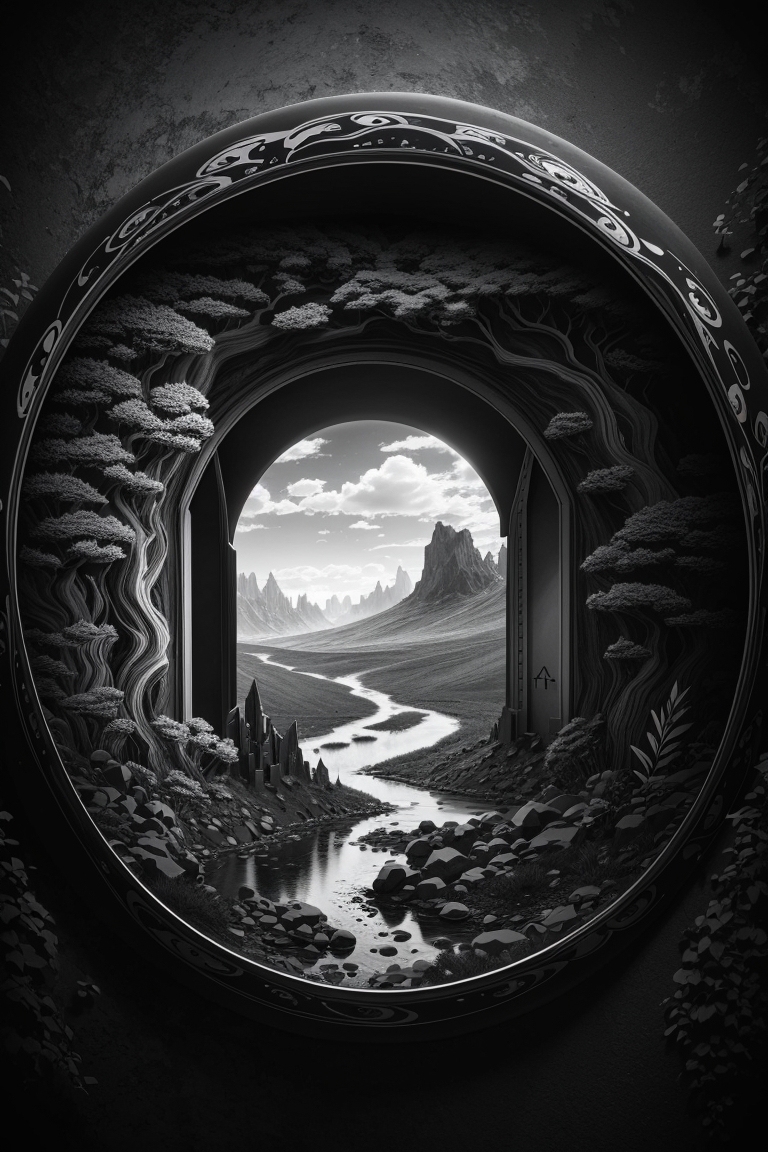
[Top image prompt:
Only line drawing without color **looking through a iron keyhole towards a mythical landscape, dark fantasy, very black background around keyhole, sharp focus, photographic, 3D]
The significance of a prompt is to input the desired command for AI to tap into a deep well of related content, randomly accessing images from online databases. The text reference recognizes all the necessary digital images, and specifications to tweak and calibrate into the final outcome. Give particular attention to the usage, "tweak" and "calibrate". This is not the same as copying verbatim.
"Good artists copy, great artists steal." - Pablo Picasso & Steve Jobs
How many artists seek inspiration? What masters derived their craft from other creatives? How many great innovators from the past to present tweaked and calibrated their crafts, to reinterpret it, or "make better"?
All of them.
Art is subjective enough on its own. It cannot and does not fit neatly within the confines of any structure. One should also recognize the impossibility of recreating an exact copy in either by an artist's hand, or hitting the "Generate" button in an AI art platform. No two creations are identical without the use of a machine, i.e. photocopier or scanner. There are very advanced settings one can apply in the process of AI art creations. I will go into this detail further at the end.
The Rise of AI Art and the Legal Controversies Surrounding It
AI adoption has been one of the fastest growing sectors, next to the cryptocurrency industry, ever known in all of industrial revolutions. Now in the hundreds of billions, the AI market is expected to easily become a trillion dollar market. ChatGPT, a popular advanced launguage model"chatbot" released to the public, reached 1 million users within the first five days. 50% of U.S. mobile users have already integrated it into their routines, and 97% business owners believe AI will completely benefit their companies. This staggering growth has its concern in not only its level of dependence, but more importantly a lack of clarity in the legal framework for copyright issues.
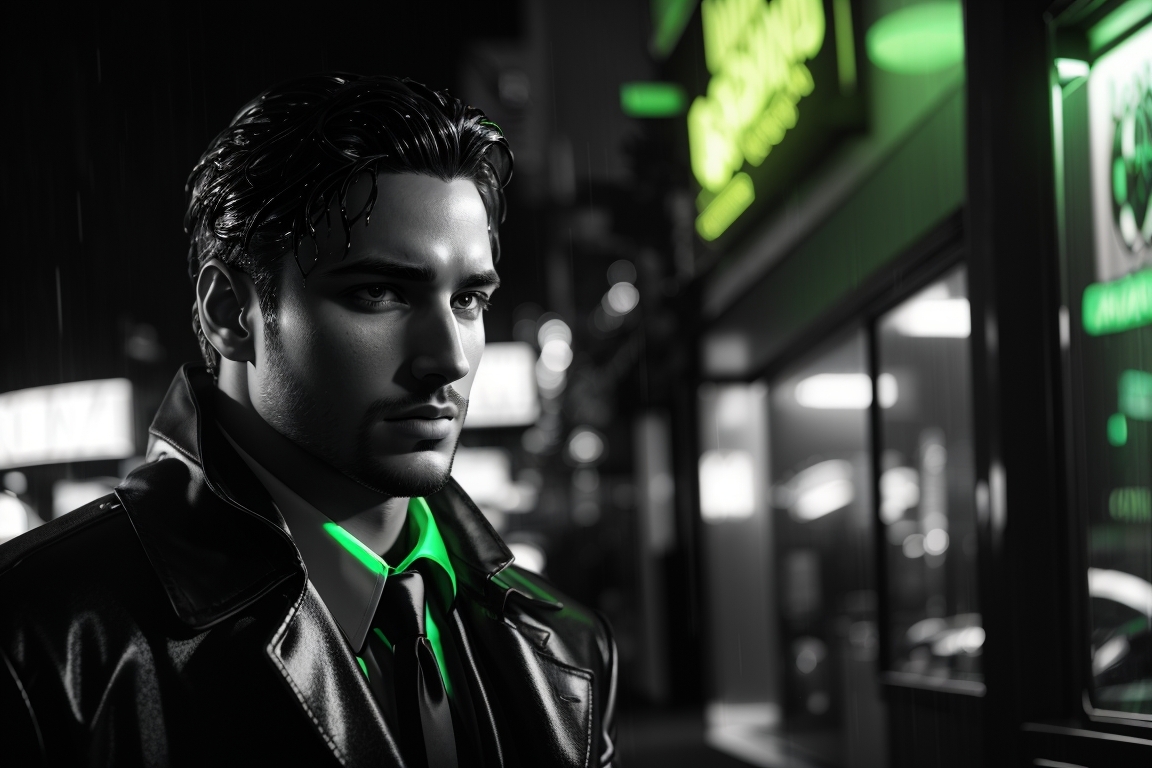
[Second image prompt:
black and white with a subtle hint of green neon comic-noir aesthetics in Frank Miller's Sin City style, strong attractive man in trenchcoat in front of a luminescent cafe, wet city street reflection, wide angle shot, film noir atmosphere, high contrast, shiny eyes, captivating gaze]
A prompt can be generalized information to achieve certain art effects, however suspicion can set in once the prompt states, "in the style of...". This often follows with specific artists names or copywritten brands. It is undetermined whether this particular area would constitute permission. In my opinion, this is merely an inspirational aspect. Let's see if the following details would help evaluate this matter.
When it comes to evaluating copyright laws and their applicability to AI-generated artworks, it is important to consider various factors. Copyright laws are designed to protect intellectual property rights, including creative works such as art. However, the rise of AI-generated artworks has raised questions about how these laws should be interpreted and applied. One concept that comes into play is the fair use doctrine. Fair use allows limited use of copyrighted material without permission from the copyright holder under certain circumstances, such as for criticism, commentary, or transformative works. Transformative works refer to creations that add new meaning or expression to the original work by altering its purpose or context. In the case of AI-generated artworks, determining whether they fall under fair use can be complex. While AI algorithms are capable of creating unique pieces of art, they do so by analyzing and learning from existing copyrighted works. This raises concerns about potential infringement. To navigate this issue, courts may need to consider factors such as the purpose and character of the AI-generated artwork, the amount and substantiality of the original work used, and the effect on its market value. Additionally, it becomes crucial to determine whether an AI-generated artwork truly qualifies as a transformative work or if it merely replicates existing content without adding significant new elements. As technology continues to advance and more AI-generated artworks emerge, copyright laws will need to adapt accordingly. It is likely that legal frameworks will evolve in order to strike a balance between protecting intellectual property rights while also fostering innovation in this rapidly evolving field.
In the meantime, AI generated works are not protected. Due to a certain case involving computer scientist, Dr. Stephen Thaler, a judge denied his application to copyright an image, which Dr. Thaler himself admitted had no human authorship. "The US Copyright Office has offered some hope to generative AI enthusiasts, though. "The answer will depend on the circumstances, particularly how the AI tool operates and how it was used to create the final work," the USCO said. "This is necessarily a case-by-case inquiry."" You can read more here.
AI litigation is on the rise provoking many prime examples to hopefully find answers one day. Another insightful example to take note is this January 2023 case:
Andersen, et al. v. Stability AI Ltd. The case brought by three artists on behalf of themselves and a class of similarly situated individuals against the AI image generator companies Stable Diffusion, MidJourney and Deviant Art. ("Artists' Class Action")
The judge dismissed all counts of this suit claiming there was no substantial similarity between the artist's creations and the AI systems, such as a failure to provide specific plausible facts. "Substantial similarity" refers to the degree to which the accused work resembles the copyrighted work. The most interesting part of the court's motion is the holding that the output images from generative AI do not automatically violate the derivative work right under section 106(2) of the Copyright Act.
Find more on this in putative class action and Artists' Class Action.
"In the United States, if you want to enforce your rights in court, you must have a copyright registration on your creative work."
Let's be real. The reason this is even a discussion is because AI art is profitable. Some of the most popular ecommerce shops are AI generated digital downloads. However, there is no way of knowing just how long this controversial situation can last amongst traditional artists vs AI artwork. There are valid arguements on both sides. A strong ethical standpoint is clear, either art is directly and deliberately being copied, or art inspires one to create something similar yet not identical.
Recognizing AI-Generated Art as a New Category of Creativity
The AI conversation states, “AI is inspired by artists the same way humans are”. My caveat to this statement is the available tools that we have access to, relies largely on human interaction. Art generative platforms are not perfect and tend to also miss the target. This provides a golden opportunity which encourages the artist to then provide an aspect of human authorship into the piece, such as photoediting, photoshop, and/or apply the particular human touch, which can possibly recategorize the intellectual collaborative property to copyright status? Ultimately, it is the human mind that plays a part and will develop the creation. Albeit the AI construct formulates the representation, it is still derived from many other uploaded human representations. It is a complimentary collaboration. It is a category I personally deem as "AI assisted art".
The Role and Responsibilities of Artists and Developers in AI-Generated Artworks
As I eluded to at the beginning of this written journey, about the very "tedious settings" one can apply in art generations, this I believe can alleviate the issue of infringements. Within the most advanced platforms, the developers have cleverly upgraded the capabilities within the settings and parameters in the most detailed integrations. Even adding the slightest element to an inspired piece can change the entire image. As I said, art is subjective and very maluable. If we look at the popular and highly advanced generative platform Leonardo AI, the amount of variations that can be applied are impressive to say the least. The artist is given options such as negative prompts, finetuned models with additional elemental styles and scale, platform pipeline, presets, tiling option, image weight, a guidance scale, image guidance which can alter a piece to significant originality, and many other advanced controls. Then the identifiable proofs to the piece such as Seed number, date stamp, resolution details, aspect ratio, and of course the prompt. These are the details that specify the result and proof of AI artwork into originality. I believe these are also key metrics to afix to the artwork itself, redefining a finished package. This may not only safeguard the integrity of AI assisted artwork, but also entail an ethical pattern to the responsibility of exhibiting as an AI art enthusiast. A digital footprint if you will.
Conclusion: Embracing the Potential and Future Impact of AI Art
In conclusion, it is crucial for individuals and industries alike to embrace the immense potential and future impact of AI in the realm of art. AI has the power to revolutionize artistic practices and open up new avenues for exploration. By incorporating AI into the artistic process, artists can benefit from a wealth of possibilities. They can leverage AI algorithms to generate unique ideas, create visually stunning artworks, or even collaborate with AI systems to co-create pieces that blend human creativity into an unforseen economy in the art markets, i.e. real world assets and NFTs. Furthermore, embracing AI in art can also democratize access to artistic tools and knowledge. With the help of intuitive AI-powered interfaces, individuals with varying levels of technical expertise can engage in art creation and express their creativity without significant barriers. However, it is important to acknowledge that while AI holds great promise for the art world, it cannot replace human artists. Rather, it should be seen as a powerful tool that enhances human creativity and pushes boundaries. As we move forward into an increasingly digitized world, it is essential for artists, institutions, and society as a whole to adapt and embrace the potential of AI in art. By doing so, we can unlock new forms of expression and push artistic boundaries beyond what was previously imaginable.
Thank you for your time reading this. I hope it has provided some value to your artistic arsenal, or for anyone you know that may benefit. You can also show appreciation and buy me a coffee to get me through the late hours of research. The best way to encourage creatives is providing some support liking, buying, or sharing. Thank you so much!
Stay tuned for the next round, "Is this art profitable?"