

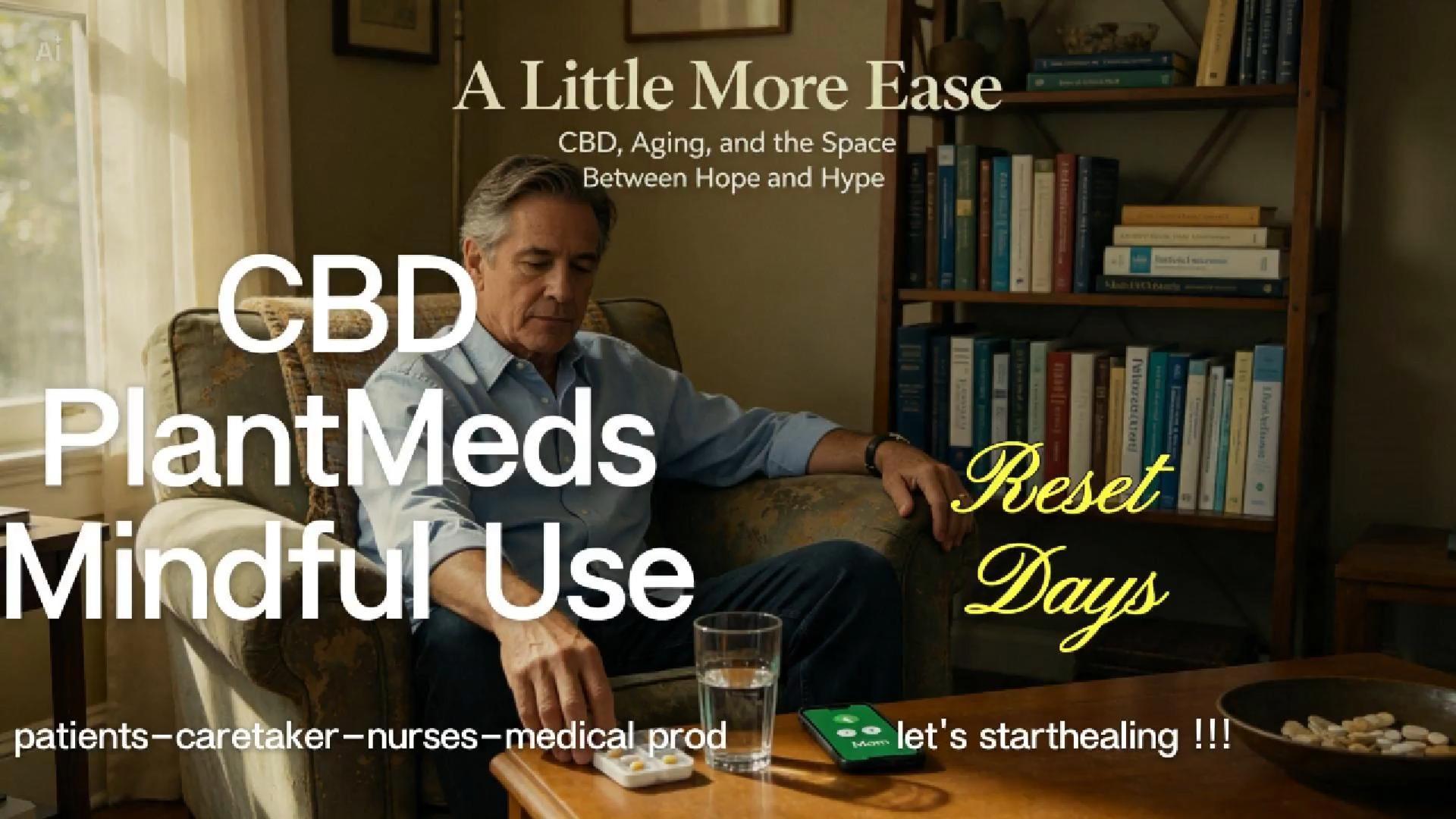
A Little More Ease...
There comes a point when “How are you?” becomes a complicated question.
You could answer honestly.
But somebody has an appointment in twenty minutes.
So you say, “I’m doing all right.”
Which might mean you slept. Or didn’t. Your shoulder hurts, your mother called three times before breakfast, and the medication schedule now requires office supplies.
But you’re here.
Technically, all right.
I want to talk about the space between getting through the day and feeling comfortable in it—and where CBD, cannabis, aging, and caregiving fit into that conversation.
Not a miracle cure.
Not “throw away your prescriptions and trust a leaf.”
Something quieter. And hopefully more useful.
[Title card: “A Little More Ease”]
## What Are We Hoping Will Change?
I read a presentation about CBD and older adults, and one idea stayed with me:
The goal isn’t to get someone using cannabis.
The goal is more ease. Better function. A life they can participate in.
Maybe that means sitting comfortably through dinner. Calling someone back. Enjoying an afternoon instead of enduring it.
Nobody puts “stayed for lunch and actually enjoyed it” on a wellness billboard.
But that matters.
Before we go further: this is a conversation, not a treatment plan. A podcast cannot review your medications or decide what’s appropriate for your health. That takes a qualified clinician who knows your situation.
## Hope, With the Volume Down
When you’ve been uncomfortable for a long time—or you’re watching someone you love struggle—a hopeful story can feel like a door opening.
I understand the appeal.
But someone else’s experience isn’t a promise.
Some cannabis formulations containing THC, alone or with CBD, may offer short-term relief for chronic pain. That doesn’t establish that every CBD gummy, oil, or cream offers the same benefit. The formulation matters. So do the limits of the research. [nccih.nih](https://www.nccih.nih.gov/health/chronic-pain-and-complementary-health-approaches-usefulness-and-safety)
I don’t want to confuse possibility with certainty.
We’d prefer a clear yes or no. Ideally printed on the bottle.
Sometimes the honest answer is: there are unanswered questions, and your situation matters.
Less exciting than a slogan.
A better place to start.
## “Natural” Still Comes With Questions
I have nothing against plants.
I’d like that entered into the record.
But “natural” and “safe” are not interchangeable.
CBD can interact with medications, may cause liver injury, and can increase sedation when combined with alcohol or certain drugs.
That deserves more attention than a reassuring label—especially when someone already takes medication for sleep, anxiety, or pain.
Taking things at different times isn’t a guarantee that an interaction disappears.
That’s a medication-review question.
Not a scheduling trick.
Nobody wants to buy a little bottle and discover it comes with homework. But “What else are you taking?” isn’t dismissing the idea.
It’s taking it seriously.
## The Person With Seventeen Tabs Open
Then there’s the caregiver researching after everyone else has gone to bed.
One tab says promising.
One says dangerous.
One is an argument from several years ago.
And one has somehow added something to your cart.
I don’t want this to become another subject you’re expected to master because someone you love needs help.
You’re already remembering appointments. Listening for movement down the hallway. Trying to sound patient while answering the same question again.
Caregiving doesn’t have to feel beautiful every minute to be done with love.
Some of it is beautiful.
Some of it is laundry.
Some of it is sitting in a parked car because nobody needs anything from you there.
For now.
That person needs support, too.
Not another confident stranger implying they should already know the answer.
## Bring the Question, Not the Conclusion
Instead of starting with “Which product should I buy?” start with what’s getting in the way.
“I’m not sleeping.”
“This pain is keeping me from things I enjoy.”
“My parent is uncomfortable, and I need help understanding the options.”
Bring the full picture to a clinician or pharmacist: medications, supplements, alcohol use, and the specific product you’re considering.
Then ask:
- What improvement are we hoping to see?
- What side effects should we watch for?
- What would make us stop and call?
- How will we know whether this is helping?
Not “better wellness.”
Something you can describe without a marketing department.
You’re allowed to ask questions before buying something.
Afterward, too.
The purchase does not obligate you to become its public defender.
## When Dementia Enters the Conversation
This is where I want to slow down.
The presentation included a family’s account of improvement in someone with dementia. That was their reported experience—not my clinical experience, and not a promise to another family.
When someone you love is changing in ways you can’t prevent, hope lands differently.
You’re not browsing.
You’re looking for something you can do.
I don’t want to turn that vulnerability into a sales pitch.
“This deserves careful study” and “This will help your mother” are not the same sentence.
That difference needs to stay visible.
Especially when the story would sound better without it.
## Keep the Person in the Room
Whatever the decision—CBD, another medication, a change in routine—the person receiving care still deserves a voice.
Ask what they want.
Give them time to answer.
Don’t discuss their body as though they’ve stepped out of the room.
Needing help doesn’t mean they’ve stopped having preferences.
I’d want that courtesy.
Possibly with less cheerful commentary about how well I’m doing.
I’m interested in the possibility of more comfort. I’m also interested in being honest about uncertainty—and what someone might be selling us along the way.
Those interests can coexist.
We don’t have to dismiss everything or believe everything.
We can stay curious without handing over our judgment.
Because the point was never the bottle.
It’s the person hoping their day might feel a little less difficult to live through.
## Connect and Explore
Leave a comment or contact me through [Buy Me a Coffee](https://buymeacoffee.com/socialyetdistanced).
- [Holistic Caring](https://holisticcaring.com/ref/jack): CBD and plant-medicine education for patients, caregivers, and medical professionals.
- [Bloom Hemp](https://bloomhemp.com/ref/jack): Product information and discount offers.
- [Ask the Green Nurse](https://thegreennurse.substack.com/)
- [T-Shirts Say So](https://bit.ly/TShirtsSaySo)
Editorial note: If any links earn you a commission, add a clear affiliate disclosure before publishing.