About JINGUCHA: Embracing the Stereotype
Digital Archive for a Tamil Culture & Community-Engaged Storytelling
I excavate ideas of beauty rooted in ancestral memory, inspired by Tamil communities in Malaysia. My work reveals how beauty and taste are shaped by class, rurality, and post-colonial shame.
What does JINGUCHA mean?
Jingucha in South Indian (Tamil) pop culture songs refers to a rhythmic phrase. It mimics the jing-chak sound made using a pair of metallic cymbals used in Indian music, called Jalra.
In Malaysia, Jingucha can be an internal slur among Tamil speakers. It insinuates a flamboyant colour combination, referring to fashion that is gaudy.
I assume this is also what people mean when they say “very Indian colours”.
So, I’m exploring what if I embrace this stereotype and open the invitation for you to do the same.
How did JINGUCHA begin?
The Navarathiri Festival (that takes place in September) inspired this work. During this celebration of the divine feminine, I documented the space in real time, sketching and recording movement as fast as I could while observing the devotees and performances around me.
Later, I researched archival images and layered them with my work. This collection has 13 collages. Each one combines sketches, archival art, and photos.
Where has JINGUCHA taken place?
2nd International Conference on Film & Society
15 April 2026
AICB Centre of Excellence,
Kuala Lumpur
நாங்கள் சேர்ந்து வந்து கதைக்கலாம்
(Let’s come together and talk)
30-31 May 2026
Jean Stokes Community Centre,
London
JINGUCHA: Embracing The Stereotype — Private Showcase
20th June 2026
Five Arts Centre, GMBB
Kuala Lumpur
Your support will help me grow this gradually towards a web-exhibition in 2027.
Why this project is important for Malaysian and global Tamil diaspora?
"The exhibition makes visible how ideas of beauty and taste are shaped by class, rurality, and postcolonial shame, revealing judgment itself as something learned and inherited. By looking straight up and then turning away from an internalised gaze, Rupa reflects and builds on identity, which here is not fixed but in motion, incomplete, like the capturing of the dance. The work unfolds in lived, embodied time and embraces the saturation set aside in childhood without hesitation.
Jingucha doesn’t provide answers, but rather an energy to carry forward, loud and deliberate. Rupa unapologetically takes authorship of the present moment as part of a larger story of connected humanity and, in doing so, invites us to do the same."
Review by Sofia Castello,
Researcher, Portugal
How much will this cost?
1. Fixed & Production Costs (1 Year)
Laptop Upgrade: $1600
Smartphone Upgrade: $775
Microphone: $100
Hard Drive: $368
Design Software (1 year): $120
Internet Service (1 year): $530
Home Studio Rent (1 year): $4,420
*Physical Exhibition: $6,000
Includes archival quality Giclée prints, framing, statement vinyl, installation, catalogue, transportation, photography, documentation, project management, venue rental, marketing.
Production $Subtotal: $ 13,913
2. Digital Long-Term Accessibility (10 Years)
Web Hosting ($192 × 10): $1,920
Domain Name ($50 × 10): $500
Accessibility Subtotal: $2,420
While I have tested selling prints to fundraise, if I aim to keep it accessible to the community I want to serve - it only covers about 6-10% of the actual cost and labor, involved to create a project like this. And I will have to sell in thousands to make it viable.
What are the next steps for JINGUCHA?
1) Revive web: skinandsoul.art
2) Revise web draft 2.0 to receive feedback round 4
3) Study archival Indian art
4) Conduct sharing sessions about Jingucha & archival findings
5) Write summary of archival study
6) Apply for international and local exhibition open calls & grants
7) Write proposals for suitable venue & partners
8) Update contributors with progress report
9) Update social media with milestones and Behind The Scenes
10) Script and develop video
11) Shoot & edit video
12) Video feedback circles
13) Adapt revisions
14) Finalize web platform
15) Figure out art prints distribution
16) Setup & digital print shop
17) Testing & Fixing
18) Write press release
19) The Full Public Staggered Rollout
20) Public events + sharing sessions
21) Document impact metrics + update contributors with final report
22) Project Closing Ritual.
Who is the creator behind this idea?
Rupa S. Maniam is a multidisciplinary visual artist with a background in digital media.
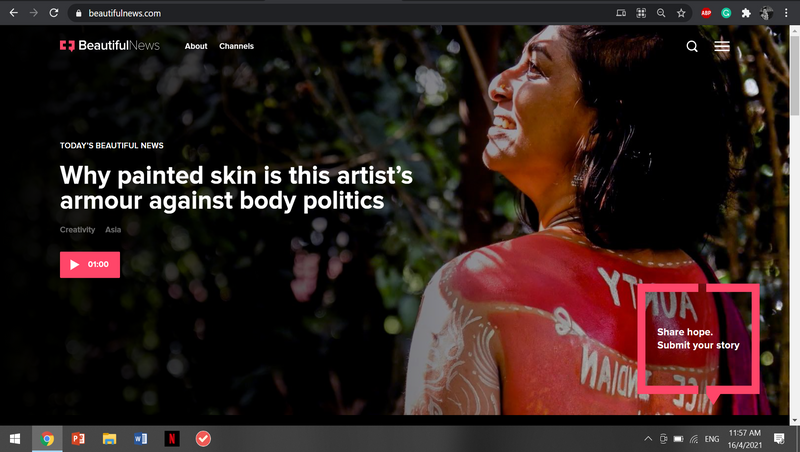
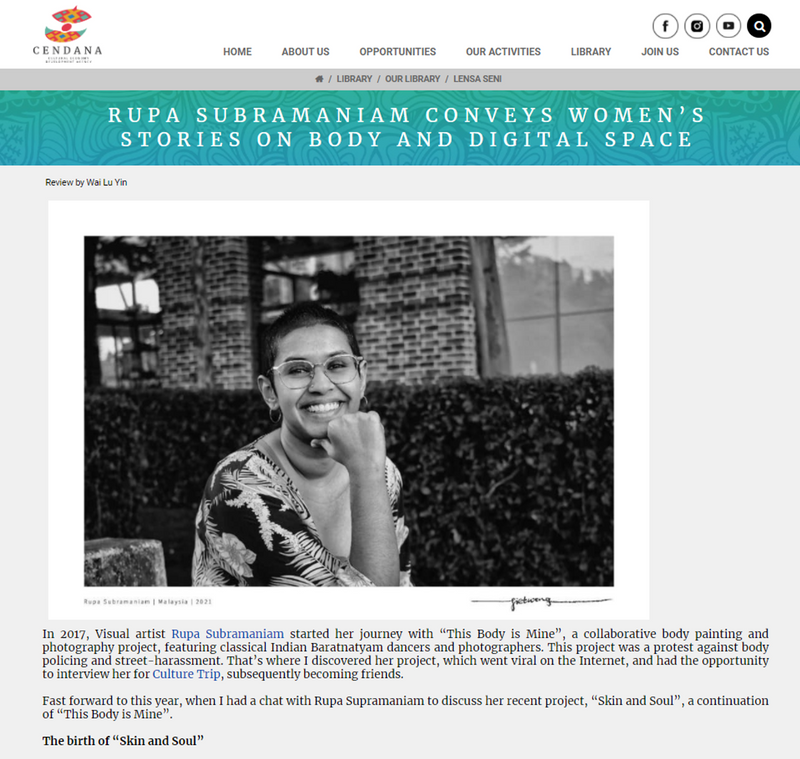
Her take on Hindu Goddesses protesting body policing, “This Body is Mine” (2017) reached 2 million views worldwide. She founded Art Battle MY (2016) and has featured 70+ artists, painted on 30 Women in 30 Days (2018), led the Banana Leaf Art Exhibition (2019) with 50 over Malaysian Indian Creatives, published a documentary on Non-Consensual Dissemination of Intimate Images (2020), was the Creative Director for Malaysia’s Women’s Tribunal Arts Festival (2021), and published a creative collage journal that’s free for the public to download called “Draw Your Way Home” (2023).
She has created two web exhibitions prior to this: one for GoodkidsMY, called Apa Pandang-Pandang, and her first solo, Butterflying the Highway, in 2025. JINGUCHA: Embracing the Stereotype will be her third web exhibition.
Rupa's work is both accessible and deeply insightful. She is a recipient of numerous awards, including multiple Malaysian Media Awards during her time in media agency, the Aegis Global Media Gold Award (2012) , Marie Claire Malaysia's Women of the Year award (2019), FEMALE’s Superwomen (2019) along with Prestige’s Top 40 Under 40 Award (2020).
*If you like to sponsor any part of this process / envision bringing this part of a cultural event in Malaysia / global Tamil diaspora / volunteer creative talent - please get in touch.
I'm also happy to inherit refurbished tech, like the mic and hard drive if you have got them! Contact: [email protected] // [email protected]
Recent supporters