

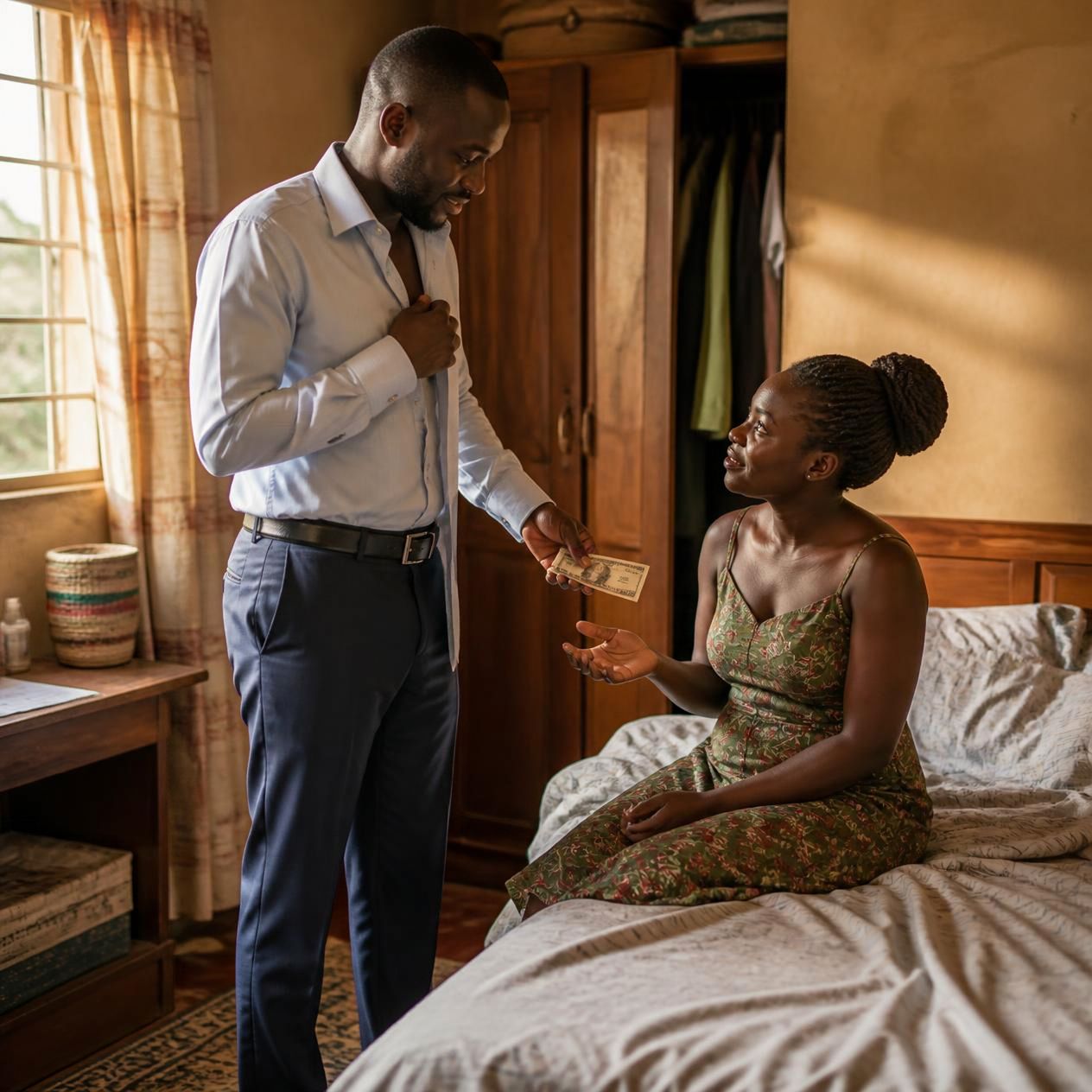
Who pays for sex, and why?
It is a question that surfaces in research papers, late-night conversations, and the quiet corners of the Internet, usually framed in the language of pathology or moral failure.
The answers that follow are often tidy: the men are married and unsatisfied; they are single and lonely; they are chasing a kink they cannot name at home; they are simply bored.
All of those explanations contain pieces of truth, but none of them are complete.
I write this as someone who once occupied the other side of the transaction.
Not as a high-end client with unlimited resources, but as a man with disposable income who decided, repeatedly, that the company of a sex worker ranked higher on the priority list than several more “respectable” expenses.
I was a regular!
I formed what I believed, at the time, were meaningful relationships with the women whose services I solicited.
Later, during the course of the Sex Worker Visibility Project, an interview with a provider named Elyse forced me to sit with a harder possibility: that I may have been one of those “men who cannot always tell the difference between an erotic moan and something closer to endurance”.
That possibility still sits uncomfortably.
It is not the whole story of those years, but it is part of it.
What remains clearer, even after the self-interrogation, is the emotional weather that kept drawing me back to the so-called houses of ill repute.
The physical act was never the primary currency. What I was purchasing, or attempting to purchase, was a temporary suspension of loneliness. The imagined emotional attachment was, for practical purposes, as real as any other.
The euphoria it produced did not require the other person to feel the same thing for it to land.
The research is less simple than the stereotype
Academic work on male clients has moved past the old caricatures. Studies that actually speak to the men involved consistently find that intimacy and connection rank higher than pure physical release for a substantial portion of them.
Jones and Hannem’s research into escort clients’ sexual scripts describes men who construct meaning around the encounter that goes well beyond the sexual act itself.
Many of the men they interviewed valued the feeling of being seen, even if that seeing was bounded by time and money. Sanders and others have documented the same pattern among regular clients: the desire for communication, familiarity, and a temporary sense of mutual regard.
Bernstein’s concept of “bounded authenticity” is useful here, too.
The client often wants something that feels real within clear limits. He does not necessarily want a relationship that will follow him home. He wants the texture of intimacy without the open-ended obligations that ordinary relationships demand. The transaction creates a space in which that exchange can happen without the usual risks of rejection, misunderstanding, or long-term entanglement.
Loneliness appears again and again in the accounts. Not always the dramatic, isolated loneliness of the completely alone, but the quieter kind that can sit inside a marriage, a friendship group, or a successful career.
Men report feeling unable to speak about certain parts of themselves. They report missing physical affection that is not complicated by history or expectation. They report wanting, for a defined period, to be the centre of someone else’s attention without having to earn it through the ordinary labour of a relationship.
The void that does not have a clean name
I have called it a deficit in earlier notes, but the word is not quite right.
Deficit implies something missing that should be present, a shortfall against a normal standard. What many clients, including myself, describe is closer to a void that the ordinary structures of their lives do not fill.
Work, family, and social expectation can leave large parts of a man’s emotional range unvisited. The commercial encounter becomes one of the few places where those parts are allowed to surface without immediate consequence.
This is not a defence of the industry, nor is it an argument that paid intimacy is a perfect substitute for the unpaid kind. It is an observation drawn from both research and personal history.
The men who frequent these spaces are not a single type.
Some are exploring parts of their sexuality that feel unsafe elsewhere. Some are managing depression or anxiety by purchasing a form of human contact they cannot otherwise arrange.
Some are simply tired of the performance required in conventional dating. The common thread is not moral failure. It is the recognition that certain emotional needs are difficult to meet inside the lives they actually live.
In the work of fiction (The Homeless Diaries: Tales of a Broken Man) I have written, the character Wolfgang Storm moves through similar terrain.
He is not a simple predator or a simple victim. He is a man whose hunger for connection outruns his ability to sustain it in ordinary relationships.
The sex workers he encounters are not passive objects; they are professionals navigating their own calculations of risk, money, and emotional labour.
The distance between Wolfgang’s private mythology and the women’s actual experience is one of the quiet engines of that story. I recognise versions of that distance in my own past with sex workers.
What the client rarely says out loud
Inside the rooms and the private messages, the conversation between clients is limited.
Men do not typically sit around comparing notes on the emotional texture of their encounters. What circulates is gossip, rankings, and the occasional warning.
The deeper motives stay mostly private. That privacy is part of the product. Discretion is not only about protecting reputations; it is about protecting the fragile story the client tells himself about what the encounter means.
When those stories surface in research interviews, they are often more complicated than the public imagination allows.
Some men speak of the relief of not having to perform competence.
Some speak of the pleasure of being touched without having to initiate or negotiate every step.
Some speak of the simple fact that, for an hour or two, they are not alone with their own thoughts. The physical release is real. The temporary quieting of loneliness is often the larger transaction.
None of this erases the power imbalance inherent in the exchange.
Money creates a structure in which one person’s time and body are available on terms the other person sets.
The emotional labour performed by the sex worker is frequently invisible to the client who experiences it as natural warmth. That asymmetry is real and deserves its own examination. It is simply not the only fact in the room.
The local texture of the encounter
Context matters. The same psychological currents run through commercial sex in different cities and countries, but the local practices, expectations, and cultural scripts shape how those currents are expressed.
In Uganda, for instance, certain styles of encounter carry their own history and meaning.
Practices such as Kachabali, which centre female pleasure and require a degree of mutual attention and timing, sit inside a longer conversation about what sexual connection is supposed to look like.
Accounts from providers and clients in that setting often emphasise cooperation and responsiveness rather than pure performance. For a fuller cultural and experiential discussion of that particular practice, the writing collected at Uganda Escorts offers a grounded local perspective that sits usefully alongside the broader research.
That kind of local knowledge does not dissolve the structural questions.
It does, however, remind us that the men who seek these encounters are not only purchasing a body. They are stepping into a set of existing cultural and interpersonal scripts, some of which already contain ideas about mutuality, attention, and the management of loneliness.
What remains after the hour ends
I no longer occupy the client position in the way I once did.
The Sex Worker Visibility Project has forced a different kind of attention: longer conversations, more room for the women’s own framing of their work, less space for the private mythology I once carried.
The loneliness that once felt like a personal emergency now looks more like a widespread condition that the ordinary institutions of adult life are not particularly good at addressing.
Men will continue to pay for sex for many reasons. Some of those reasons will remain purely physical or experimental. Others will continue to circle the same quiet territory: the desire to be touched without having to explain themselves, the temporary relief of not being alone, the hope that for a defined period someone will meet them where they actually are.
Research that takes those motives seriously does not romanticise the industry. It simply refuses to reduce the men inside it to a single, convenient story.
The more honest question is not whether loneliness drives some of this behaviour.
It clearly does!
The more useful questions are what kinds of loneliness are being answered, what kinds of labour the sex worker is being asked to perform in response, and whether the rest of us are prepared to look at the emotional landscape that makes the transaction feel necessary in the first place.
That landscape is larger than any single encounter. It includes the stories men tell themselves about what they are allowed to need, the limited scripts available for male vulnerability, and the quiet calculation that it is sometimes safer to purchase a temporary connection than to risk a permanent one.
Understanding that calculation does not require us to approve of every form it takes. It only requires us to stop pretending the calculation is simple.