
Rating: 5.5/10
There is a certain kind of television that asks very little of you, and delivers exactly that in return.
The WONDERfools, Netflix’s 1999-set Korean superhero comedy, is not quite that show — but it is closer to it than I would have liked.
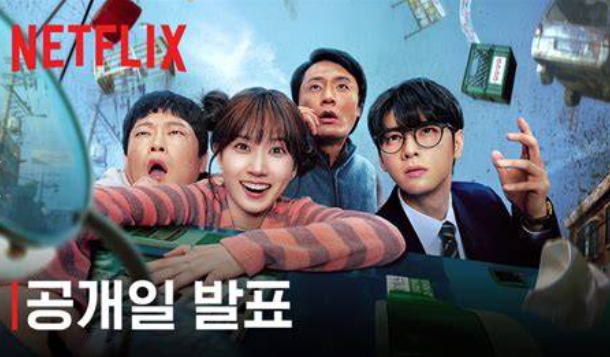
Set against the backdrop of Y2K hysteria in the fictional Haeseong City, this eight-episode limited series follows three spectacularly unremarkable people who stumble into superpowers and are promptly tasked with saving their town from a villain operation hiding in plain sight. The premise is disarmingly charming. The execution is a great deal noisier than it needed to be.
The Most Interesting Idea in the Room
Let me start with what The WONDERfools actually gets right, because there is something genuinely worth examining underneath all the chaos.
The Western superhero industrial complex — and it is an industrial complex at this point — has a recurring problem that nobody talks about nearly enough. It keeps giving extraordinary abilities to extraordinary people.
Peter Parker, before the spider bite, is already academically gifted enough to be embarrassing. Tony Stark is a genius billionaire. Even the supposedly ordinary Captain America is a man of exceptional character and moral clarity, selected because of his distinction.
The WONDERfools pushes back on that logic, and it does so without apology.
Eun Chae-ni, nicknamed Trainwreck (Park Eun-bin), has no formal education, no social network, no family to speak of. She is introduced as a woman the world has essentially written off. Her power — teleportation and cellular regeneration — mirrors the X-Men’s Kitty Pryde or Wolverine in broad strokes, but the crucial difference is that neither of those characters arrived at their abilities as a person who had already been comprehensively failed by life. Chae-ni did.
Then there is Son Gyeong-hun, or Nightmare (Choi Dae-hoon), a man whose wife and daughter regard him as exactly that. He develops a rudimentary but recognisable version of Spider-Man’s physical abilities. He is also, by every conventional measure, a devastating failure of a human being. Not troubled. Not misunderstood. Simply, consistently, catastrophically bad at being a person.
Kang Ro-bin, the third member of this accidental collective, develops superhuman strength despite a lifetime of being both emotionally and physically wrecked. His nickname is approximately Super SAP in the translation I watched — a detail that signals exactly how much the show thinks of him.
This is a case I would defend. There is something refreshing, even quietly radical, about a superhero story that hands the franchise keys to people the world would rather not look at. It is a different moral argument from the one Marvel and DC have been making for decades.
The problem is that The WONDERfools never quite trusts that argument enough to let it breathe.
Park Eun-bin, Doing the Heavy Lifting
She is, without question, the reason to watch this.
Park Eun-bin is a genuinely gifted actress — Extraordinary Attorney Woo remains a masterclass in playing complexity with complete sincerity — and she brings that same commitment to Chae-ni, even when the material underneath her is not worthy of the effort.
Chae-ni’s energy is contagious in the way that the show intends, but what Eun-bin does beyond the energy is more interesting. There is a real person under the frenzy. A woman who has been told, repeatedly and in various ways, that she is worth nothing — and who has developed a kind of manic momentum as her only defence against fully believing it. The teleportation is the obvious power. The refusal to stop moving is the quieter one.
It is a shame that so much of the writing around her mistakes volume for depth.
The Overacting Problem
I want to be careful here, because there is a version of this criticism that simply represents cultural distance.
Korean drama has its own theatrical register, one that I have come to understand better across months of watching — from Squid Game to The Art of Sarah to Perfect Crown. Heightened expression, elevated emotional temperature, comedy that wears its heart on its sleeve. I am not unfamiliar with the idiom, and I have grown to appreciate it.
But The WONDERfools pushes past that register into something else entirely.
Three of the four central characters — Chae-ni being the arguable exception — spend much of their screen time operating at a pitch that makes genuine emotional investment difficult. The comedy reaches for physical absurdism as a default setting, and what gets lost in that constant noise is the very thing that makes the show’s central argument interesting: these are people the world failed, and they are trying to matter anyway.
When that idea lands, and it does occasionally, the show momentarily becomes something worth caring about.
The rest of the time, it is simply very, very loud.
The Sensei and the Villain Question
Lee Woon-jeong (Cha Eun-woo), the specially appointed civic servant who serves as the fourth member of this unlikely collective, is by far the most measured presence in the show.
He is also, by design, the most recognisable to anyone with a working knowledge of the Western superhero template: quiet, perceptive, driven by unresolved trauma, with abilities — telekinetic in nature — that echo Magneto’s gravitational mastery more than anything else on this canvas. Where Magneto’s trauma was forged in the Holocaust and calcified into ideology, Woon-jeong’s is more intimate. But the architecture is similar: a man so shaped by what was done to him that his power has become inseparable from his wound.
Cha Eun-woo is the calming centre the show needs, and the romantic tension between him and Chae-ni is the most coherent emotional through-line in all eight episodes.
The villains are where The WONDERfools makes its most interesting structural choice.
Rather than operating from the shadows, they hide in the most public space imaginable: a cheerful, aggressively welcoming church that recruits openly and enthusiastically from the community. The horror is not secrecy. It is visibility — the ease with which a predatory structure can embed itself in plain sight when it speaks the language of comfort and belonging.
Kim Hae-sook and Son Hyun-joo anchor the antagonist side with something the heroic trio mostly lacks: genuine menace, earned backstory, and the kind of gravitational performance that makes every scene they occupy land with more weight. They were children subjected to failed medical experiments. What they became is a direct consequence of what was done to them — a moral echo of the heroes’ own story, refracted through a darker lens.
In a more balanced show, that parallel would be devastating. Here, it gets swallowed by the noise.
The 1999 Question
There is one more thing worth naming before I give you my verdict.
The decision to set The WONDERfools in 1999, in the shadow of Y2K, is not an arbitrary one. A year when the world genuinely believed catastrophe might arrive at midnight, when ordinary people felt the ground shifting under their feet — it is a quietly smart frame for a story about ordinary people being handed extraordinary responsibilities.
The show does not always know what to do with that frame. But it is there, and in the moments when the writing slows down enough to let it register, the series earns a layer of texture it otherwise struggles to access.
The Verdict
I soldiered through The WONDERfools because of what it is trying to do, and because Park Eun-bin is the kind of performer who makes the watching worthwhile even when the material is not.
But I would be less than honest if I did not say that for long stretches, this felt more like a commitment than a pleasure. The genuinely funny moments are there, and they are genuinely funny — but they are islands in a sea of noise. The show’s most interesting idea, the one about unremarkable people being the most deserving of a shot at meaning, is better than its execution.
The villains outclass the heroes in every register that matters. The 1999 backdrop is more evocative than the script fully realises. And the central quartet, at its best, offers a vision of superheroism that the genre badly needs more of.
At its worst, it is the most cheerfully ridiculous Korean production I have yet encountered — by quite some distance.
There will not be a second watch. But I do not regret the first.
If pieces like this add something to how you think about film and television, consider supporting this independent work directly on Patreon or via the Medium Tip Jar.