

Rating: 9/10
28 Years Later: The Bone Temple is a spectacular, and highly sophisticated example of a film sequel that has elevated the franchise, which it achieves by reaching beyond the realm of a pure survival thriller and tapping into philosophical debates around faith, social regression, and human nature.
In my 2025 review of 28 Years Later I argued that the Zombie genre had been resurrected under the steady hand of Danny Boyle, but in Boyle’s absence for this instalment of the franchise it has become increasingly apparent to all and sundry that the real star behind the camera is in fact the film’s writer Alex Garland who delivered both screenplays.
What sets The Bone Temple apart from anything else in the post-apocalyptic horror genre is the strength of the storytelling, and Garland clearly deserves all the plaudits for it!
The Bone Temple narrative revolves around four characters in particular, each of them serving a critical role in the painting of contrasting portraits.
While followers of the franchise will already be familiar with Dr Ian Kelson (Ralph Fiennes), a former GP dedicated to memorializing the victims of the epidemic, and Spike (Alfie Williams), a teenager who is on a personal quest to find his mother (a motivation that feels increasingly like a ghost story the deeper we get into The Bone Temple), this 28 Years sequel really takes us down a rabbit hole with the eccentric Sir Lord Jimmy Crystal (Jack O’Connell), who brings a completely new dynamic to the unfolding saga.
I always watch on in a state of bewildered awe when actors like O’Connell interpret such bizarre characters without missing a step.
Nevertheless, in this film there is also the small matter of Samson (Chi Lewis-Parry), a physically imposing (and dare I say well endowed) Alpha leader of the infected, who serves a particularly important, and perhaps underrated function in the delivery of the film’s narrative.
While we are here, it would probably be prudent to continue with Samson’s thread, given that he is such an imposing figure in this film, and despite saying painfully little throughout, he remains impossible to ignore.
Throughout The Bone Temple, Samson is often depicted entirely or partially nude, particularly during his time in Kelson’s laboratory, which is why my observation of well endowed is a particular reference to his genitalia, which Director Nia DaCosta makes sure we never miss.
However, Samson’s physical endowment actually serves a specific thematic purpose in the movie’s visual language, extending well beyond what lies just below the waist.
By showcasing Samson’s physical form in such a raw, unfiltered way, The Bone Temple emphasizes his role as a primordial being, where he is stripped of the civilized trappings of clothes, shame, and societal norms.
Samson’s physical presence — including his stature and anatomy — is designed to underscore that he is a creature of nature, unburdened by the neuroses of the “Jimmys” or the clinical coldness of Kelson.
So that contrast is clearly a very deliberate and skillful device used by the writers and directors for this film.
Let’s talk a little more about Jimmy, who is the leader of a small but utterly ruthless cult during the timeline for this film.
Something instantly noticeable about them is that every member of that cult hides behind masks, blonde wigs, and baggy tracksuits, which means they are all defined by what they put on, to project the power that they hope to wield on the mainland.
That is obviously a total contrast to the image depicted for Samson, who is not hindered by any emotional vulnerability, and therefore does not need to project an image of power.
Samson just is!
Because he possesses a natural, “endowed” power that requires no costume, and his nudity represents a terrifyingly honest form of existence that the cult can’t replicate despite their bravado.
The contrast between Samson and Kelson is actually the main driving force of this film though, and far more nuanced than many would care to give it credit for.
From the moment we were first introduced to him, Dr. Kelson was defined by his intellect and a rigid, almost monastic self-discipline, which is a recurring theme in this film, and indeed Fiennes’s entire acting career.
Kelson’s existence in a world of total and utter chaos is still curated here, as he listens to classical LPs, maintains a meticulous ossuary, and uses chemical compounds like iodine and morphine to navigate his world.
Samson, conversely, is pure biological expression, and lives in a state of absolute wordless presence.
Just to close this discussion off, the “well-endowed” nature of Samson’s physical form serves as a visual reminder of what Kelson has sacrificed for his survival: his own vitality and connection to the primal world.
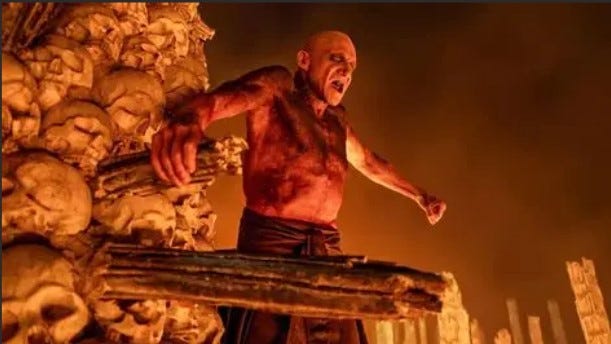
A glaring example of this would be Kelson’s orange-tinted, iodine-stained skin, which makes him look artificial and withered next to Samson’s raw, muscular reality.
Kelson initially views Samson as a specimen to be managed from a distance with a blowgun, but as the film progresses, their relationship becomes increasingly intimate — a “buddy movie” in the most surreal, and frankly unhinged sense.
By the climax of this movie, which is also a little surreal and unhinged, when Kelson must “perform” as a demon for the Jimmys, he is forced to strip away his clinical armor and daub his own chest in charcoal, trying to mimic the raw power that Samson possesses naturally.
Despite his best efforts Kelson is still no Samson in the end!
The relationship, and fascinating contrasts between Kelson and Samson are so fascinating that you might just forget that there is the small matter of a young, traumatized boy (Spike), whose only shot at survival is to secure his membership of a sadistic Satanist cult.
Spike serves as vessel for trauma, where his “coming-of-age” is perverted by the violence of the Jimmys that he must now associate with.
By this point, Spike has moved from a boy desperately trying to find his mother, to a Jimmy himself, even if only in name, and so his story highlights the impossibility of maintaining purity in a world that demands savagery for survival.
The fascinating thing about the mainland is that faith, in whatever form, remains a strong pillar for all the characters involved, despite the absence of any formal religious institutions.
So, you have Kelson who is the atheist, and then you have the cult leader Jimmy, who represents the dark side of belief, but even when you peel away at that, you will discover there is a driving force behind Jimmy’s dark, ruthless past.
Traumatized by watching his family die as a child, Jimmy has rejected his father’s Christianity for a nihilistic Satanism, and in turn he uses religious dogma as a tool for control, styling his gang after Jimmy Savile and claiming to be the son of “Old Nick.”
A major plot development in The Bone Temple is the apparent discovery that the Rage Virus hasn’t erased the human mind, and that it has merely suppressed it under a layer of permanent psychosis.
Samson, naturally, is the all-important test case for this discovery, where Kelson’s experimentation with psychosis medication gradually helps Samson regain some of his cognitive function.
The realization that the infected can be reached via empathy and medicine — rather than just violence — redefines the infected as victims rather than monsters, which is an important twist for this film, particularly for Jimmy Ink (Erin Kellyman), who must choose between Kelson’s hope and Jimmy Crystal’s cruelty before the final credits start rolling.
The Bone Temple if a remarkably layered post-apocalyptic horror film that articulates its most defining themes with the elegance of a masterpiece painted in blood and bone.