

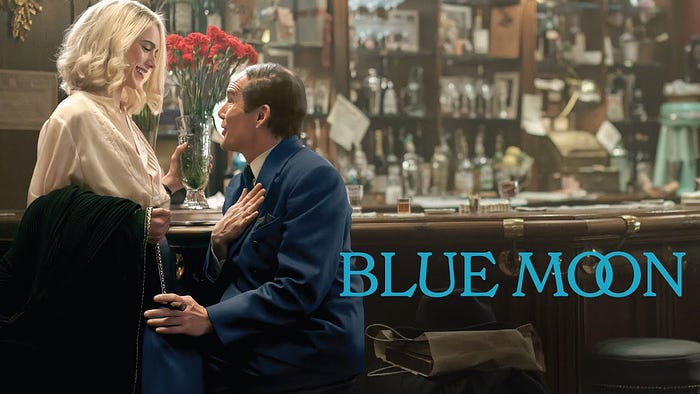
Rating 8/10
Richard Linklater’s Blue Moon is a poignant, dialogue-heavy movie which explores a broad range of themes, from professional decline to unrequited love, all of which is anchored by a career-defining performance from Ethan Hawke as the legendary lyricist Lorenz Hart, who reminds us all that nothing quite compares with the fragility of the male ego, especially in a field as brutal and cutthroat as the performing arts.
The film’s setting, for virtually the entire 100-minute runtime is the bar at Sardi’s Restaurant, where Hart tries to drown his own sorrows (on club soda), and the most heart-breaking aspect to this is that he bears his entire soul to a mere audience of three, that isn’t really listening.
We have the barman Eddie (Bobby Cannavale), the piano player Morty Rifkin (Jonah Lees), and the writer E.B White (Patrick Kennedy).
Incidentally, during the exchange with E.B White, Hart shares an anecdote about a mouse that apparently serves as a creative spark for White’s future work (Stuart Little).
So, for the literary enthusiasts among us, that was a delightful little touch!
In this movie E.B White is depicted as a proper, intelligent contrast to Hart’s chaotic energy, while Eddie operates as Hart’s BS detector and unofficial guardian, attempting to keep him on club soda, while Hart navigates the painful reality of the Oklahoma! premiere happening nearby.
Meanwhile Morty is the grounded, youthful witness to Hart’s decline, and it is hard to determine just how much of what he feels for Hart is empathy, embarrassment, or sorrow.
Throughout the sorry episode, Morty does nothing but treat Hart with courtesy though, which is perhaps a nod to his own military background.
Despite all that emotional weight, some audiences might walk away from this film feeling like it was a lost opportunity to tap into a far more controversial conversation, surrounding the relationship between Hart and Elizabeth Weiland, played by Margaret Qualley, who is a mile away from Maid in this movie.
While their relationship serves as an important subplot to this story, writers might as well have gone in for a pound, given that they exercised considerable artistic license with that narrative anyway — but perhaps that is just the deviant in me talking.
The central conflict in this film is Hart’s realization that the world of musical theater has moved on without him, and that nobody is really missing him either.
While his friend and colleague Richard Rodgers (Andrew Scott) has pivoted to the wholesome and structured style of Oscar Hammerstein II (Simon Delaney), Hart remains a relic of an era of witty, cynical, and sophisticated wordplay.
The film takes place while the Oklahoma! cast celebrates nearby.
Hart views the show as fraudulent and sentimentally bland, yet he is sharp enough to recognize it is a roaring success, and ultimately the future of theater, so his internal struggle is between his pride (his belief that his art is superior) and his crushing awareness that he is now a forgotten man.
Hart’s rejection of the new Broadway standard is his way of protecting his ego from the fact that he is no longer needed, something most people working the creative arts have felt at some point or another.
During the running of this film, we learn that the bond between Rodgers and Hart lasted over 20 years, but by 1943, it had dissolved due to Hart’s unreliability and alcoholism.
When Rodgers arrives at Sardi’s, the tension between them is palpable, but he does offer Hart a “pity job” (revising A Connecticut Yankee), which Hart perceives as an insult to his genius.
Rodgers, who is a difficult read in this film, owing to a controlled performance by Scott (who is often the guy with the puncheable face in movies), is portrayed with a mix of reverence and resentment.
He clearly loves Hart but can no longer tether his career to a man who is too drunk to get anything done, which highlights the theme that respect and love are sometimes not enough to sustain a professional relationship.
In a fascinating stylistic choice, Linklater emphasizes Hart’s physical and social “smallness,” where at 4'10", Hart feels literally looked down upon by the “giants” of the new era.
As an extension of that, Hart frequently hides in the bar at Sardi’s, holding court with the bartender and a piano player, seeking sanctuary in a space where he is still “King,” even as the actual power has shifted to the theater across the street.
We have all felt important in the bar at some point, although we never care to admit it.
Fascinatingly here, Hart describes himself as “ambisexual” or “omnisexual,” living in an era where he must remain closeted.
This sense of being an outsider — due to his height, his sexuality, and his addiction builds on the feeling that Hart’s contributions to the arts, and indeed life, are being erased in real-time.
Hart’s infatuation with Elizabeth Weiland, a 20-year-old Yale student, serves as a tragic subplot to this entire narrative, and so serves an important role in this movie.
However, I still contend that there was an opportunity here to fully exploit this dynamic instead, which would have upped the emotional stakes considerably, but what do I know?
Hart spends the night trying to win Weiland’s love with gifts and card tricks, hoping to prove he still has the magic, but all of this really serves as a distraction from the “intense pain” of his breakup with Rodgers — the real relationship in this film.
Men do this so often, albeit usually the other way around, but Weiland’s subplot is ultimately a defense mechanism for Hart; trying to navigate a heartbreak he can manage because he knows, deep down, it was never going to work with the girl.
Weiland is literally just a girl, which is actually reflected in elements of the dialogue between her and Hart.
Finally, the film poignantly contrasts the immortality of Hart’s lyrics (like “Blue Moon” or “My Funny Valentine”) with the rapid decay of the man who wrote them.
Blue Moon ends with a postscript noting Hart’s death just months later in November 1943, where he dies from pneumonia after collapsing in the street, essentially drinking himself to death, while his former partner begins Broadway’s greatest era.
Despite his cynicism, Hart is the saddest man in the room, seeking adoration through his wit, and really getting absolutely nothing in return.
He gives away creative sparks to others — like a chance encounter with E.B. White, where Hart’s anecdote about a mouse inspires Stuart Little — showing that while he is self-destructing, his brilliance continues to fuel the world around him.
Blue Moon is a beautiful, but bitter pill of a movie.
It captures the exact moment where genius meets its expiration date, anchored by an Ethan Hawke performance that is worthy of far more attention than it is getting.
For Lorenz Hart, the world was no longer a stage — it was just a bar at Sardi’s, an audience of three, and a slow fade to black.
The movie is a heartbreaking tribute to the man who gave us the lyrics to our lives, even as he lost the words to save his own.
Hart’s story is a sobering reminder that genius requires a container.
While Hart had only club soda and a piano player, modern creatives use tools like Adobe Creative Cloud to build a digital archive that ensures their ‘witty, cynical wordplay’ outlives their own physical decline.
As an Amazon Associate, I earn from qualifying purchases. This article contains affiliate links to products and tools mentioned in my reporting.