

Rating: 8/10
Having finally caught up with the rest of the cinematic universe, by ticking off this 98th Academy Awards bucket list item, I can confidently conclude that Jessie Buckley, who produces a performance for the ages as Agnes (Anne) Hathaway in Chloé Zhao’s Hamnet, already has two hands on the statuette, more than six weeks in advance.
Of that, there can be absolutely no doubt!
However, Best Picture and Best Director for Hamnet are still open questions, despite the film’s Golden Globes success.
The difficulty with Hamnet is that it is essentially Shakespeare in Love without the extraordinary star power, the brisk pacing (aided by a memorable score that still rings in my head today), the humor, and frankly the fun.
We can all accept Hamnet for what it is, an exceptional work of art, but beyond Buckley’s moving performance and the dramatically elevated tone from the movie’s writers, there is very little to help this film linger long in the memory.
Hamnet’s reimagining of the life of William Shakespeare (Paul Mescal) pointedly shifts the lens away from the “Great Bard” and onto the domestic landscape of his wife, Anne Hathaway, and the loss of their son, Hamnet (Jacobi Jupe), which is refreshing but risky.
I fear Hamnet has stumbled into the “curse of the masterpiece” — a film so technically proficient and emotionally heavy that it risks becoming a monument rather than a narrative.
It’s an exceptional work of art, but art in a museum doesn’t always “move” with the viewer back into their daily life, but let’s not dwell on that too much, and instead focus on the cerebral elements that make Hamnet the masterpiece that it is.
As a point of departure, Hamnet excels with highly engaging, thought provoking, and playful dialogue, which is used as an affective mechanism for building character depth, and building historical atmosphere.
As you navigate your way through this movie, you will undoubtedly feel this a world that you want to be part of, despite the blatant disregard for hygiene and fertile ground for the spread of disease.
There is a certain charm about Shakespeare’s England that is created purely by the use of language, which is beautifully brought home in this film, even for the inconspicuous characters.
In Hamnet, the dialogue between Agnes and her husband (Shakespeare) often feels like a linguistic dance, which actually serves as a vital contrast in the looming tragedy that defines the film.
By allowing the characters to engage in quick-witted, flirtatious, or rhythmic exchanges, writers establish a vibrant, living bond that makes the eventual silence of grief feel deafening, which is a truly affective device for audiences paying close attention.
With this film it is not just about the plot, but rather it is about the manner in which the plot unfolds, which is the type of writing that makes mere mortals like the author of this review feel even more worthless.
The dialogue for this film is also engaging because it essentially bypasses the stilted ‘museum-speak’ of many historical screenplays, and instead the characters speak with a contemporary urgency and emotional intelligence that we can all relate to.
The dialogue is thought-provoking because it bridges the four-century gap, making 1580s Warwickshire feel as immediate as a modern-day conversation, without necessarily abandoning the tone or style.
To round off this point, I would just say that Agnes’s dialogue is often a tactical tool, where she says just enough to provoke a reaction, using language to navigate the social stigmas and expectations of her time, much like an artist reading the room before they speak.
Something this movie does so well is that it deconstructs the myth of the solitary male genius, by arguing that Shakespeare’s “sovereignty” in London was built on the labor and spiritual grounding provided by Agnes in Stratford.
In this movie Anne refuses to be the forgotten wife of a London celebrity and maintains her own “fortress” in Stratford, proving that her autonomy is separate from her husband’s fame.
While William is away in London, navigating the booming theater scene of the era, Agnes is the one managing the family, in difficult circumstances, and with a considerable amount on her plate.
Among other things she is a healer and a “forest-dweller” who understands the social chemistry of her village, although that is also a source of stigma in some community circles.
In Hamnet, Agnes is portrayed not as a neglected wife, but as a strategic force of nature, where her connection to nature isn’t just a hobby.
It’s a sophisticated, specialized discipline, brought home by a dramatic scene where Agnes delivers her first child Susanna (Bodhi Rae Breathnach) in the forest, all on her own, and seemingly without glitch.
While I will touch more on this later, it is also fascinating that Susanna is the only child who doesn’t encounter any physical or emotional difficulties in this story, while the two who were delivered through more modern or ‘sophisticated’ methods become central to the film’s tragedy.
This feeds into the idea that Agnes is entirely governed by her conviction, but owing to later developments even she begins to call that faith into question.
A compelling theme which emerges from this lesson on faith and conviction is that you ultimately cannot cheat death, a reality that Agnes has considerable difficulty coming to terms with.
Right up to the moment that tragedy eventually strikes, Agnes is totally consumed by the notion that something will happen to one of her children, that it determines the trajectory of her life and marriage, which includes opting for distance and solitude from her husband, William.
In the end she manages to compromise her marriage, and loses the child she was trying to protect anyway, and part of the struggle is not really knowing how to navigate that reality, which puts even further strain on the marriage.
Thankfully there is still some salvation for William and Agnes in the end, but because this story is told so well that is not immediately obvious to all and sundry.
While William is in London building a “simulated reality” on stage, Agnes is in the woods dealing with the biological reality of life and death, which is also where we encounter a friction between the “Professional Knowledge” of the city (doctors, scholars) and the “Indigenous Knowledge” of the forest-dweller.
Agnes’s inability to save Hamnet, despite her vast knowledge of nature, is what makes the primary tragedy of this film so “visceral,” because it represents a failure of the one system she trusted, forcing her to finally look toward William’s “art” as the only remaining vessel for her son’s soul.
William, meanwhile, is shown as a man caught between two worlds — the creative lure of the city and the biological pull of his family.
We always imagine that this conflict between work and family is a modern phenomenon, but in truth it is a reality that has clearly been confronted by man for centuries.
There is price to be paid for being a good provider, and in this instance, Shakespeare appears to pay the ultimate price, which provides the perfect segue into the next prominent theme that fuels this movie, which is the duality of grief.
William and Agnes’s son Hamnet and his twin sister, Judith (Olivia Lynes), represent a mirrored existence here.
When the plague strikes, the film explores how grief isn’t just a “dark episode” but a literal tearing apart of a whole unit.
The central tragedy occurs when Hamnet chooses to “trade” his life for Judith’s, when he sees his sister dying of the pestilence, where Hamnet seemingly wills the sickness onto himself, but his sacrifice becomes the catalyst for everything that follows in the telling of this tragic tale.
Years after Hamnet’s death, Shakespeare writes Hamlet (the great and familiar tragedy that we have all come to love), but it is such a pity that very little emphasis is placed on the creative process, which was a particular highlight with the Romeo and Juliet theme from Shakespeare in Love.
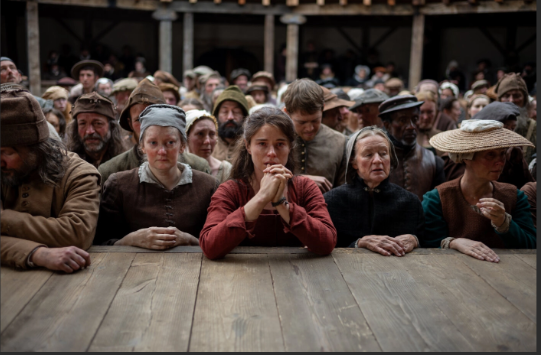
Nevertheless, Hamnet culminates in the performance of the play (Hamlet), where the ghost of the father is played by William, mourning a son who bears the same name (we are told that Hamnet an Hamlet were used interchangeably in that era).
William uses the stage as a vessel to communicate with his lost son, bridging the gap between life and death, and during these final moments of the film, Shakespeare takes the “wreckage” of his son’s death and archives it into a masterpiece that ensures the boy’s name is never forgotten.
Scholars and fans of Hamlet will absolutely love this movie, as they should, but it might also feel a little too long for the casual and broader movie going audience.