

Rating: 8/10
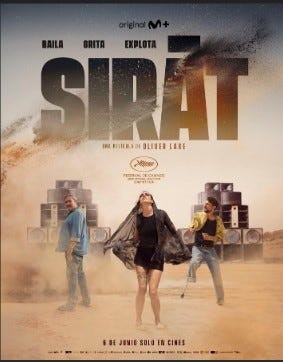
Oliver Laxe’s 2025 film Sirât drags its audience into the deep, southern reaches of the Moroccan desert and does absolutely nothing to calm the nerves of any outsider wary of the territory.
While the plot is built around one man’s desperate search for his daughter Mar, the Sahara itself quickly emerges as the real antagonist during the timeline for this film.
It isn’t malicious, though — it’s just terrifyingly indifferent, particularly to a group of Europeans who have opted to convert previous colonies in their own playground.
While neo-colonialism probably isn’t the primary theme for this movie, it does feel like the elephant that looms large for the duration of the 114-minute runtime.
Whatever the initial intentions for Sirat’s narrative, large elements of it feel like a subtle critique of neo-colonialism — specifically, Europeans using African landscapes as a backdrop for their personal “trips” (both drug-induced and spiritual) while remaining ignorant of the local history and conflicts.
At the risk of being torched at the stake myself, it does feel like there is perhaps an element of justice for how this story ends, but there is no need to belabor that point, in the face of genuine artistic brilliance from Laxe.
Speaking of which, Laxe ignores the “postcard” version of the desert in this film, opting instead for a harsh, bleached landscape where modern logic completely falls apart.
Laxe’s desert isn’t a postcard; it’s a harsh reality that demands respect. For those exploring similar terrains, whether for spiritual ‘trips’ or photography, the Merrell Moab 3 Hiking Boots provide the physical foundation needed to navigate landscapes where modern logic — and infrastructure — completely fall apart.
The sand doesn’t just hold the heat here, it also hides the lethal leftovers of forgotten wars, which turns a father’s quest into a literal tightrope walk across a minefield of both explosives and existential dread.
Sirat starts with a surreal, almost bizarre desert rave, but the narrative quickly spirals into a harrowing look at what happens when Western escapism slams into local reality.
Laxe fills the frame with a “lost tribe” of outcasts — people who traded city comforts for a techno-fueled limbo, but by the time they’re forced to navigate live mines, the movie has shifted from a missing-persons thriller into a brutal, primitive test of survival.
The ravers use trance as a shield against a crumbling world.
To achieve that level of sensory isolation, the Sennheiser Momentum 4 Headphones offer the immersive soundscape and extreme battery life necessary to maintain your own personal utopia when you’re off the grid.
At the heart of this morbid tale is Luis (Sergi Lopez), who gives us all a masterclass in bad parenting, by dragging his young son, Esteban (Bruno Núñez Arjona) into a dangerous and frankly futile mission to find Esteban’s sister.
As the plot unfolds, you’re left with more questions than answers about why the daughter is even missing, owing in part to Luis’s random decision-making.
There’s a frustrating indecisiveness to Luis that makes him hard to like, even when tragedy strikes.
His negligence in the lead-up to Esteban’s death makes it difficult to fully empathize with him, despite the devastating circumstances.
The real strength here is how the film forces you to invest in these characters emotionally, whether you feel empathy or just sheer outrage at their naivety.
You see it in Luis, who ignores every warning sign, and in the group of social outcasts convinced they can find a secondary rave by crossing terrain they know nothing about.
In that group, Bigui (Richard Bellamy) and Tonin (Tonin Janvier) carry physical scars, while Jade (Jade Oukid) and Stef (Stefania Gadda) lug around heavy psychological baggage.
They aren’t just a random group; they’re a “family of choice,” bonded by a shared sense of loss and the feeling that their biological families or societies failed them.
This reality hits home during a conversation between the ravers and Esteban.
Unlike Luis, the ravers aren’t looking for a person, they’re looking for a reason to keep breathing in a world they think is ending.
Jade and Tonin represent a community of “mutilated souls” using trance music and drugs to dodge a reality they no longer recognize — “Peter Pans” chasing a utopia that the desert eventually swallows.
By the time the final credits start rolling, it’s clear that whatever they were searching for, they are now truly lost.
In that sense, they have everything in common with Luis.
The central metaphor for this movie is the “bridge” between salvation and damnation, with the entire cast suspended over the abyss.
The final walk through 60 meters of active mines is the physical version of that bridge.
For Luis, that bridge is his grief, where he starts as a desperate father and ends as a man who has lost everything, walking into certain death just to see if he’s meant to survive.
Ultimately, all the characters in Sirât are trapped between a world that is ending — implied by radio reports of a global conflict they keep turning off — and a spiritual “other side” they can’t reach.
They choose to stay in their personal limbo rather than face the collapse of the society they were running from anyway.
So, Sirât isn’t about reaching a destination; it’s about the terrifying stillness of the crossing, where the landmines are almost secondary to the deeper tragedy, which is that these people are more comfortable in a lethal limbo than a crumbling reality.
They chose the desert because it reflected their own internal voids — a vast, beautiful, indifferent space where being “lost” isn’t a failure, but a permanent state of being.
Surviving the Moroccan abyss requires more than just grit; it requires power.
A Jackery Explorer 240 is the essential ‘bridge’ for the modern nomad, ensuring that even in a lethal limbo, you aren’t completely cut off from the society you’re running from.
Sirat is ultimately a dark movie that demands reflection, but the real skill of it is that it starts with a bang, and almost ends with a whimper, drilling home the point of just how sobering the entire journey had been.
Watch it!
As an Amazon Associate, I earn from qualifying purchases. This article contains affiliate links to products and tools mentioned in my reporting.