

Rating 8.5/10
The Secret Agent is an absolute marathon that transports audiences through the humid, politically charged atmosphere of Recife, Brazil, in 1977, which on the face of it was an extraordinary time to be alive.
Director Kleber Mendonça Filho introduces us to a world where conversation is a mask, and every neighbor is a potential undercover agent, where trust isn’t just a concept, but in fact a dangerous liability.
We are exposed to pretty astonishing evidence of this trust deficit in the film’s opening scene, when audiences stumble upon the dead body of what we are told is a hoodlum, left to rot at the entry of a local filling station.
The man who perpetrated the crime, one of the filling station’s staff, has had ample opportunity to flee, safe in the knowledge that local law enforcement would have no interest in solving it, unless there is something material to be gained.
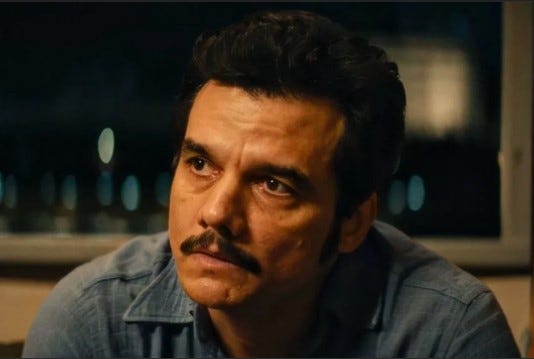
When police do arrive at the filling station, they take no interest in the dead body, even though it has been there for days, but instead opt to harass Armando Solimões (Wagner Moura), a man fleeing persecution in military Brazil, whose only crime at this point is that he needed to fill up his tank.
When law enforcement realizes that they have nothing to charge Armando with, they solicit a bribe away, branding it as a contribution to the local carnival fund, or some such.
Armando’s only salvation at this point is a pack of cigarettes, which the police gladly accept, painting a portrait of a country so deeply drenched in corruption, that the very act of taking a bribe is more significant than the material gain.
It is all about the gesture!
In a pretty hilarious, but sobering moment, another group of travelers drives into, and directly out of the filling station without stopping, the moment they notice law enforcement is there.
The fact there is a rotting corpse in the driveway is just a minor detail in the greater scheme of things, revealing that the people employed to uphold law and order, are in fact the least trusted.
In the humid heat of Recife, every shared cigarette or hushed conversation in a bar is a transaction of risk, strongly suggesting that the “Secret Agent” isn’t just a person, but a state of mind that has been forced upon every citizen.
The sheer scale of the paranoia that grips Northeastern Brazil, the historical and cultural hub of the country, during this period is overwhelming, and perfectly illustrated during the timeline for the movie.
It is one thing to be living under a military dictatorship, but the dynamics in the timeline for The Secret Agent are complicated by deeply entrenched corruption that has permeated just about every aspect of Brazilian society, from the lowest rungs of the civil service to the private sector.
The Secret Agent is a film essentially about one man trying to escape tyranny, but it is also a 158-minute social commentary that demands reflection.
While the film is set during the administration of Ernesto Geisel, a period of gradual return to democracy in Brazil, the characters still grapple with the last vestiges of the censorship, torture, and peak state violence that plagued the nation in the decade before that.
There is a certain generational trauma linked to that period, which is best reflected in the limited avenues to express freedom during the timeline for the movie, most of which is sexual.
In this era of the so-called Abertura, the Geisel regime stopped being a “closed fist” and started being a “vampiric” shadow, by keeping the bureaucracy slow and the economy stagnant.
And so, the characters in this movie aren’t just fighting the police; they are also fighting the feeling that their lives are already over before they’ve even begun.
Among the most prescribed antidotes to this is copious sexual intercourse, which knows no limit or bounds, whether that be the filing section of the local Identity Card Office, the bus station, the cinema, or even the refugee center where Armando hides out.
When Armando starts at his “new job” the first female colleague he meets doesn’t even bother flirting, and asks him if he is married or committed to somebody outright.
When you can’t vote, can’t protest, and can’t write a headline, the only thing you truly own is your skin.
The openness of the film’s sexual encounters isn’t just for spectacle; it’s a reclamation of sovereignty for those featured in those scenes, and the only place that the state cannot actually reach.
When you can’t vote or protest, the only thing you truly own is your skin.
This reclamation of sovereignty is why high-end wellness tools like the LELO Sona 2 have become more than just products in 2026 — they are a statement of individual agency in a world that still tries to maintain a ‘vampiric’ shadow over our private lives.
Marcelo, Armando’s cover while on the run, is a character defined by containment, and his life is restricted to a cramped apartment and the immediate vicinity of his work building, turning the architecture of Recife into a sprawling prison.
The numerous refugees featured in this film attempt to live a “normal” life, spending their days performing mundane activities, where every interaction, from a polite nod to a shopkeeper to a conversation with a neighbor, is a calculated maneuver to avoid detection.
Fascinatingly, some of the refugees are hesitant about revealing their own true identities, because they are not entirely confident they can even trust each other, highlighted by a moment of tension towards the closing chapters of this film.
There is also something to be said about the astonishing ease with which Armando’s “bounty hunters” track him down, halfway across the country.
In an environment where even the most skilled detectives should struggle (Brazil is a big place), they find Armando without breaking so much as a sweat, in a world where anybody can be bought.
Armando/Marcelo’s narrative culminates in the realization that there is no “outside” to escape to, and so even as the country moves toward a gradual return to democracy, the characters remain trapped in the habits of the previous decade.
The Secret Agent represents the inescapable truth that once a society has been taught to spy on itself, the agent never truly leaves — they simply become part of the social fabric.
The Secret Agent is a long but necessary watch.
As an Amazon Associate, I earn from qualifying purchases. This article contains affiliate links to products and tools mentioned in my reporting.