

 Image/Bloomberg
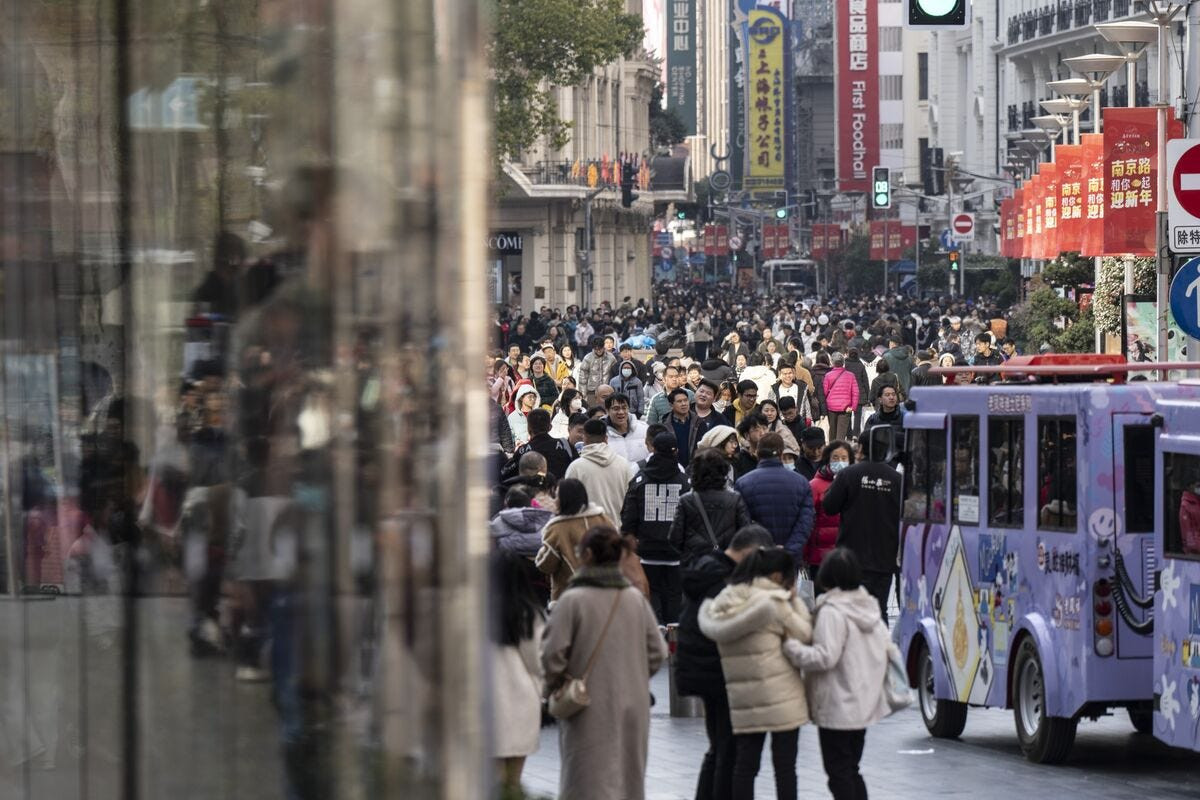
As of September 1, 2023, all employers in China are required to contribute to social insurance for their employees, covering pensions, medical care, paid maternity leave, and other benefits. While this policy appears to strengthen workers’ rights, it has triggered widespread concern. The worries stem not only from fears of worsening financial strain on individuals and companies, but also from long-standing dissatisfaction with China’s social security system.
Why now?
In explaining the timing of the nationwide enforcement of mandatory social insurance, Chinese state media have framed the policy as a safeguard of “workers’ basic rights” and a “national institutional benefit,” highlighting the inclusion of “flexible employment groups” such as food-delivery riders, ride-hailing drivers, and couriers - often described as the “final gap” in social protection. This narrative presents the policy as an act of care for vulnerable groups and a sign of social progress.
Yet fiscal and demographic realities tell a different story. One immediate reason for the current push toward universal coverage is that the pension fund is nearing a critical threshold. A 2019 actuarial report from the Chinese Academy of Social Sciences warned that, without structural reform, the Urban Employee Basic Pension Fund would be depleted by 2035. Subsequent adjustments have extended this projection to 2044, but the fundamental conclusion - unsustainability - remains unchanged.
Current data is even more alarming. According to China’s Ministry of Finance, in 2024 the national basic pension fund had revenues of approximately 6.2 trillion yuan and expenditures of 5.8 trillion yuan, showing a nominal surplus. However, after excluding government subsidies of over 2.6 trillion yuan, the fund is heavily reliant on fiscal injections. The 2025 budget report further shows that more than one-third of the reported “surplus” in the national social security fund comes from central government transfers rather than the fund’s own mechanisms.
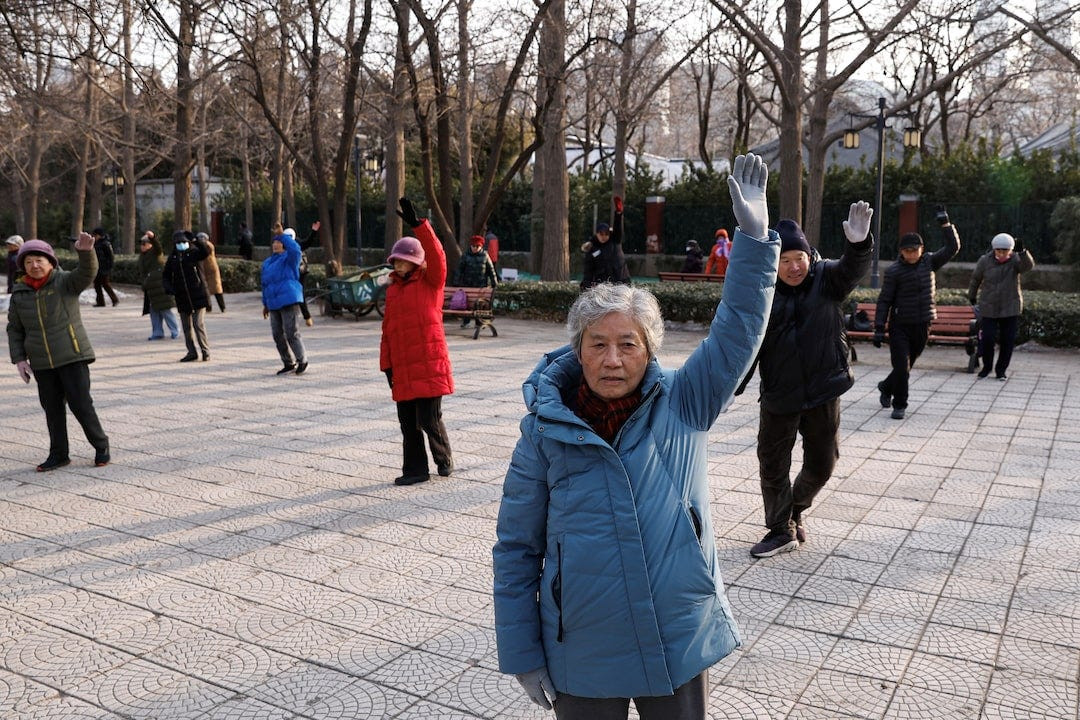
China’s demographic trajectory makes the crisis all but inevitable. Data from the National Bureau of Statistics show that in 2023, the population aged 60 and above exceeded 297 million, accounting for 21.1% of the total population; by 2035, this is projected to reach 400 million, over 30%. Meanwhile, the working-age population has declined for twelve consecutive years, with a dramatic drop of 6 million in 2022 alone. These trends are worsening the dependency ratio: currently, about 2.5 contributors support one retiree, but by 2035 this may fall below 1.3:1, far under the 1.67:1 ratio required for balanced fund operations. In practical terms, nearly every young worker would have to “support” one elderly person, placing severe strain on the system.
The operational design of the system amplifies the risk. China relies on a pay-as-you-go (PAYG) model, in which current contributions fund current benefits - an approach inherently dependent on a pyramidal population structure. Yet total fertility has fallen below 1.0, among the lowest globally. Despite multiple policy attempts to encourage second and third births, the declining birthrate persists, further shrinking the future labor force and leaving almost no buffer for pension sustainability.
Fiscal pressures compound the problem. In 2023, national public revenue growth slowed markedly, while social security expenditures continued to rise, accounting for over 16% of the budget and becoming one of its largest components. Local governments facing fiscal stress have had to borrow more or cut other public services to cover pension gaps. Reports of delayed pension payments have surfaced in provinces like Liaoning and Jilin; although authorities quickly denied these claims, public anxiety about system sustainability has intensified.
There are also “invisible” loopholes. For years, many companies - especially small- and medium-sized enterprises and platform-economy firms - have circumvented social-insurance contributions through “dual contracts.” In 2021, the Ministry of Human Resources and Social Security disclosed that among roughly 174 million gig workers nationwide, most were not genuinely contributing to social insurance. In other words, a large pool of potential contributors has not entered the fund, yet they may still claim pension benefits in the future, further exacerbating the deficit.
In sum, while official messaging stresses fairness and rights protection, the true motive behind the policy is to postpone the pension fund’s depletion. Given demographic imbalance, strained local finances, and widening regional disparities, the fund is far more fragile than many realize. Put bluntly: universal contributions are less about improving individual benefits than about keeping the system itself afloat for a few more years.
 Image/NYT
The concerns
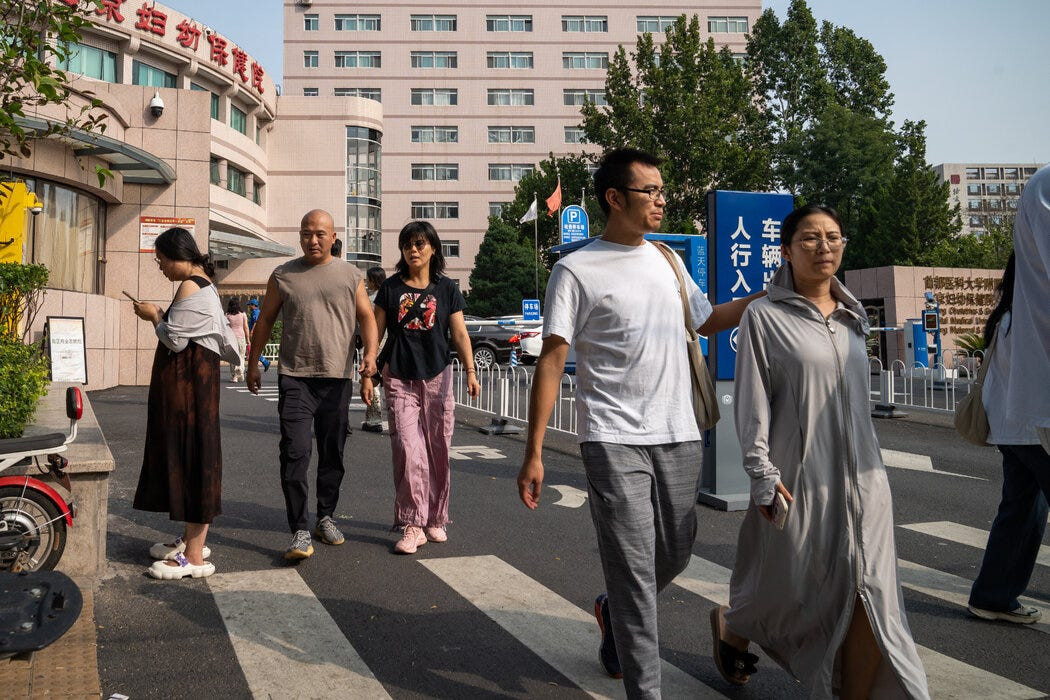
The nationwide implementation of mandatory social insurance has sparked widespread social anxiety, rooted in the dual pressures of the current economic environment and individual financial circumstances.
For enterprises, the new obligations significantly increase operating costs. Under current regulations, employers must contribute about 20% of wages for pension insurance, around 10% for medical insurance, and also cover unemployment, work-injury, and maternity insurance - bringing the total social-insurance burden to around 30% or more. In a slowing economy with declining market demand and tighter financing conditions, many small- and medium-sized enterprises (SMEs) are already operating on razor-thin margins. According to domestic media reports, some manufacturing firms report profit margins below 3%, while social-insurance contributions may exceed one-quarter of total payroll, directly squeezing their survival space. Some business owners have candidly noted: “Our profits are lower than the contributions; hiring staff has become a losing proposition.”
For individual workers, contributions also represent a substantial financial burden. Ministry of Human Resources and Social Security data indicate that urban employees must contribute 8% of their wages for pensions and an additional 2% for medical insurance. With average wage growth lagging behind rising living costs - housing, education, healthcare - many perceive this expenditure as an added strain. Young people are particularly affected, facing high unemployment and low wages. In 2024, the urban youth unemployment rate briefly surpassed 20%, and even employed individuals often earn less than 5,000 yuan per month; after social-insurance and income-tax deductions, take-home pay is even lower. Many worry: “I’m paying now but may not benefit in the future - it’s uncertain whether I’ll even receive a pension.”
The situation is particularly acute for gig-economy workers. Delivery riders, ride-hailing drivers, and couriers—previously able to maintain higher take-home pay by paying little or nothing into social insurance—are now required under the new policy to enroll in the system. Monthly contributions can range from several hundred to over a thousand yuan, putting direct pressure on already precarious livelihoods. This has fueled heated online debates about whether to contribute, with some fearing they may be forced out of the industry entirely.
Mandatory social insurance also exacerbates labor-market pressures. To offset costs, some companies may reduce hiring or rely more heavily on temporary labor, shrinking job opportunities. Analysts note that, in the short term, universal contributions may create a “perverse incentive”: higher employment costs could discourage firms from expanding their workforce.
Consequently, both enterprises and individuals face the same fundamental question: in a weak economy with generally low incomes, why assume greater obligations - especially when the sustainability of the social-insurance system itself is in doubt? Contributions today offer no guaranteed future security but immediately diminish economic capacity - a contradiction of “short-term pain with no long-term solution” that lies at the heart of public anxiety over universal social insurance.
Read more @ Sinosage.substack.com
Enduring inequality
Although the government presents mandatory contributions as a pathway to fairness and universal coverage, structural inequalities within the system remain its central contradiction. The long-standing “dual-track” pension system exemplifies this: before reform, employees in government and public institutions did not pay pension contributions, receiving pensions directly from state finances, while ordinary enterprise employees had to contribute individually and received far lower benefits. Even after nominal unification, arrangements such as “deemed contribution years” allowed public-sector workers to retain high benefits, institutionalizing inequality.
The disparities are most evident in pension amounts. According to the Ministry of Human Resources and Social Security, in 2024 the national average monthly pension for enterprise employees was about 4,000 yuan, whereas the starting level for rural residents’ basic pension was only 123 yuan (most rural retirees received 200–300 yuan per month, even with partial subsidies). In some underdeveloped regions, a rural retiree’s monthly pension barely covers a single day of living expenses in a first-tier city. Retirees in Beijing and Shanghai receive averages of 5,900 yuan and 5,600 yuan per month, nearly three times that of central and western regions.
The gap between public- and private-sector employees remains contentious. Before the 2014 unification, civil servants and public-institution staff paid low personal contribution rates yet typically received pensions exceeding 8,000 yuan, while many private-sector employees, even after 30 years of contributions, retired with only 2,000–3,000 yuan. Although new entrants post-reform now contribute like enterprise employees, historical accumulation allows earlier public-sector staff to enjoy a “benefit dividend.” As one commentary noted: “Unification is only nominal; privileges persist in practice.”
Concrete examples underscore this inequality: a rural retiree in Henan received only 128 yuan per month, prompting online jokes that “it doesn’t even cover a month’s medicine,” whereas a retired deputy department-level official in Jiangsu collected over 10,000 yuan per month, with almost all medical expenses reimbursed. Regional disparities and historical underpayment reinforce systemic inequities. Pension funds are managed at the provincial level, meaning aging populations and fiscal constraints in northeastern and central-western provinces depend on subsidies to maintain payouts, while economically developed regions enjoy higher, incrementally rising pensions. In 2023, the average pension in Liaoning was under 2,800 yuan, compared with over 5,600 yuan in Shanghai. The same contributions thus yield vastly different retirement incomes depending on location.
Furthermore, pension accounts with no real reserves — combined with retroactive payment requirements — have fueled public resentment. Some local governments and institutions that previously under-contributed to social insurance now require employees or flexible workers to make back payments - often amounting to tens or even hundreds of thousands of yuan - without guaranteeing proportional pension benefits. Regional segmentation further entrenches institutional barriers: rural migrants and interprovincial workers may experience coverage gaps upon returning home, and cross-province medical reimbursements remain highly cumbersome. A system meant to support citizen mobility instead functions as a “wall” restricting it.
Waste and privilege within the healthcare system also inflame public sentiment. High-level hospital wards report daily expenditures of tens of thousands of yuan, fully reimbursed by insurance or public funds, while ordinary employees face high out-of-pocket costs and hesitate to seek care. Pension systems display similar “reverse subsidies”: higher-income groups receive larger pensions and better public resources, while lower-income contributors pay more yet receive far less. As one commentary summarized: “The money ordinary workers pay ends up subsidizing the extravagant consumption of a privileged few.”
These inequalities have eroded trust among younger generations. They feel “unable to see the future,” distrust the value of contributions, and in some cases simply opt out of the system. Official warnings - such as emphasizing that “failure to contribute will cancel all benefits” - aim to compel compliance, but this threat-based approach may backfire, pushing those barely participating to abandon contributions altogether.
 Image/Reuters
Shifting narratives, growing distrust
The Chinese government’s shifting rhetoric on pension mechanisms has further deepened public distrust in the social-security system. For decades, official narratives emphasized “state-provided retirement,” creating a clear promise: as long as individuals worked diligently and paid contributions on time, their life in old age would be secured by the state. In recent years, however, policy documents and mainstream media have increasingly stressed “personal responsibility” and “family support,” signaling a shift from “the state provides” to “save yourself, rely on your children.” This rhetorical change has unsettled many, as the long-standing institutional guarantee they relied upon now appears to be quietly disappearing.
The crisis of trust stems not only from this shift in discourse and systemic inequality but also from corruption, waste, and institutional abuse. Pension and medical-insurance funds, which should constitute the most critical social safety net, have repeatedly been exposed to “leakage and misappropriation.” In 2018, the National Audit Office reported on audits across 31 provinces, uncovering misappropriated funds totaling 220 billion yuan - some diverted to real-estate projects and local financing platforms, with certain regions even operating unfunded accounts. At the local level, some officials have used pension funds to fill fiscal gaps, causing severe deficits in fund accounts.
Even more concerning is the lack of transparency in fund management. The public has little insight into how these funds are actually managed and limited ability to oversee their use. Whenever rumors emerge that “pensions may not be paid,” the government quickly issues clarifications, but such reassurances fail to alleviate widespread skepticism. As a result, even repeated official assurances that pensions “will never fail to be paid” do not restore mainstream public trust.
The combination of institutional inequality and fund mismanagement creates a vicious cycle: as trust diminishes, people are more likely to underpay or evade contributions. The resulting shortfall exacerbates fund deficits, prompting the government to impose stricter collection measures. Far from enhancing a sense of security, this dynamic reinforces fears that “money paid in may never be received.”
In other words, China’s pension challenge is not merely an economic or demographic problem - it is a profound crisis of institutional trust.
A ticking time bomb
The crisis of China’s social-security system arises from both the inevitable pressures of demographic shifts and fiscal constraints, and the compounded effects of unequal institutional design, mismanaged funds, and deficits in political trust. Consequently, this challenge is likely to remain one of the deepest societal tensions in China for decades to come.
From a technical perspective, measures such as delaying retirement, raising contribution rates, and developing corporate or commercial pension schemes may postpone the exhaustion of the funds. Yet all these measures inevitably touch sensitive vested interests, while the core issue - rebuilding institutional trust between fairness and efficiency - remains largely untouched.
From a social perspective, the vast disparities in pension benefits, overconsumption on the part of privileged groups, and meager returns for ordinary workers have generated widespread resentment. This not only suppresses labor incentives but also perpetuates a vicious institutional cycle.
From a political perspective, as fiscal pressure intensifies and new cases of privilege, corruption, and abuse come to light, public confidence in the system is likely to erode further. At that stage, the government will confront not only widening fiscal deficits, but also an escalating crisis of legitimacy.
In short, pensions are not merely figures on a balance sheet - they represent a ticking time bomb embedded within China’s social and political order. Whether it can be defused, or whether it will eventually detonate, will determine not just the fate of hundreds of millions of retirees, but also the long-term stability of Chinese society.
If you like our work, please consider subscribing or buying us a coffee. Thank you!
Read more @ Sinosage.substack.com