
 Image/CSIS
In mainland China, it is extremely rare to see protests that are explicitly anti-CCP, anti-Xi Jinping, or against the existing political system. Recent developments, however, suggest that the number of such protests is increasing.
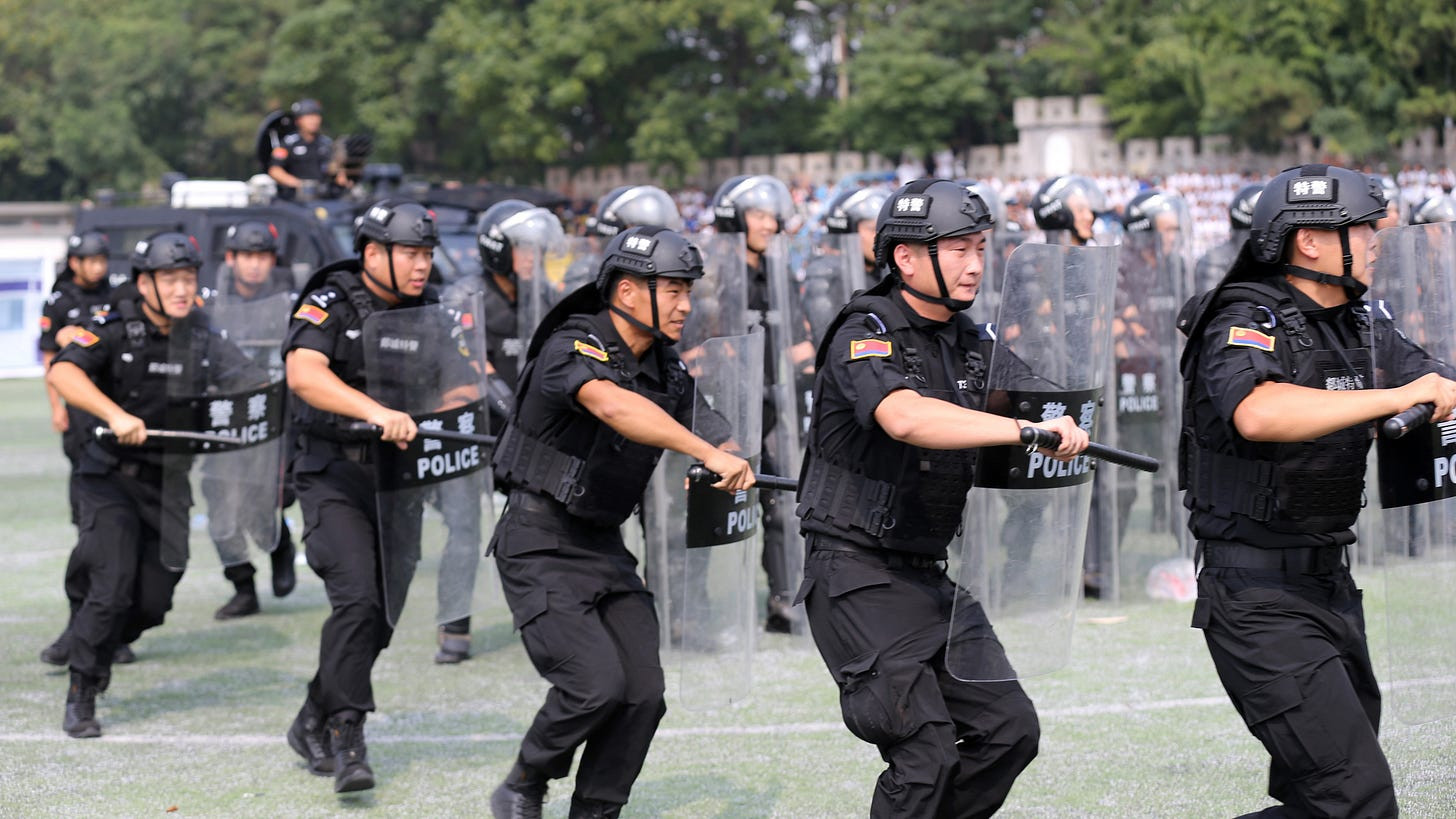
Representative cases have occurred recently in Jiangyou City, Sichuan Province, and in the city of Chongqing. In the first case, a campus bullying incident, compounded by a series of improper responses from the school and local government, ultimately escalated into a large-scale protest by local residents. This led to direct violent clashes with local law enforcement. A large number of police and armed police carried out almost indiscriminate beatings and arrests. Those affected included minors and elderly people who were observing or trying to assist others. While protests of this kind are not uncommon in China, it is extremely rare for participants to chant slogans such as “Return our democracy.”
By contrast, the protest in Chongqing was extraordinarily rare because it directly challenged the legitimacy of the Chinese Communist Party. When enormous banners calling for the overthrow of the CCP and the recovery of freedoms and rights were projected onto building walls in Chongqing University Town at night, many people were shocked. These two seemingly unrelated events point to a common underlying issue — the undemocratic political system.
Statistics from the Chinese Data Monitoring (CDM) project show that since its launch in 2022, the number of recorded protest events in mainland China has risen rapidly. In the first half of 2025, nearly 3,000 protest events were recorded, representing an increase of almost 75% compared with the same period in 2024. Labor protests remain the most common type, rising by 67%, while housing-related protests — primarily initiated by unpaid construction workers, contractors, or homebuyers whose projects were unfinished — have doubled. These numbers are almost certainly underreported, as many incidents are censored before researchers can track them.
Most protests are not driven by political motives, but they can take on a political character when met with violent suppression. Among protests recorded by CDM and other observers, the number of events with direct political objectives is also increasing. Although such cases remain extremely rare, their high risk and significant political implications deserve attention.
Read more @ Sinosage.substack.com
Before the Sitong Bridge incident, politically-oriented protests had only been recorded during the 2011 Jasmine Revolution period, when a very small number of Chinese citizens called for an end to one-party rule. Similar grassroots political protests almost completely disappeared from public view afterward. It was not until October 13, 2022, that a large banner demanding the removal of Xi Jinping and the implementation of democratic elections appeared on Sitong Bridge in Beijing’s Haidian District. Later that November, influenced by the Sitong Bridge incident and triggered by the Urumqi fire in Xinjiang, widespread anti-lockdown protests — the ‘White Paper Revolution’ — erupted across China. Within a week, these protests spread to at least 21 provinces, dozens of cities, and nearly 100 universities. Participants directly called for Xi Jinping to step down, for an end to one-party dictatorship, and for the implementation of democracy. At the same time, similar protests appeared among Chinese communities worldwide.
In February 2023, a similar protest appeared in Jinan, the provincial capital of Shandong, where large banners reading “Down with the Communist Party, Down with Xi Jinping” were projected remotely onto the exterior walls of the Wanda Plaza shopping district for the first time. In 2024, similar large banners demanding freedom, democracy, and voting rights, and calling for Xi Jinping’s removal, appeared on a pedestrian bridge in Xinhua County, Hunan. In April 2025, three large banners appeared on a pedestrian bridge outside a bus station in Chengdu, Sichuan, calling for political reform, an end to unchecked one-party rule, and democracy.
Alongside these visually striking protests, sporadic, small-scale political slogans have appeared in multiple cities, such as “The CCP ≠ China,” “The CCP is a descendant of Marx and Lenin; the Chinese are descendants of Yan and Huang,” “The CCP is a cult,” and “Xi Jinping step down.” Displaying these messages publicly carries extremely high risks for oneself and for family and friends, so they are often found in remote corners of streets or inside restroom walls.
The Chinese government has continuously promoted “grassroots governance,” aiming to confine conflicts to the local level, whether by addressing grievances or silencing complainants. The Party prefers to prevent incremental dissent from erupting and to quickly erase all evidence. However, worsening economic conditions have led to increasingly broad and intense dissatisfaction among the Chinese population with the Communist Party government. Rigid, authoritarian governance is becoming harder to manage in a highly digitized society.
Most importantly, a notable feature of these growing protests is that they are driven not by social elites but by ordinary Chinese people responding to their own experiences. Although it is still difficult to determine whether this represents a new trend in China’s political landscape, the potentially significant implications deserve more careful attention.
If you like our work, please consider subscribing or buying us a coffee. Thank you!
Read more @ Sinosage.substack.com