
 Image/ABCNews
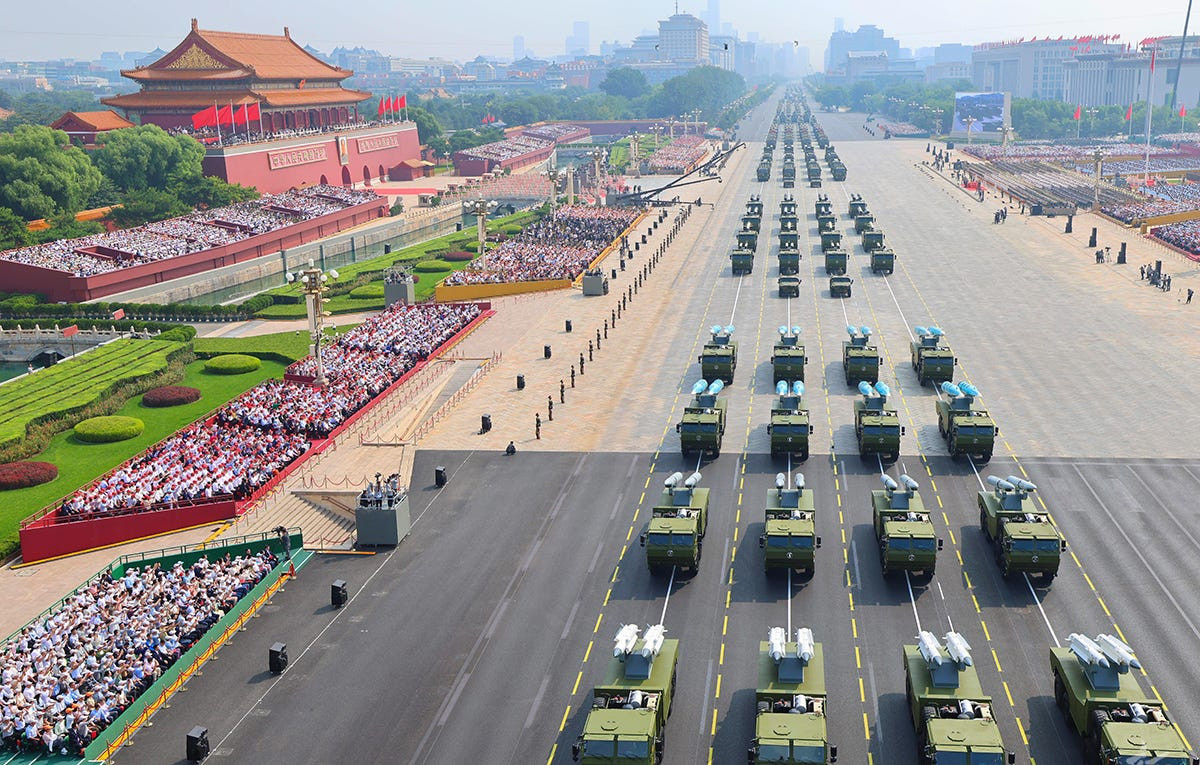
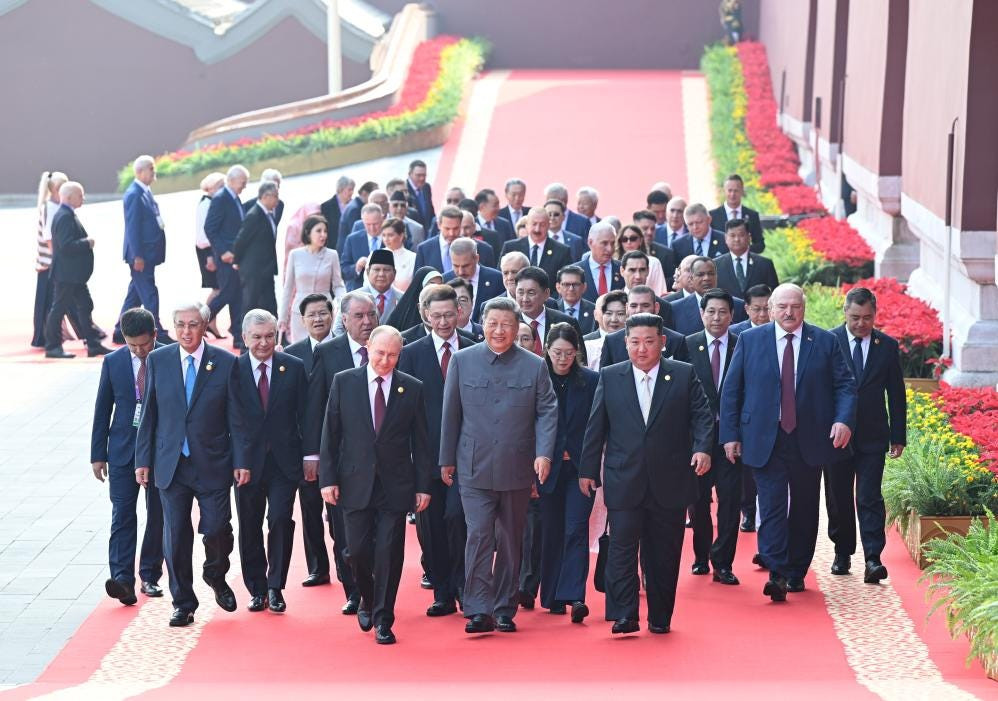
On September 3, when Xi Jinping stood alongside Vladimir Putin and Kim Jong-un on the Tiananmen Gate in Beijing, a new international order seemed to be taking shape. Centered on China and supported by military power, this order seeks to challenge the Western-dominated system, relying on highly centralized authority and a unified ideology. This was not merely a military parade, but a carefully orchestrated political and geostrategic performance.
Yet just days before this spectacle, the night sky over Chongqing displayed a very different signal. Slogans opposing Communist Party rule were projected onto building walls, and ordinary internet users who questioned the parade were blocked or detained. The contrast between the grand spectacle and these rare acts of dissent was stark: on one side, the Party meticulously cultivates the illusion of strength, unity, and security; on the other, vulnerabilities, unease, and resistance remain hidden under high pressure.
This represents the fundamental contradiction in contemporary China—the sharp tension between illusion and reality. The Party seeks to present itself through grandiose displays as an unshakable ruling power and to project confidence on the global stage; yet reality continually exposes crises in legitimacy and sustainability. When the underlying social foundation cannot fully support the narrative, the illusion itself becomes unsustainable.
Security vs Insecurity
To ensure that the September 3 parade proceeded without incident, the Chinese authorities implemented a near “wartime” security system. This was not limited to Beijing, but extended nationwide, forming a comprehensive, fully mobilized security operation. Beijing was thoroughly transformed into a vast “control zone,” while high-pressure measures were simultaneously applied across the country.
In the capital, areas around Tiananmen were strictly controlled or even sealed off. Office buildings, shopping centers, and tourist sites were forced to close, and residents were instructed not to step onto their balconies, even just to watch. Entrances to overpasses and interchanges were guarded 24 hours a day to prevent banners or unexpected incidents. Security checkpoints were set up on major roads, subway entrances, community streets, and even sidewalks, requiring pedestrians and vehicles to pass through multiple layers of inspection, including ID verification, belongings scanning, and random vehicle or bag checks. These checkpoints were typically staffed by a combination of armed police, public security, and volunteer informants, forming a tightly sealed security network. Airspace was strictly restricted, banning drones, kites, and even pigeons, leaving the entire capital seemingly enclosed under an invisible glass dome.
At the same time, information and thought control was fully implemented. Internet censorship reached an extreme: any social media posts questioning the parade were quickly deleted. In some cases, even ordinary individuals expressing criticism in private WeChat groups were visited by local police and detained under charges of “picking quarrels and provoking trouble.” Every fluctuation in cyberspace was treated as a potential “security threat.”
Preventive measures against dissenters and human rights groups were equally extensive. Many active human rights lawyers, petitioners, and activists were forcibly sent on “trips” or placed under house arrest in the days leading up to the parade to prevent them from accessing media or causing disruptions. On Beijing’s streets and in neighborhoods, hundreds of thousands of volunteer informants were mobilized to form a dense grassroots surveillance network.
This overwhelming security apparatus was intended to create an atmosphere of “absolute safety.” Yet the extreme and pervasive measures used to construct this “security” ironically serve as the clearest demonstration of insecurity.
Read more @ Sinosage.substack.com
Unity vs Dissent
On the grand stage of the parade, Xi Jinping stood at the center of the Tiananmen Gate, symbolizing the Party-state’s “core” position. The message was clear: the CCP is China, and China is inseparable under Party rule. Yet beneath this surface of unity, emerging dissent reveals fractures in the image.
In China, protests directly targeting CCP rule are extremely rare, which makes them all the more striking. The banner on the Sitong Bridge in 2022, public actions in Jinan and Hunan in 2024, and the projections in the skies over Chengdu and Chongqing in 2025 all demonstrate sporadic but notable acts of resistance. More recently, graffiti and stickers proclaiming “CCP ≠ China” have appeared in Langfang, Shenyang, Dalian, and elsewhere, forming a spreading symbolic presence. Although these actions are scattered, they collectively signal that challenges to the CCP’s governing legitimacy are beginning to break through the silence.
This challenge comes not only from street-level actions but also from elites and intellectuals expressing criticism publicly. Letters of critique by Tian Qizhuang, joint statements from Party elders, articles by Zhang Yingjie, and a series of anonymous manuscripts all identify systemic failures: authoritarian structures, personality cults, and economic decline. These writings, originating both inside and outside the system, provide a more systematic critique than graffiti or projections, revealing dissatisfaction among the CCP elite and the broader intellectual class.
Ironically, the military, which the CCP seeks to portray as its “most loyal and reliable” pillar, also shows signs of fracture. In recent years, Xi has repeatedly purged senior officers in the Rocket Force, Strategic Support Force, and even the Central Military Commission under the guise of anti-corruption campaigns. These frequent personnel upheavals not only expose serious corruption and power struggles within the military, but also indicate the top leadership’s lack of trust in its loyalty. When a regime must rely on purges to maintain military allegiance, its so-called “unity” is inherently unstable.
Unlike previous protests that focused on individual rights, social justice, or local policies, this wave of dissent strikes more directly and dangerously: it no longer merely demands improvements, but challenges the legitimacy of the ruling authority itself.
Strong vs Fragile
Undoubtedly, one of the central messages the Beijing parade aimed to convey was the strength of the Chinese state. For domestic audiences, it reinforced the narrative of the CCP as the driver of an “unstoppable rising power”; for international observers, it signaled China’s intention to compete with and potentially surpass the West. However, the narrative of national strength is built on an economic, technological, and social foundation that is widely questioned.
In the technological domain, China emphasizes achievements in 5G, electric vehicles, artificial intelligence, and high-speed rail as evidence of independent innovation. Yet many of these accomplishments reflect adaptation, expansion, and branding rather than genuine independent innovation. For example, in semiconductors, China can produce older-generation chips but remains dependent on Dutch lithography machines, American design software, and Japanese materials for advanced processes. In aviation, while the C919 passenger plane is promoted as “domestic,” its critical technologies and components—such as engines and avionics—come almost entirely from Western companies. In software ecosystems, China has yet to develop globally competitive alternatives to Windows, Android, or iOS. Even the high-speed rail, often a source of national pride, relies on core technologies sourced from joint ventures with Siemens (Germany), Kawasaki (Japan), and Alstom (France); China has achieved rapid development through accelerated absorption and scale, but signal systems, braking, and key components remain dependent on imports. The CCP is skilled at framing foreign dependence as “self-reliance,” but any Western sanctions or supply chain restrictions could abruptly halt progress.
Economically, China remains the world’s second-largest economy and a global manufacturing hub, but its growth engine is slowing. Unemployment has repeatedly hit record highs; the real estate sector, once a driver of prosperity, faces widespread debt issues that could lead to collapse, already severely impacting banks and local governments. As Party control over private enterprises tightens, innovation is suppressed, and companies must prioritize political loyalty over market competitiveness. Widespread middle-class discontent, massive capital outflows, emigration, and a very low birth rate further compound the challenges.
All of this demonstrates that the CCP’s narrative of a strong nation rests on a fragile economic, technological, and social foundation.
 Image/PMN
Illusion and Reality
As a representative form of political performance, military parades have never been merely a display of military power; they are also a symbol of the regime’s legitimacy and international status. The National Day parade in 1984, during the early period of reform and opening-up, coincided with a society generally filled with hope and confidence. At that time, the parade was seen as the starting point of national rejuvenation, a marker of the country emerging from the ruins of the Cultural Revolution and reintegrating into the world. Public demands and expectations largely aligned with the Party-state narrative, and the grandeur of the parade reflected, to some extent, the collective psyche and societal aspirations for the future.
However, the meaning of the 2025 parade has fundamentally changed. It no longer represents the future or hope, but has become a carefully curated political performance. Domestically, the authority and military power it displays are already detached from the reality experienced by the Chinese public and society; on the international stage, China’s “success and confidence” projected by the parade more often signals the significant threat and challenge that authoritarianism poses to the world.
The contrast between illusion and reality is particularly striking here. On one hand, there is the grand spectacle created by the Party, demonstrating confidence and immovability to the outside world; on the other hand, the Party must deploy stringent security measures to suppress dissenting voices and conceal systemic vulnerabilities.
Ultimately, this internal contradiction is a true reflection of the Chinese Communist Party’s power—both strong and fragile—and the media-captured dialogue about achieving immortality perfectly illustrates the blurred boundary between illusion and reality in the pursuit of power. Most importantly, this internal tension not only affects the CCP’s domestic stability but also determines how far it can advance in reshaping the international order.
If you like our work, please consider subscribing or buying us a coffee. Thank you!
Read more @ Sinosage.substack.com