

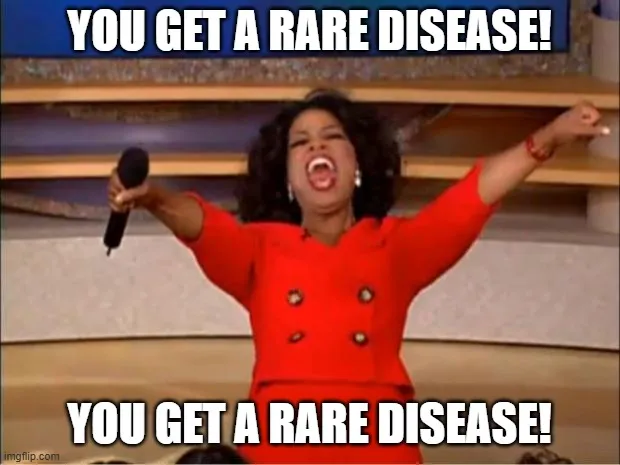
I joke, because…what else can you do? I’m not going to lay down and die, so I laugh.
It’s rare disease day and, all jokes aside, I appreciate the attempt to spread awareness. It’s nice when you mention your disease and people don’t look at you like you have lobsters crawling out of your ears, so awareness is a good thing.
My main diagnosis is Ehlers-Danlos Syndrome (EDS), which is still classified as a rare disease, although this may change down the road once it is not as underdiagnosed as it is now. On average, EDS affects approximately 1 in 5000 people, although this number varies by type.
I have a few other diagnoses that qualify as well, but EDS is my main nemesis.
In honor of the day, and in honor of me being a badass survivor (along with all of the others who fight this every day), here’s a snippet from my book telling just a little of how it all started.
Thank you for seeing us. We don’t need special treatment, or even sympathy. Just a little understating goes a long way.
It started with vertigo. I bent down to pick up my low-to-the-floor dust mop of a Pekingese dog, and when I stood back up, the room spun like I was a teenager again after a fun Friday night. This wasn’t fun, though. It was alarming. I’d never had vertigo before, and if you’ve ever had it, you know that it’s an uncomfortable and frightening symptom.
Over the next few nights, I realized that the vertigo was following me to bed. Every time I’d roll over, the whole room would roll right along with me. Despite having some health anxiety at the time, I still wasn’t terribly alarmed yet.
We had a vacation coming up, though, so I went to Urgent Care to have them check my ears before I went out of town, just to make sure an ear infection wasn’t brewing. When I got there, they told me I should go to the emergency room because they couldn’t rule out a stroke at their facility. That seemed unlikely, even to a worrier like me, but I drove straight there, just to be safe. At the ER, they ran a CT scan and a few other tests, took all my money, and sent me home.
My symptoms started to spread on vacation. The vertigo didn’t get worse, but it also didn’t improve. I also started to get paresthesia, which is a fancy term for abnormal sensations like tingling, numbness, burning or prickling. For me, it was mainly on the left side of my head and face, which did not help my ever-increasing fear of a stroke. The best way to describe what I was feeling was like getting a chill that never resolves itself into that final “brrrr” moment as it disappears. It felt like some type of alien creepy-crawly movement under my skin.
After we got home, things got worse. Since most of the odd sensations (which were now becoming painful) congregated in my upper left side; head, shoulder, back, jaw, and arm, I started to worry about a cardiac issue being to blame.
I spent the next year desperately searching for answers. At one point an ER doctor was concerned enough to keep me overnight and run even more tests, all of which showed nothing. I saw doctor after doctor, most of whom were less than helpful (we’ll talk about that more later in this book), until finally someone recommended I see a Neurologist.
At that point, I was so tired of being sick and scared that I half-heartedly printed out a list of five doctors who took my insurance and started down the list. One of them had an opening in less than two weeks, which felt like a miracle. I didn’t even look up reviews. I couldn’t bring myself to care. I was exhausted. I just set the appointment and expected it to produce more of nothing.
I got lucky, though, because that neurologist was the first doctor to really help me, and he is still part of my medical team to this day. He walked into the room in his polo, jeans and Converse and I was immediately put at ease. His easy demeanor and earnest questions were like nothing I’d experienced up to that point, and even my husband noticed how different this doctor was.
After questions were asked and answered, he set me up for an MRI and told me in no uncertain terms that I was not to Google my symptoms. Anyone else I would have ignored, but Dr. Walker could have told me to hang upside down and sing the Star Spangled Banner and I would have done it. It just felt so good to feel cared for.
We went back for my follow up and learned the MRI showed no sign of a tumor. Dr. Walker confessed that this had been his main concern, and that was why he didn’t want me Googling. He started me on a protocol of injections in the back of my neck over the next few months and never got mad when I swore like a sailor while he was sticking me.
The injections didn’t really help, and shortly after we discontinued them, he told me, “I think in a few months we’ll be calling this fibromyalgia.” You could see the frustration on his face, because anyone with fibro knows it’s a diagnosis of exclusion. It simply means you have a certain constellation of symptoms (mainly unexplained pain, but many other things are possible as well) and everything else has been ruled out. They are still trying to figure out what fibro actually is. Some say it’s autoimmune, some say it’s dysautonomia. We’re still learning. Regardless, it’s a hollow diagnosis that simply means you will probably be managing these symptoms forever. As Dr. Walker said, “It means that many days you will wake up and feel like you got hit by a truck for absolutely no reason.”
It was nice to have a name, and it was nice to stop feeling like I was inventing all of these symptoms, but that relief was tainted with hopelessness and fear of what would come next.
That first diagnosis was in 2017. I’ll be honest and tell you that I’ve been suffering ever since.
But I’ve also been learning. I’ve been learning ways to manage the multiple conditions I’ve been diagnosed with. I’ve been learning about self-care and self-compassion. I’ve been learning to deal with other people’s opinions. I’ve been learning about the medical establishment and how to navigate it and advocate for myself. I’ve been learning to overcome my fear and be at peace with my reality. Mostly, I’ve been learning how to be this new me without losing my old self.
From: Gentle Hugs: A Compassionate Guide to Living with Chronic Pain and Illness by Shelly Aronson