

How to think like the market instead of reacting to it.
🧩 Introduction
Every chart reflects two auctions running side by side:
The external market auction of price and participation.
The internal mental auction inside each trader’s mind.
Both search for value.
Both balance and rebalance with time.
The difference is that the market operates on logic, while the individual often reacts on emotion.
Understanding this conflict is key to trading maturity.
"The market never loses emotional control. Traders do."
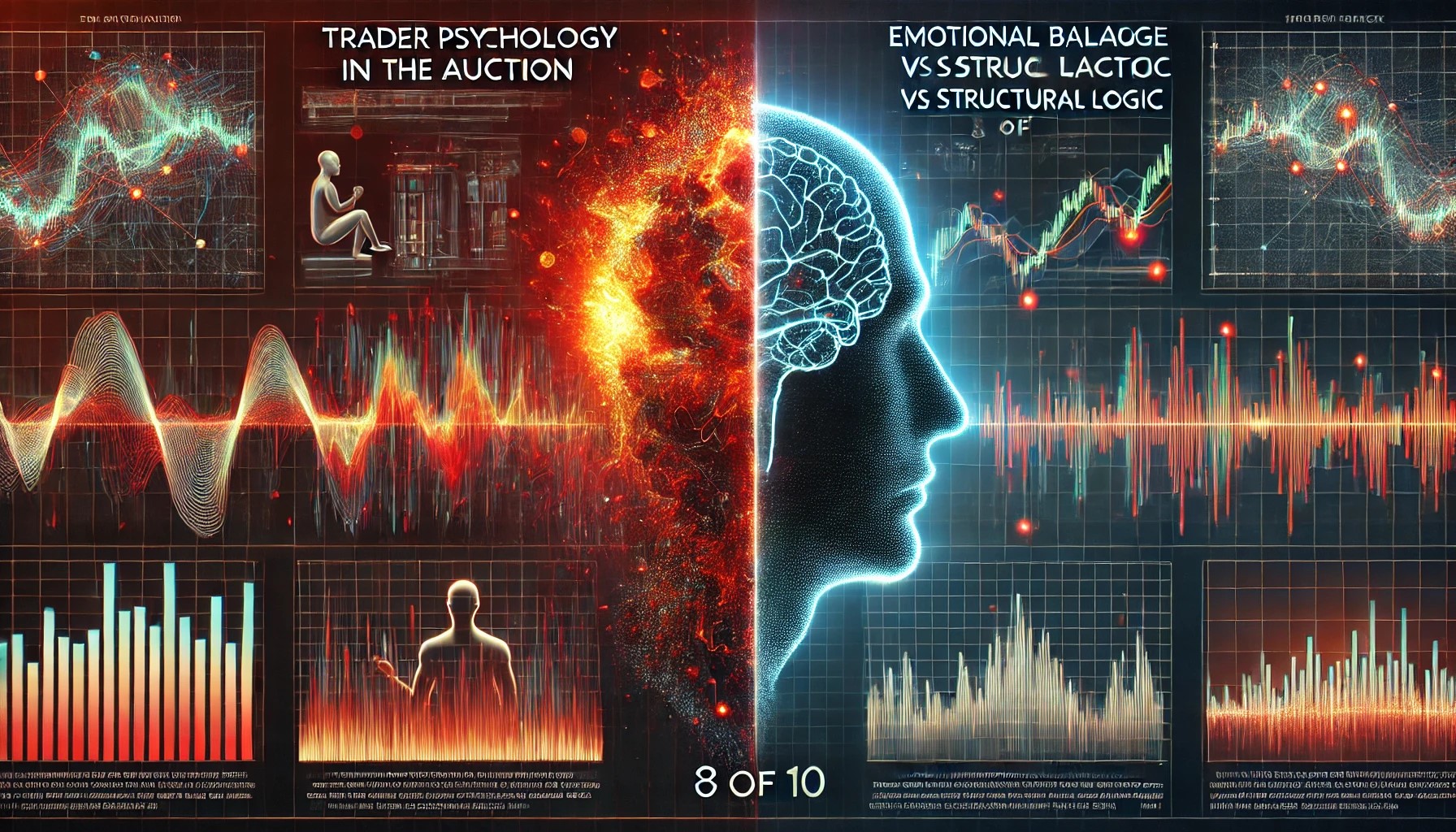
⚙️ The Psychology of Balance and Imbalance
In Auction Market Theory (AMT), price alternates between balance and imbalance.
Emotion follows the same pattern.
During balance, traders feel safe.
During imbalance, fear and euphoria dominate.
The auction’s strength is its neutrality - it accepts, rejects, and adjusts.
A trader’s weakness is attachment - wanting control over what is uncertain.
Your goal is to mirror the auction’s logic, not the crowd’s emotion.
📊 Emotional Signatures in Market Structure
Certain behaviors repeat across traders in every phase:
Market Phase Trader Emotion Typical Mistake Balance Boredom, impatience Forcing trades inside equilibrium Imbalance Fear of missing out Chasing breakouts too late Transition Confusion Trading noise before confirmation Reversion Frustration Fighting the new direction
Recognizing these emotional cycles prevents you from becoming part of the liquidity the market feeds on.
🏛️ Logic of the Auction vs Logic of the Trader
The auction follows clear logic:
Discover fair value
Balance around it
Expand when acceptance fails
The emotional trader follows reactive logic:
Seek reward
Avoid pain
Chase movement
Where the auction adapts, the trader often resists.
Professional development is about replacing reaction with structure.
🔄 Balancing Emotion with Structure
You can’t eliminate emotion.
But you can structure your actions so emotion can’t dictate them.
Define Context Before the Trade
Know if you are in balance, imbalance, or transition.
Decide tactics before volatility rises.
Use Data for Validation
Value migration, delta, or volume clusters confirm logic.
Replace “I feel” with “the auction shows.”
Accept Variability
Losing trades are structural feedback, not emotional failure.
Every auction rebalances. So can you.
"You trade your beliefs about structure, not your feelings about outcome."
🧭 The Crowd’s Emotional Imbalance
Crowd behavior mirrors imbalance phases:
At highs, optimism turns to excess.
At lows, pessimism turns to despair.
Both extremes mark the emotional edges of the auction.
Professionals recognize these as opportunities - unfair prices created by emotional imbalance.
Trading opposite the crowd doesn’t mean being contrarian for its own sake.
It means trading where emotion breaks structure.
💡 Emotional Awareness Framework
Use this quick framework before each session:
Identify Market Phase: Balance, imbalance, or transition?
Identify Your State: Calm, reactive, confident, or anxious?
Align Them: Trade only when both market and mindset are balanced.
When your internal state mirrors the structure, decision quality rises automatically.
📈 Example - Emotional Imbalance in Action
Imagine the market has been rotating calmly for hours. Suddenly, price breaks upward.
The crowd sees breakout and chases.
Professionals wait to see if value follows.
When price fails and returns to balance, the crowd panics.
Professionals fade the failed discovery with logic.
Same chart, two perspectives.
The difference isn’t analysis - it’s psychological structure.
⚖️ Discipline as Structural Alignment
Discipline isn’t about restriction.
It’s about synchronization with the auction’s logic.
The auction follows rules - discover, balance, expand.
The disciplined trader follows process - plan, execute, review.
When both move together, trading becomes a reflection of structure, not emotion.
💬 Final Thoughts
Markets don’t reward emotional strength - they reward structural awareness.
Understanding the psychology of balance and imbalance allows you to remain objective while others react.
The professional mindset isn’t emotionless.
It’s balanced - just like the auction itself.
"Emotional balance creates structural clarity. Without it, every tick feels personal."
🌐 About This Series
This article is part of the SharpWick Auction Market Theory Series, dedicated to building both technical and psychological structure for professional trading.
👉 Next in the series (9 of 10): “Advanced AMT Concepts - Single Prints, Excess, and Value Gaps.”
💡 Support This Work
If this series helps you strengthen both structure and mindset, consider supporting continued SharpWick research:
☕ Support SharpWick on Buy Me a Coffee
Your support allows SharpWick to remain fully independent - producing depth, not noise.
Every contribution builds balance - between logic and emotion.
SharpWick - Tools. Logic. Precision.
🚨 Risk Disclosures
⚠️ Risk Disclosure
Futures and forex trading involve substantial risk and are not suitable for every investor. An investor could potentially lose all or more than their initial investment. Only risk capital should be used for trading, meaning money that can be lost without jeopardizing one’s financial security or lifestyle. Past performance is not necessarily indicative of future results.
📊 Hypothetical Performance Disclosure
Hypothetical performance results have many inherent limitations. No representation is being made that any account will or is likely to achieve similar profits or losses as those shown. Hypothetical trading does not involve financial risk, and it cannot fully reflect the emotional and psychological factors of real trading.
Additional factors, such as market conditions, liquidity, and execution delays, may adversely affect trading results. It is important to understand that all trading involves risk, and no trading strategy or indicator can guarantee profits.
Trade responsibly!