
Introduction
The Nasdaq 100 (NQ) futures market, with its high volatility and rapid moves, can be enticing for many futures scalpers. The potential for quick, substantial profits is certainly there. However, beneath its high-speed allure lies a market that even experienced traders find difficult to navigate, often leading to frustrating losses. For scalpers seeking more consistent and less erratic trading, the E-mini S&P 500 (ES) and Russell 2000 (RTY) futures offer a more reliable and less stressful trading experience.
While NQ can certainly be profitable on its best days, the risk is that its unpredictable price movements can quickly disrupt well-thought-out scalping setups. Let’s explore why ES and RTY might be more sensible scalping choices for futures traders.

The NQ Conundrum: Why It Can Be Tricky
Futures traders often encounter these common challenges with NQ:
Apparent Strength, Sudden Reversals: NQ often shows strong directional moves that look like solid breakout opportunities. However, just as a scalper enters, the price can reverse abruptly, invalidating the setup. Moments later, the price may whip back in the original direction, leaving the trader stopped out and frustrated.
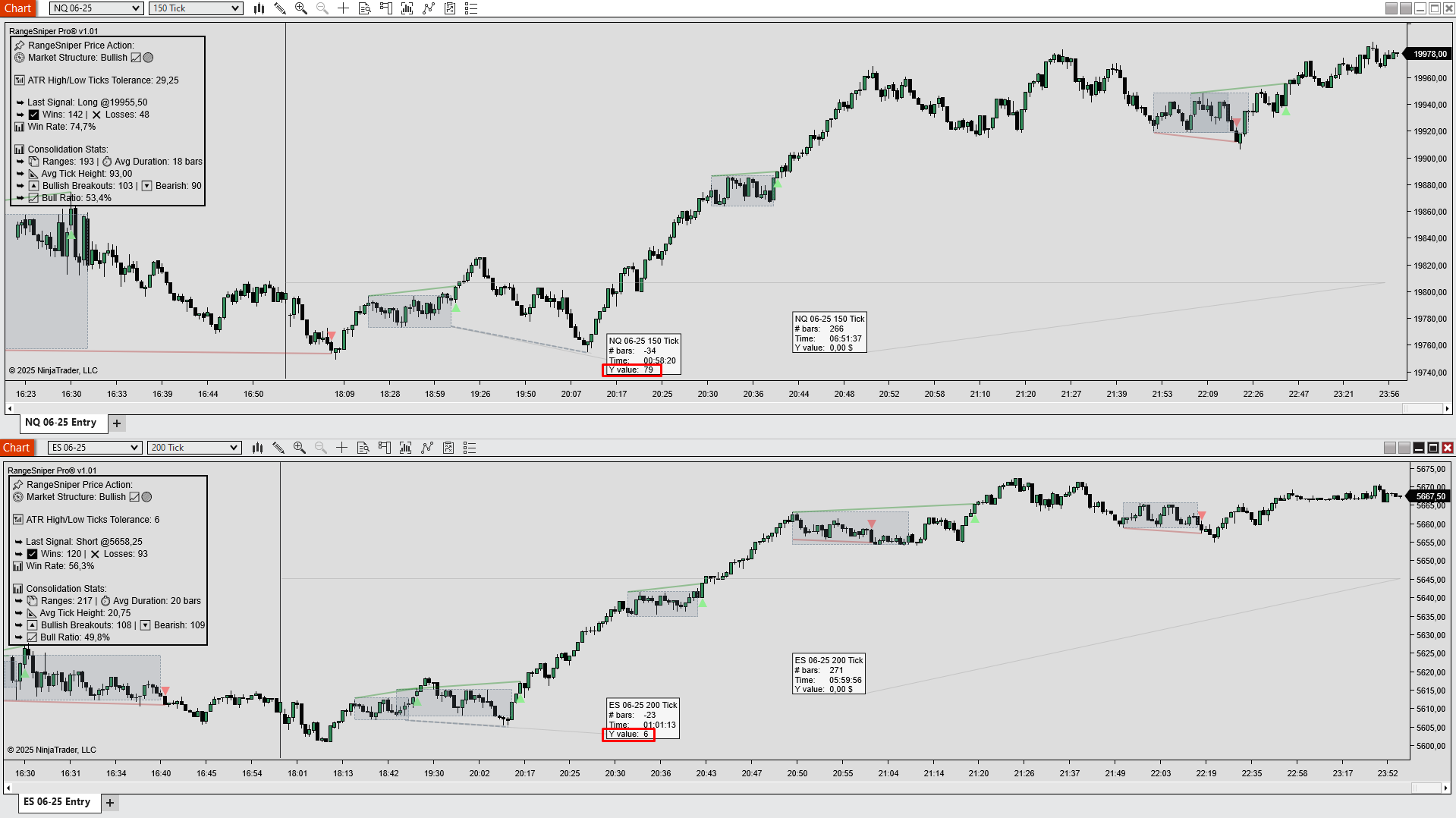
Divergence with Correlated Markets: NQ frequently behaves differently than its close counterparts, such as ES. For instance, a valid setup on ES might mirror a similar setup on NQ, but while ES continues in the predicted direction, NQ moves erratically or breaks the pattern prematurely, leading to unnecessary losses.
Heightened Emotional Toll: The fast pace of NQ trading, with sharp reversals and rapid moves, can create a more stressful environment. The fear of missing out (FOMO) and the pain of quick losses can easily take an emotional toll, causing many traders to feel “burned” by NQ, even with disciplined strategies in place.
Micro Contract Temptation: While NQ micro contracts (MNQ) offer a lower-risk entry point, the instrument’s erratic behavior can still result in a string of frustrating small losses, which can be demoralizing even with smaller position sizes.
Why ES & RTY Are Better Choices for Scalpers
In contrast to NQ’s volatility, ES and RTY futures offer a more predictable and less stressful trading environment for many scalpers. Here’s why:
Smoother, More Predictable Price Action:
ES (E-mini S&P 500): Known for its deep liquidity and broad market representation, ES typically shows more orderly price movements. Scalpers often find ES more predictable, with price action respecting key technical levels and patterns more reliably. While ES can still be volatile, its movements are generally less erratic than NQ.
RTY (Russell 2000): RTY, representing small-cap stocks, offers solid liquidity and smoother price action, making it a popular choice for scalpers. With a good balance of opportunity and manageable risk, RTY movements tend to be cleaner and more responsive to scalping strategies.
Higher Reliability of Setups: Technical patterns and indicators that may be quickly invalidated in NQ are often more reliable on ES and RTY. While no market is 100% predictable, ES and RTY setups tend to play out with greater consistency, which reduces uncertainty and increases confidence.
Less Emotional Stress: The more predictable nature of ES and RTY means fewer sharp reversals and unexpected moves. This creates a less emotionally taxing environment, allowing traders to maintain their mental fortitude and stick to their strategies more effectively.
Better for Building Foundational Skills: For newer futures scalpers, ES and RTY provide a more stable environment to hone trading skills. The clearer price action on these instruments allows for better pattern recognition, making it easier to build and refine a scalping strategy.
Considering the Switch or Adding ES & RTY to Your Arsenal
If NQ’s erratic movements have been a source of frustration, here are a few steps to help you adjust:
Dedicated Observation: Spend some time watching ES and RTY charts alongside NQ. Observe how they respond to news events, respect key technical levels, and compare their behavior. This can help you understand when NQ might be diverging from the broader market context.
Backtesting: Take your preferred scalping strategy and backtest it on historical data for ES, RTY, and NQ using NinjaTrader 8's Market Replay. This will give you a clearer picture of how each instrument behaves under different market conditions.
Start Small with ES & RTY: Begin by trading micro contracts (MES or M2K) on ES and RTY to familiarize yourself with their price action. As you get a feel for their rhythms and tick values, you can gradually scale up.
Conclusion: The Smart Path for Futures Scalping
The Nasdaq 100 (NQ) will always attract traders looking for high volatility and quick returns. However, for futures scalpers prioritizing consistency and a higher probability of setup follow-through, the E-mini S&P 500 (ES) and Russell 2000 (RTY) futures are often more reliable and less stressful markets to trade. By recognizing the potential pitfalls of NQ and exploring ES and RTY as alternatives, you may find a more stable and profitable path in your scalping journey. Sometimes, the saner choice is the smarter one.
🚨 Risk Disclosures
⚠️ Risk Disclosure
Futures and forex trading involve substantial risk and are not suitable for every investor. An investor could potentially lose all or more than their initial investment. Only risk capital should be used for trading, meaning money that can be lost without jeopardizing one’s financial security or lifestyle. Past performance is not necessarily indicative of future results.
📊 Hypothetical Performance Disclosure
Hypothetical performance results have many inherent limitations. No representation is being made that any account will or is likely to achieve similar profits or losses as those shown. Hypothetical trading does not involve financial risk, and it cannot fully reflect the emotional and psychological factors of real trading.
Additional factors, such as market conditions, liquidity, and execution delays, may adversely affect trading results. It is important to understand that all trading involves risk, and no trading strategy or indicator can guarantee profits.
Trade responsibly!