

Every trader, from novice to veteran, knows the sting of a losing trade. It’s a universal experience, and our natural human instinct is often to fight it, to hope for a turnaround, to avoid admitting we were "wrong." But what if I told you that one of the most powerful skills a trader can develop is the ability to embrace small, quick losses?
It sounds counterintuitive, but learning to cut your losses effectively is not just a defensive tactic; it's a foundational pillar of long-term trading success. Holding onto a losing trade out of hope often incurs costs far greater than the initial monetary deficit.
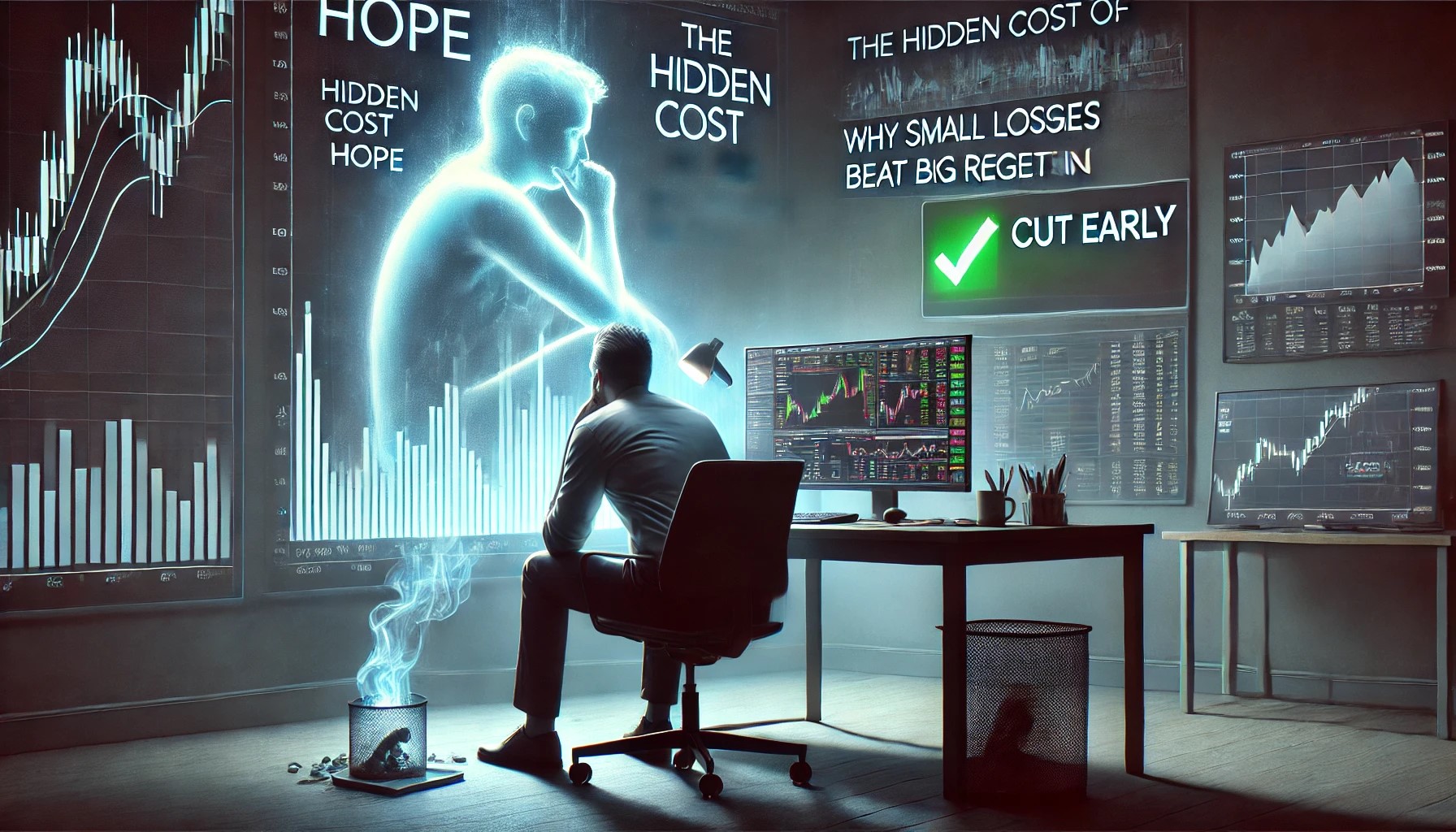
The "Hope" Trap: Why We Cling to Losing Trades
Why is it so hard to click that "close" button when a trade is going against us? Several psychological factors are at play:
Loss Aversion: Studies show that the pain of a loss is roughly twice as powerful psychologically as the pleasure of an equivalent gain. We're wired to avoid that pain.
Sunk Cost Fallacy: The more time, energy, or capital we've invested in a trade, the harder it becomes to abandon it, even when evidence mounts that it's a loser. We think, "I've already lost this much, I can't give up now."
Confirmation Bias: We start actively seeking out information (a stray indicator signal, a news headline) that supports our initial trade idea, ignoring evidence to the contrary.
Ego & The Need to Be Right: Taking a loss means admitting a mistake, and for many, that's a tough pill to swallow.
This "hope" that the market will magically reverse in our favor is a dangerous trap. It’s a slippery slope where a small, manageable loss can quickly snowball into a significant, account-damaging one.
The True Costs of Holding a Loser (It's More Than Just Money)
The red numbers on your screen are just one part of the damage. Holding onto a losing trade has several hidden, yet equally devastating, costs:
Frozen Capital & Missed Opportunities: This is perhaps the biggest unseen cost. While your capital is tied up in a struggling trade, you are unable to deploy it on new, potentially high-probability setups that are forming elsewhere. You might be watching the perfect A+ trade sail by because your funds and attention are locked in a losing battle.
Mental and Emotional Drain: Constantly monitoring a trade that's moving against you is incredibly stressful. It clouds your judgment, makes you anxious, and can lead to further poor decisions like "doubling down" on the loser or revenge trading. Your mental capital is just as important as your financial capital.
Erosion of Confidence: A single, large, uncontrolled loss can shatter a trader's confidence far more than a series of small, well-managed ones. It can take a long time to psychologically recover from a significant drawdown caused by refusing to cut a loser.
Distorted Market Perspective: When you're emotionally invested in making a losing trade work, your ability to objectively assess the broader market is compromised. You start seeing the market through the lens of your losing position, not as it truly is.
The Power of the Small, Disciplined Loss
Conversely, cultivating the discipline to take small losses quickly and decisively is incredibly empowering:
Capital Preservation is King: Your primary job as a trader is to protect your capital. Small losses ensure you live to trade another day, another setup.
Mental Clarity & Agility: Exiting a losing position frees up your mental bandwidth. You can step back, reassess the market with a clear head, and be ready to pounce on the next good opportunity without the baggage of the previous loss.
Maintaining Objectivity: It reinforces the crucial understanding that trading is a game of probabilities. Not every trade will be a winner, and that's okay. Taking a loss according to your plan is a sign of discipline, not failure.
Losses as the "Cost of Doing Business": Professional traders view small losses as routine operational expenses, much like any other business. They are an expected part of the process.
Cultivating the Discipline to Cut Losses
Developing this skill takes conscious effort:
Always Use a Stop-Loss: This is non-negotiable. Know your maximum acceptable loss before you enter any trade and have your stop-loss order in place.
Define Your Invalidation Point: Beyond just a price level, understand why your trade idea would be wrong. If that condition occurs, exit.
Focus on Process, Not Just Outcome: Judge your trading based on how well you followed your plan, including your exit rules for losers, not solely on whether a trade won or lost.
Review Your Trades (Especially Losers): Learn from them. Was it a good setup that just didn't work out, or did you break your rules? But review analytically, not emotionally.
Conclusion: Small Losses are Stepping Stones, Not Stumbling Blocks
Success in trading isn't about achieving a 100% win rate; that's a myth. It's about ensuring your winners are significantly larger than your losers, and a critical part of that equation is keeping those losers small and manageable.
Embracing the small, disciplined loss isn't an admission of failure; it's a declaration of professionalism. It's the action that frees up your capital, your mind, and your emotional energy to focus on what truly matters: identifying and capitalizing on the next high-probability winning opportunity. Small losses are not stumbling blocks on your path; they are the necessary stepping stones towards consistent profitability.
🚨 Risk Disclosures
⚠️ Risk Disclosure
Futures and forex trading involve substantial risk and are not suitable for every investor. An investor could potentially lose all or more than their initial investment. Only risk capital should be used for trading, meaning money that can be lost without jeopardizing one’s financial security or lifestyle. Past performance is not necessarily indicative of future results.
📊 Hypothetical Performance Disclosure
Hypothetical performance results have many inherent limitations. No representation is being made that any account will or is likely to achieve similar profits or losses as those shown. Hypothetical trading does not involve financial risk, and it cannot fully reflect the emotional and psychological factors of real trading.
Additional factors, such as market conditions, liquidity, and execution delays, may adversely affect trading results. It is important to understand that all trading involves risk, and no trading strategy or indicator can guarantee profits.
Trade responsibly!