
Understanding the logic behind balance, discovery, and the search for fair price.
🧩 Introduction
Every market is an auction.
Every tick, rotation, and breakout is part of an ongoing negotiation between buyers and sellers.
Auction Market Theory (AMT) is the framework that explains how this negotiation happens, how fair value is found, and how markets move between balance and imbalance.
Understanding it doesn’t require prediction - it requires recognizing structure.
This article introduces the foundational concepts that make up AMT and sets the stage for the rest of the SharpWick Auction Market Theory Series.
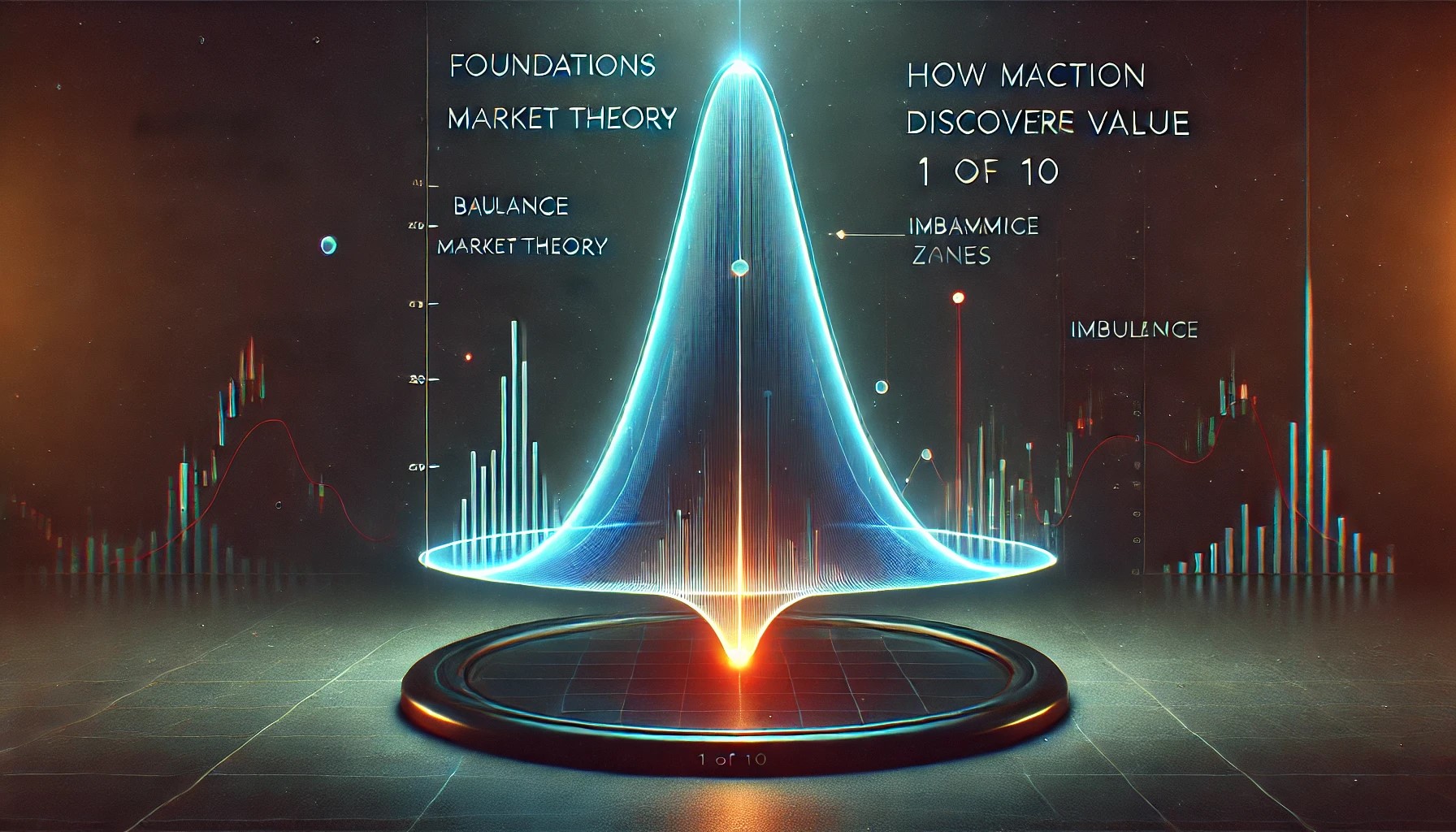
🎯 The Purpose of an Auction
An auction exists to discover the fair price of an asset.
The market does this through continuous two-way bidding:
Buyers push price up to find sellers.
Sellers push price down to find buyers.
This process of discovery creates balance zones where both sides agree on value and imbalance phases where one side temporarily dominates.
When balance breaks, the auction searches for a new area of acceptance.
That search is what creates trends, consolidations, and rotations.
"Price is the advertisement. Value is the product. Participation is the truth."
⚙️ The Building Blocks of AMT
Auction Market Theory revolves around three interconnected elements:
1. Price
The visible result of all market activity - the tag in the auction window.
2. Time
The invisible element that validates value.
If price spends time at a level, it means the market accepts that value.
3. Volume
The confirmation of participation.
Where time and volume intersect, true value forms.
The interaction of these three factors determines whether a market is in balance or searching for a new one.
📊 Balance and Imbalance - The Market’s Breathing Pattern
Think of the market as an organism breathing:
Inhale (Balance) - The market pauses, trades within a fair range, and builds structure.
Exhale (Imbalance) - The market expands, breaking away to find new value.
Neither phase lasts forever.
When the auction accepts new prices, balance returns.
When it rejects them, the market rotates back to its prior range.
Recognizing these phases allows traders to align with market intent instead of fighting volatility.
📈 Value Discovery - The Market’s True Purpose
The market’s constant function is to find and test value.
It’s not trying to trend, consolidate, or reverse.
It’s simply testing where buyers and sellers agree.
We can visualize this through:
Value Area - Where 70% of transactions occur.
Point of Control (POC) - The single price level with the highest volume or time.
High/Low Volume Nodes (HVN/LVN) - Areas of acceptance and rejection.
Each trading session builds a profile of this ongoing value discovery process.
🔍 Example - The Logic of Value Discovery
Imagine a futures market that has traded most of its volume between 4200 and 4220.
- Buyers test higher, reaching 4235 → few sellers respond → rejection.
- Sellers push lower, down to 4185 → buyers return → rejection again.
- Price returns to 4210 → balance resumes → value accepted.
In AMT terms:
4200-4220 = value area
4210 = point of control
4185 and 4235 = extremes of rejection
The market advertised price (moved beyond value), tested both sides, and returned to acceptance.
That’s how the auction discovers fair value in real time.
🧭 Why This Matters to Traders
Understanding value discovery shifts your focus from predicting direction to recognizing context.
Instead of asking:
"Will it go up or down?"
You begin to ask:
"Is the market accepting or rejecting price at this level?"
That question changes everything.
It defines whether your trades align with the market’s natural process or fight against it.
⚖️ The Trader’s Role in the Auction
Professional traders don’t move the market - they interpret it.
Their job is to:
Identify when balance is forming or breaking.
Recognize where value is being accepted or rejected.
Align their participation with the dominant auction phase.
When you understand that your orders are part of a much larger value negotiation, you stop chasing price and start following structure.
💬 Final Thoughts
Auction Market Theory is the foundation of professional market reading.
It explains why markets trend, balance, and revert - not through emotion, but through the logic of participation.
Every move is an attempt to find balance.
Every imbalance is a signal that the search for value continues.
"Your edge is not predicting where price will go - it’s understanding what the auction is trying to accomplish."
🌐 About This Series
This article is part of the SharpWick Auction Market Theory Series, dedicated to teaching the structural side of professional trading.
👉 Next in the series (2 of 10): “Balance and Imbalance - The Language of Market Structure.”
💡 Support This Work
If this series helps you understand the deeper logic of markets, consider supporting SharpWick’s independent research and trading education:
☕ Support SharpWick on Buy Me a Coffee
Your contribution helps keep SharpWick free from noise, hype, and shortcuts - focusing solely on professional structure and trader development.
Every act of support helps build balance - in the auction and in the mind of the trader.
🚨 Risk Disclosures
⚠️ Risk Disclosure
Futures and forex trading involve substantial risk and are not suitable for every investor. An investor could potentially lose all or more than their initial investment. Only risk capital should be used for trading, meaning money that can be lost without jeopardizing one’s financial security or lifestyle. Past performance is not necessarily indicative of future results.
📊 Hypothetical Performance Disclosure
Hypothetical performance results have many inherent limitations. No representation is being made that any account will or is likely to achieve similar profits or losses as those shown. Hypothetical trading does not involve financial risk, and it cannot fully reflect the emotional and psychological factors of real trading.
Additional factors, such as market conditions, liquidity, and execution delays, may adversely affect trading results. It is important to understand that all trading involves risk, and no trading strategy or indicator can guarantee profits.
Trade responsibly!