

How trader emotion fuels liquidity and why professionals wait for it.
🧩 Introduction
Markets don’t move on logic alone.
They move on emotion - the fear of missing out, the panic of being wrong, and the desperation to act when uncertainty peaks.
Those emotions create liquidity.
And for professional traders, that liquidity is opportunity.
Understanding emotional liquidity means learning to recognize when human behavior itself becomes the fuel for market movement.
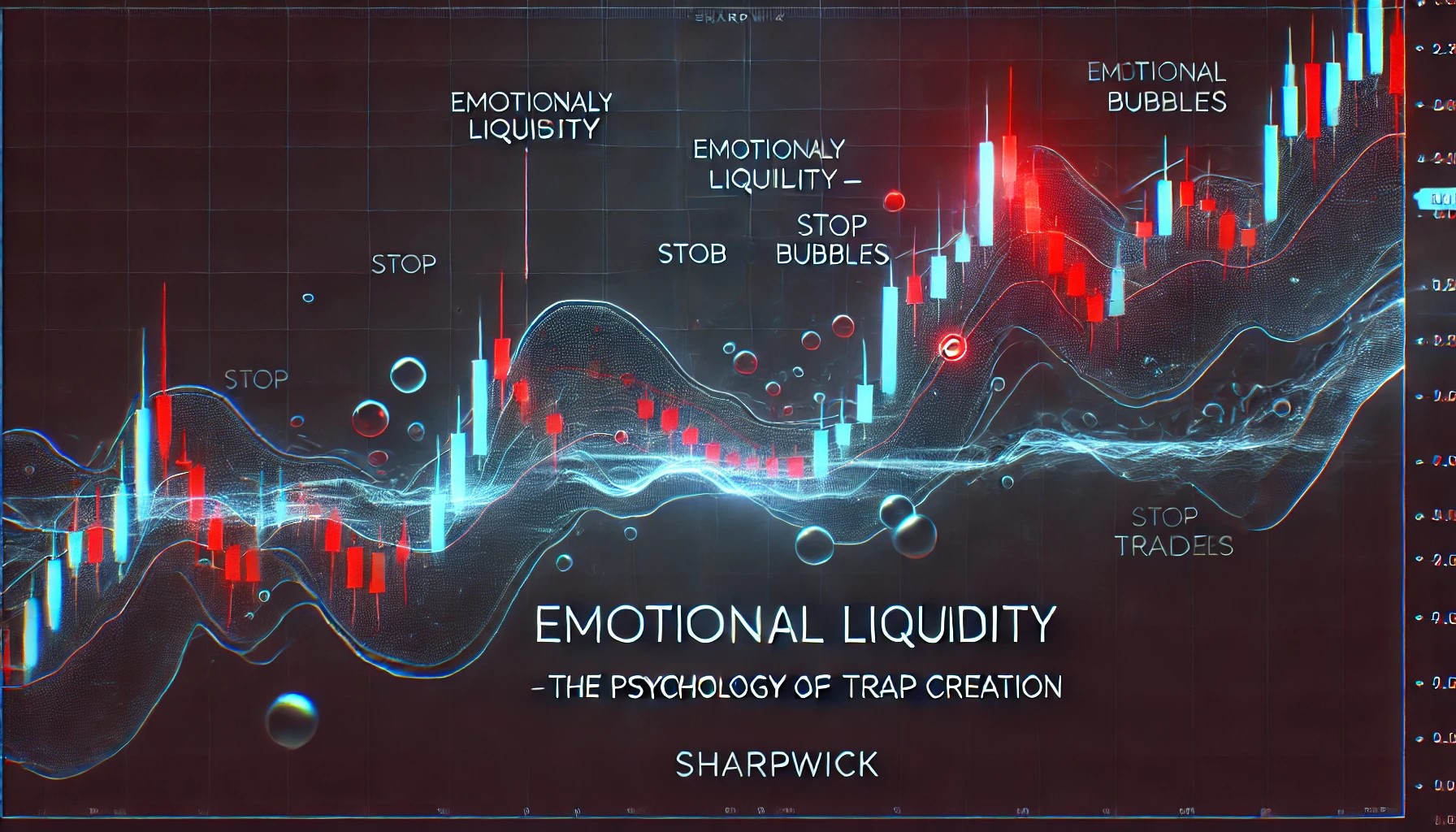
🧠 What Is Emotional Liquidity?
Emotional liquidity is the volume generated by reactive trading behavior.
It’s the sudden burst of orders created when traders act emotionally - chasing, stopping out, or overcorrecting.
Unlike passive resting liquidity, emotional liquidity appears suddenly and evaporates quickly.
It often emerges:
After breakouts or breakdowns
During volatility spikes
Around key session opens or news events
When price violates “obvious” support or resistance
Each burst of emotion provides liquidity for larger, prepared participants to execute with minimal slippage.
⚙️ The Mechanics of a Liquidity Trap
Every trap starts with the same sequence:
1️⃣ Emotion builds - traders anticipate breakout or breakdown
2️⃣ Aggressive participation - stops and market orders trigger
3️⃣ Smart money absorbs or fades the emotional flow
4️⃣ Reversal or continuation unfolds, trapping late participants
This is why markets often reverse sharply after high-volume emotional bursts.
That surge is not strength - it’s exhaustion disguised as aggression.
📊 Example - The Classic Breakout Trap
Imagine price consolidating beneath a clear resistance level.
Traders see it, mark it, and wait for the breakout.
Resistance: 4200
Price tests → 4199 → 4200 → 4202 → high delta spike
Absorption appears → price drops → 4195 → trapped buyers exit
The breakout wasn’t real momentum - it was emotional liquidity.
Once that burst of buying was absorbed, the market flipped direction, feeding on trapped participants.
💬 Why Emotional Trading Creates Perfect Liquidity
Emotional traders do two things that professionals rely on:
They concentrate liquidity.
Stops, limit orders, and chasers all cluster around obvious levels.They create urgency.
Emotional conviction means volume floods in at predictable moments.
This combination produces high-quality execution points for institutions and experienced traders who know how to fade emotion with logic.
⚖️ Emotion vs Logic - Two Sides of the Auction
Trader Type Behavior Outcome Emotional (Reactive) Trades based on fear, greed, and urgency Provides liquidity Logical (Prepared) Waits for emotion to peak, then executes Uses liquidity
The reactive trader supplies the opportunity.
The logical trader capitalizes on it.
That’s not exploitation - it’s market structure.
Every auction requires one side to be reactive for the other to be strategic.
🔍 How to Identify Emotional Liquidity in Real Time
Look for three key signs that emotion is driving order flow:
1. Sudden Delta Spikes Without Progress
Large positive or negative delta with minimal price displacement indicates trapped emotion being absorbed.
2. Fast Volume Expansion in Obvious Zones
Watch for extreme volume bursts near prior highs, lows, or VWAP - especially after prolonged buildup.
3. Violent Reversal After Exhaustion
Once the emotional flow is consumed, the reversal is usually fast and aggressive, as trapped traders unwind.
🧩 The Psychology of Traps
Traps are the natural outcome of crowd emotion colliding with institutional logic.
They aren’t manipulation - they’re inefficiency created by human predictability.
Traders chase strength too late.
They anchor to prior levels too tightly.
They refuse to accept loss quickly enough.
Professional traders know this rhythm. They wait for the crowd to commit - then step in where liquidity peaks.
“The market doesn’t trap you. It invites you to trap yourself.”
📈 Using Emotional Liquidity to Build an Edge
While precise strategies vary, here’s how professionals apply the concept:
Anticipate crowd focus - identify where emotion will likely concentrate.
Wait for confirmation - high delta + low displacement = exhaustion.
Act post-trap - trade the reversal or continuation once trapped flow is revealed.
Use volume and delta as validation, not prediction.
Patience turns emotional volatility into structured opportunity.
💡 Emotional Liquidity and Market Structure
Emotional liquidity connects perfectly with the broader SharpWick framework:
Liquidity shifts show where price is drawn.
Absorption shows who’s defending.
Delta shows who’s attacking.
Emotion shows when imbalance becomes opportunity.
Combine them, and you’re not trading signals - you’re reading behavior in motion.
💬 Final Thoughts
Every major market move begins and ends with emotion.
When you understand how emotional liquidity forms and fades, you stop being part of the crowd and start thinking like the participant creating the next move.
Emotion drives volume.
Logic defines control.
And the space between them is where real opportunity lives.
“Emotion creates the waves. Logic rides them.”
🌐 About This Series
This article is part of SharpWick’s educational series on professional market interpretation - helping futures traders decode order flow, liquidity, and emotion to understand the deeper structure of market behavior.
👉 Next in the series (10 of 10): “From Reading to Reacting - Executing with Confidence.”
💡 Support This Work
If this series helps you see markets through a more professional lens, consider supporting continued research and content creation:
☕ Support SharpWick on Buy Me a Coffee
Your contribution helps keep SharpWick resources independent, research-driven, and built for serious traders.
Every act of support refines the logic - and the traders who follow it.
🚨 Risk Disclosures
⚠️ Risk Disclosure
Futures and forex trading involve substantial risk and are not suitable for every investor. An investor could potentially lose all or more than their initial investment. Only risk capital should be used for trading, meaning money that can be lost without jeopardizing one’s financial security or lifestyle. Past performance is not necessarily indicative of future results.
📊 Hypothetical Performance Disclosure
Hypothetical performance results have many inherent limitations. No representation is being made that any account will or is likely to achieve similar profits or losses as those shown. Hypothetical trading does not involve financial risk, and it cannot fully reflect the emotional and psychological factors of real trading.
Additional factors, such as market conditions, liquidity, and execution delays, may adversely affect trading results. It is important to understand that all trading involves risk, and no trading strategy or indicator can guarantee profits.
Trade responsibly!