
In case you missed it: I’m writing a Book!
Thanks to your support this month, I was able to cover the costs of the following:
Carrier War: $11
Copyright agreement for oral history interviews: $135
Fold3 subscription: $50
If you’ve been getting value out of these updates, and aren’t already, consider becoming a paid subscriber or passing this along to someone who might. Every bit helps me acquire more primary, secondary, other sources, and research tools!
 I was recently reading an academic article on JSTOR published in the last few years about carrier operations in World War II. As I was reading, one statement stood out: “Crucial in the period under discussion was the replacement of the very good Wildcat with the excellent Hellcat; the capture of a crashed, yet largely intact, Zero fighter in the Aleutians in June 1942 helped American designers produce in the Hellcat, a superb Zero-killer.” This annoyed me because this is not true regarding the Hellcat. So, I will explain.
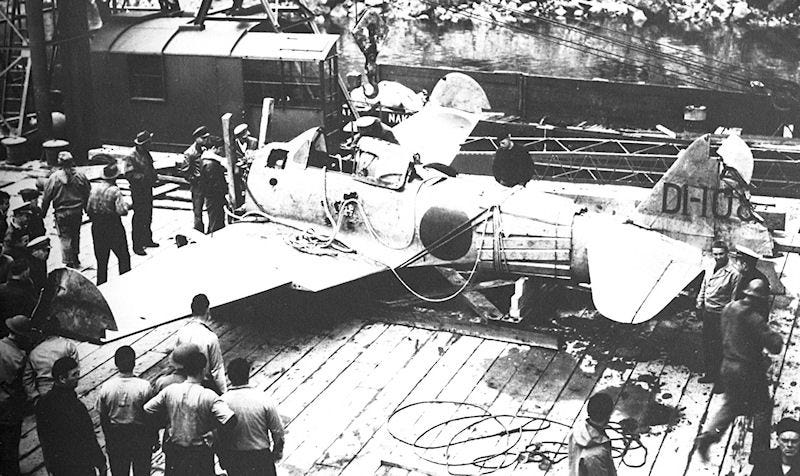
Two principal myths have emerged out of the event known as “Koga’s Zero.” On July 1, 1942, a regular reconnaissance mission over Akutan near Alaska by a PBY Catalina spotted the wreckage of a plane. Upon closer examination, it was discovered to be a Japanese plane, and it looked surprisingly intact, at least compared to other wrecks that were often found. On July 11, a team was dispatched to examine the wreck. They discovered a nearly intact Mitsubishi A6M2 Model 21 Zero, Japan’s principal fighter during the war. It took several weeks and expeditions, but the plane was eventually dug out and shipped to San Diego to be repaired and flown at the beginning of August. It wasn’t till September that the plane was repaired and flown, but it gave the Bureau of Aeronautics a mountain of data to work with. These were eventually published in Informational Intelligence Summary 59, Technical Aviation Intelligence Brief #3, Tactical and Technical Trends #5 (published before the first test flight), and Informational Intelligence Summary 85, which were subsequently disseminated and briefed through American Naval aviation.
Several myths have emerged from this event. The two biggest ones are that the capture enabled American fliers to learn and develop tactics that turned the tables in the air. The second, relevant to this book, is that the Hellcat’s design was in direct response to tests and diagnostics from the captured Zero.
For the myth on the tactics aspect, one just has to look at the after-action reports from VF-42 and VF-2 after that Battle of the Coral Sea and find that they captured the Zero’s traits fairly accurately: a fast climb rate, tight turning radius, and evidently no self-sealing fuel tank. This was in mid-May, months before the intact Zero had been captured. Furthermore, the high-beam defense, or “Thatch Weave,” the standard defensive tactic for naval aviators in the Pacific, was developed in September 1941 based on an intelligence bulletin from American and Chinese aviators flying against the Zero in China. This is not to suggest that data from the flying and technical testing did not help; it did, but it largely evolved into a myth that American fliers had no idea what they were doing in 1942, and it wasn’t until “Koga’s Zero” that this changed.1
Strangely, the Hellcat aspect of these myths did not originate in American scholarship but in Japan. The book Zero!, written by Masatake Okumiya and Jiro Horikoshi, one a former pilot and the other a staff officer in the Japanese Navy in collaboration with American writer Martin Caidin in the 1950’s, stated that, “the Americans rushed to completion a fighter airplane intended specifically to wrest from Japan the advantage afforded by the Zero. This was the United States Navy’s Grumman F6F Hellcat.” They add, “Our first reports on the new Grumman stated that its design had been affected by a careful American examination of a Zero fighter captured in the Aleutians in the spring of 1942. To some extent this appeared to be so, since the philosophy of weight-saving was carried throughout the Hellcat’s structure to an extent without parallel in other American aircraft of that time.”2 It’s certainly plausible that Japan gathered intelligence to this effect, but nothing has yet emerged to that effect. But it was from Zero! that this notion began to repeat until it became a fact in of itself.
On the American side, the myth is that the captured Zero led the Hellcat to switch from the Wright R-2600 Twin Cyclone to its famous 2000 horsepower Pratt & Whitney R-2800 Double Wasp engine. However, Grumman knew that the original Wright engine was underpowered in the plane even before their first prototype had flown. The actual testing of the XF6F-1 prototype in June 1942 confirmed it, and the company was already arguing with the Navy that it should switch to the Pratt & Whitney well before the capture and flight of the Zero.3 The XF6F-3 with the new engine flew in October 1942 and actual production of the F6F-3 began shortly after. Put side by side, the two timelines simply do not allow for the causal link the myth requires. The wreck was not even spotted until July, it did not reach San Diego until August, and it did not fly until September. The Pratt & Whitney-powered XF6F-3 took to the air in October, only weeks after the Zero’s first American flight and before much of the resulting data had been compiled into the intelligence summaries that carried it to the fleet. No aircraft manufacturer, even one working at wartime speed, could have absorbed flight-test findings, reworked a fighter around them, and put a new prototype in the air in that span. Grumman’s own testing drove the engine change, not the Zero’s, and the airplane that went into production was essentially the one Grumman had already been building.
Furthermore, the development of the Hellcat was well underway before the Zero was even captured. In fact, Grumman had already started thinking about the successor to the Navy’s F4F Wildcat in 1939! Although they did not actually sign a contract to design such a plane until 1941, it was, and still is, common for defense contractors to start doing research and development to better position themselves to bid for contracts from the government. They knew the Wildcat was underpowered, and the next-generation plane would almost certainly need a bigger airframe and wingspan to accommodate a bigger engine to give it more power. This matters because the captured Zero myth suggests Grumman conceived the Hellcat out of thin air or based it solely on testing the Zero, which is not the case.
The persistence of the “Koga’s Zero” myth says less about the Hellcat than about our appetite for tidy causal stories and how they often persist from strange circumstances. A single dramatic intelligence windfall, dug out of the Alaskan tundra and flown in San Diego, makes for a far more satisfying narrative than the slower, messier reality: Grumman engineers who had been thinking about a Wildcat successor since 1939, a company already pressing the Navy on the Pratt & Whitney engine before the Zero ever flew in American hands, and squadron pilots who had diagnosed the Zero’s strengths and weaknesses at Coral Sea months before anyone set foot on Akutan. The myth also flatters both sides in ways that help explain its durability. For the Japanese authors of Zero!, it cast their fighter as so formidable that the Americans had to build a dedicated answer. For American readers, it offered a clean and obvious turning point, a moment when ingenuity and a lucky find reversed the fortunes of the Pacific air war.
None of this diminishes what the captured Zero contributed. The flight tests and the intelligence summaries that followed gave naval aviators hard, quantified data that confirmed and refined what they had learned in combat, and that confirmation mattered. But confirmation is not creation. The Hellcat was not born in response to Koga’s Zero, and American fighter tactics were not invented because of it. The Hellcat’s success belongs to a longer story of institutional learning, industrial foresight, and hard-won combat experience, and it is that story, rather than the myth of a single decisive capture, that explains how the Navy’s second generation of fighter pilots came to dominate the skies over the Pacific. The fact that the myth still surfaces in recent peer-reviewed scholarship is the best evidence that it still needs correcting.
1 I would also point to John Lundstrom’s appendix in The First Team and the Guadalcanal Campaign, which casts significant doubt on its validity.
2 Passages come from, “The Hellcat-Zero Myth.”
3 I will get into more details on this dispute in the book, but I can’t give away all my good material now!