

How comfortable are you planning a VFR Cross Country Flight? Take our free quiz to find out! It takes less that five minutes!
https://forms.fillout.com/t/i79FjaHED9us
Calculate Fuel Burn – Using a Cruise Performance Chart!
Before we are able to complete a flight plan we’ll need to know how to pick a power setting, then calculate True Airspeed and fuel burn during the cruise portion of a cross country.
The first thing we’ll need to do is decide what is most important to us. Are we interested in getting to the destination the quickest or in using the least amount of fuel?
We’ll use this information to determine what power setting to use. The archer provides three sets of performance data… 55%, 65%, and 75%. So we have “best economy”, “middle of the road” and “fastest cruise”.
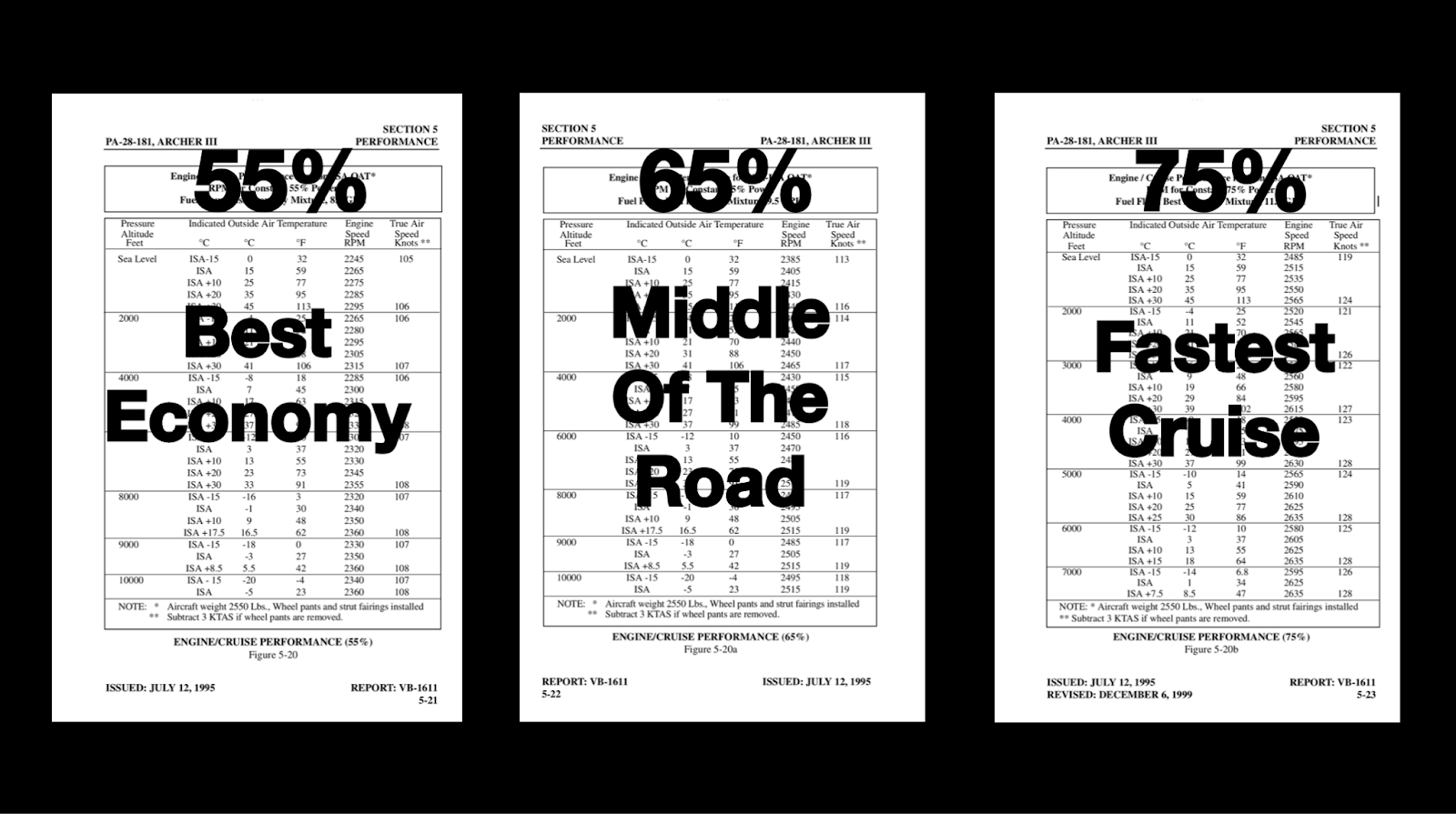
For this example, we’ll use 75% power because we want to get to our destination as quickly as possible. Having made this choice, we know that our estimated fuel burn at cruise will be 11 gallons per hour.

However, without knowing our true airspeed we won’t be able to calculate the time enroute and therefore our total fuel used.
To estimate true airspeed, we’ll need our chosen altitude of 4500 and the current temperature. Today’s METAR notes that the Altimeter reading is 30.17 and the temperature is 24C
We’ll start by calculating pressure altitude. Using the process described in one of my videos (https://youtu.be/KcisGhtIigE), I calculated our pressure altitude to be 4250 feet. Let’s round pessimistically to 4000. In this case, the lower altitude is pessimistic because it has the same fuel burn, but a lower True Airspeed range.

Now, refer to the chart. The chart requires us to estimate the temperature at altitude to determine the RPM setting to use to get 75% power. To do that, we’ll start with the ground temperature and use the standard lapse rate to estimate the temperature at 4000 ft.
First, estimate the cruise height above ground. To do that we’ll subtract the average ground elevation from our pressure altitude. If you recall from our last video, the average elevation was 1236. Subtracting 1236 from 4000 leaves 2764.
If you recall, standard lapse rate is a decrease of 2 degrees C for every 1000 ft of altitude. Therefore, we’ll divide the height above ground by 1000 and multiply the result by -2. In this case 2764 divided by 1000 is 2.764. Multiplying that by negative 2 gives us a temperature difference of -5.528 C. Adding that that from 24C leaves us with an estimated temperature of 18C (rounded pessimistically) at 4000 FT Pressure Altitude.
Going back to the chart and using the temperature nearest to 18 (17) shows that we should be able to obtain 75% power at 2595 RPM. And at that RPM we should be able to obtain between 123 and 128 KTS TAS. Which should we use?

Just for “fun” let’s use interpolation to get a very specific airspeed.
Start by subtracting the top and bottom numbers in the temperature column.
37 - (-8) = 45.
Then subtract our target value of 17 from the bottom temperature.
37 - 17 = 20.
Now divide the first result from the second result to get our multiplier.
20 / 45 = 0.44444444
Next, on the airspeed side, subtract the top and bottom numbers just like we did for temperatures.
128-123 = 5.
Multiplying 5 by our multiplier (calculated above) should give us the correction value we need to subtract from the bottom number.
5 * 0.44444444 = 2.22222222
To finish up, we need to subtract our correction value from the bottom speed.
128 - 2.22222222 = 125.777778 kts.
So there you have it! We now know our power setting, our fuel burn rate, and a very specific true airspeed that can be used to finish up our flight planning.
One more tip. After all that work, we can see there is a little under three knots between our calculated airspeed and the lowest airspeed number for that section of the chart. Therefore, for estimation purposes, 123 kts (the pessimistic number) will work just fine and should provide a safety buffer.