

 Earth Day Update: This article was first published in April 2021. In four years, the science on microplastics has moved fast — and the picture is more urgent than ever. I’ve kept the original observations and added what research has discovered since. Because the planet hasn’t changed. But what we know about what we’re doing to it has.
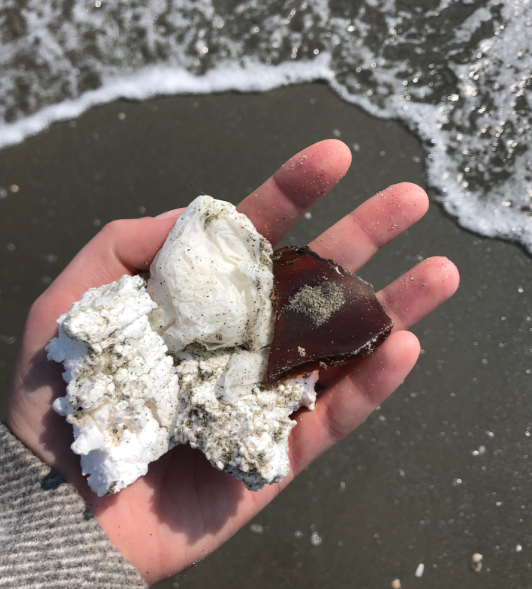
Last weekend I went for a walk on the beach and I found waste on it.
Plastic, glass, bags, polystyrene are just some of the materials that I found (and took home).
What we knew in 2021
Plastics are the third most-widely manufactured material (after cement and steel) and they have become widespread in our society.
Plastics has been found in many coastal and marine environments, including subtropical gyres, deep-sea, submarine canyons, water column, beaches, dunes and mangroves. Plastics are so widespread that they are used as an indicator of the Anthropocene age and in particular of the Plasticene age.
To date, the only place of Earth without microplastics was Siberia. Unfortunately, this is not true anymore.
Frank and collaborators measured the abundance of microplastics in the surface water of the Ob River and of the Tom River (Siberia). The average number of particles for the two rivers ranged from 44.2 to 51.2 items/m3 (in Tom River) and from 79.4 to 87.5 μg per m3 (in Ob River), respectively. 93.5% of the microplastics were less than 1 mm in their largest dimension.
Moreover, Malaygina and collaborators, demonstrated the presence of microplastics in the snow fallen over Western Siberia.
Do you want more?
An Italian study by Ragusa and collaborators recently demonstrated the presence of microplastics in human placenta. The study shows that microplastics were present in all placental portions: maternal, fetal and amniochorial membranes. It is a serious issues for human health because microplastics acts as endocrine disruptors and could cause long-term effects on human health.
Microplastics have been detected everywhere, including in commercial sea food and drinking water. Therefore microplastics represent an issue for human food security, food safety and health. Our knowledge of the topic is incomplete and we need more research on toxicity of microplastics for human health.
What science has discovered since
They’re in our hearts. Literally.
In March 2024, one of the most impactful microplastics studies to date was published in the New England Journal of Medicine. Researchers studied patients undergoing surgery to remove arterial plaque. More than two years after the procedure, patients who had microplastics in their plaque had a significantly higher risk of heart attack, stroke, and death compared to those who didn’t. This was one of the first studies to directly link microplastic exposure to hard clinical outcomes in living humans — not just animal models or cell lines.
Inspired by these findings, researchers at Stanford Medicine are now running pilot studies to understand how these particles interact with the cells lining our blood vessels. So far, the evidence suggests that microplastics can enter cells and cause major changes in gene expression — with implications for vascular disease progression.
Microplastics have been found in childrens' tonsils, plancenta and brain. Want to know more and discover what we can do about it? Read more here: https://scicommforeveryone.wordpress.com/2026/04/22/there-is-no-planet-b-2/