
Every engineering team has a documentation graveyard. It's that corner of your wiki - Notion, Confluence, GitBook, a forgotten GitHub wiki. The dates say "last updated 11 months ago." The architecture diagrams reference services that were deprecated in Q2. The quickstart guide assumes a dependency that no longer exists.
You know the problem. You've probably apologized for it. "Sorry, that doc is a bit outdated — let me walk you through how it actually works."
But here's the uncomfortable truth: this isn't a discipline problem. It isn't laziness. It's a structural one. The way most teams write documentation is fundamentally broken, because docs live in a separate world from the code itself.
"The moment a pull request merges, the documentation has already started falling behind."
The root cause nobody talks about
Think about how documentation is written in most teams. A feature ships. Someone remembers. or more likely, is reminded to write a doc. They open up the wiki, summarize what they think the feature does from memory, maybe paste in some code snippets, and call it done.
Three months later, the implementation changes. The PR is reviewed, approved, merged. It shows up in git history. But the wiki? Still showing the original design. Nobody updated it, because updating docs isn't part of the git push workflow. It's a separate task, easy to forget, easy to deprioritize.
The gap between what the code does and what the docs say it does grows with every commit. That gap is technical debt you can't see in your dependency graph.
What if documentation lived inside the PR itself?
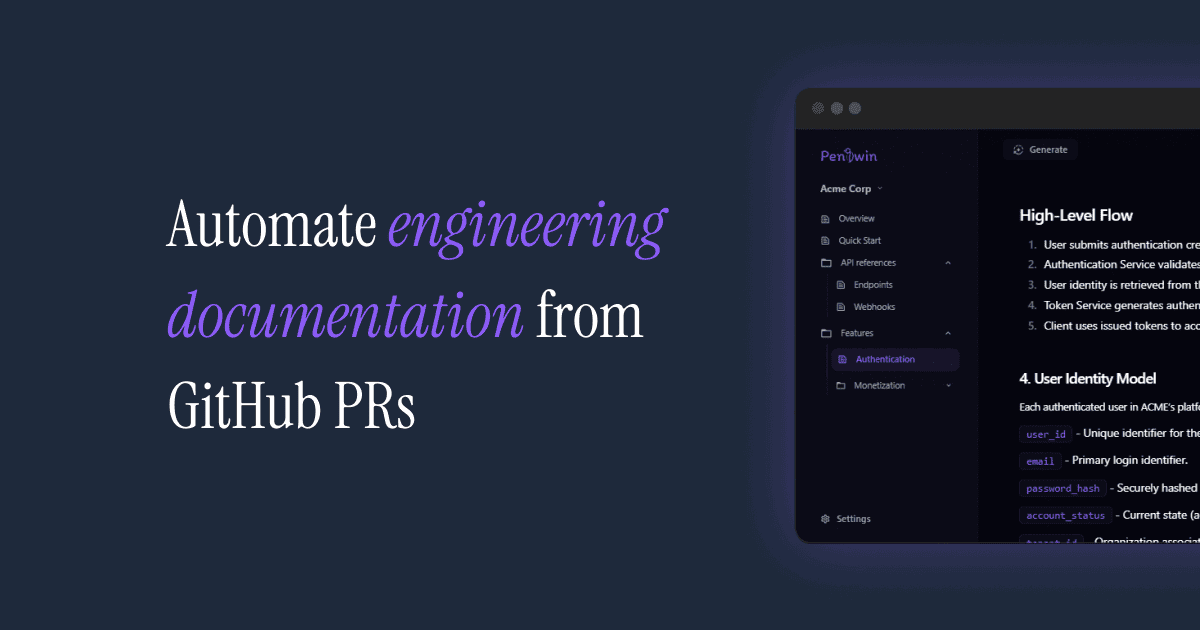
This is the question Penqwin was built to answer. Instead of treating documentation as a downstream artifact, something you produce after the code ships - what if it were generated directly from the pull request, at the moment of change?
Every meaningful code change already contains the documentation. It's there in the PR title, the commit messages, the diff itself. The information exists; it just hasn't been structured into something readable yet. That's exactly the transformation Penqwin automates.
Paste a PR or commit URL
Drop in any GitHub pull request or commit link. That's the only input needed.
Code changes are analyzed
Penqwin reads the diff and surfaces the real engineering impact, why it matters.
Structured doc, ready to ship
A clean, structured document lands in your workspace, ready for your review and any personal touch.
The developer-first editor matters more than you'd think
Tools like Notion are great for product managers writing spec documents. Confluence is fine for company handbooks. But neither was built for engineers writing technical documentation - documentation with code blocks, API references, command-line examples, and architecture notes that need to stay precise.
Penqwin's editor is designed specifically for technical content. Native code block support is a first-class citizen, not an afterthought. The interface is intentionally minimal, keeping the focus on the words and the code, not on toolbar clutter.
Organized by the way your team actually works
Documentation debt is partly a discoverability problem. Even when docs exist, they're hard to find. They're scattered across tools, buried in channels, or siloed inside individual Notion pages nobody shares.
Penqwin organizes documentation into workspaces grouped by project, team, or hierarchy. When a new engineer joins, they're not digging through Slack history for that one thread where someone explained how the auth service works. It's in the workspace, properly filed, properly current.
A note on existing alternatives
Notion is excellent for general knowledge management but requires a lot of manual structure and offers no native connection to your codebase. GitBook is polished but optimized for public-facing developer docs, not internal engineering knowledge. Neither generates documentation from your actual code changes, that's the gap Penqwin fills.
Stop writing docs from memory.
The real question isn't whether better documentation tooling is worth it. It's how much time your team has already spent explaining things that should have been documented and how much time you'll spend doing it again next sprint.
Turn your next pull request into structured engineering documentation in seconds.