

YouTube Just Handed Viewers the Steering Wheel: You Can Now Build Your Own Algorithm With a Text Prompt
For years, the only way to "train" your YouTube recommendations was to tap dislike and hope it stuck. At its Made on YouTube event on September 23, YouTube announced something different: type what you want, and Gemini builds a feed around it.
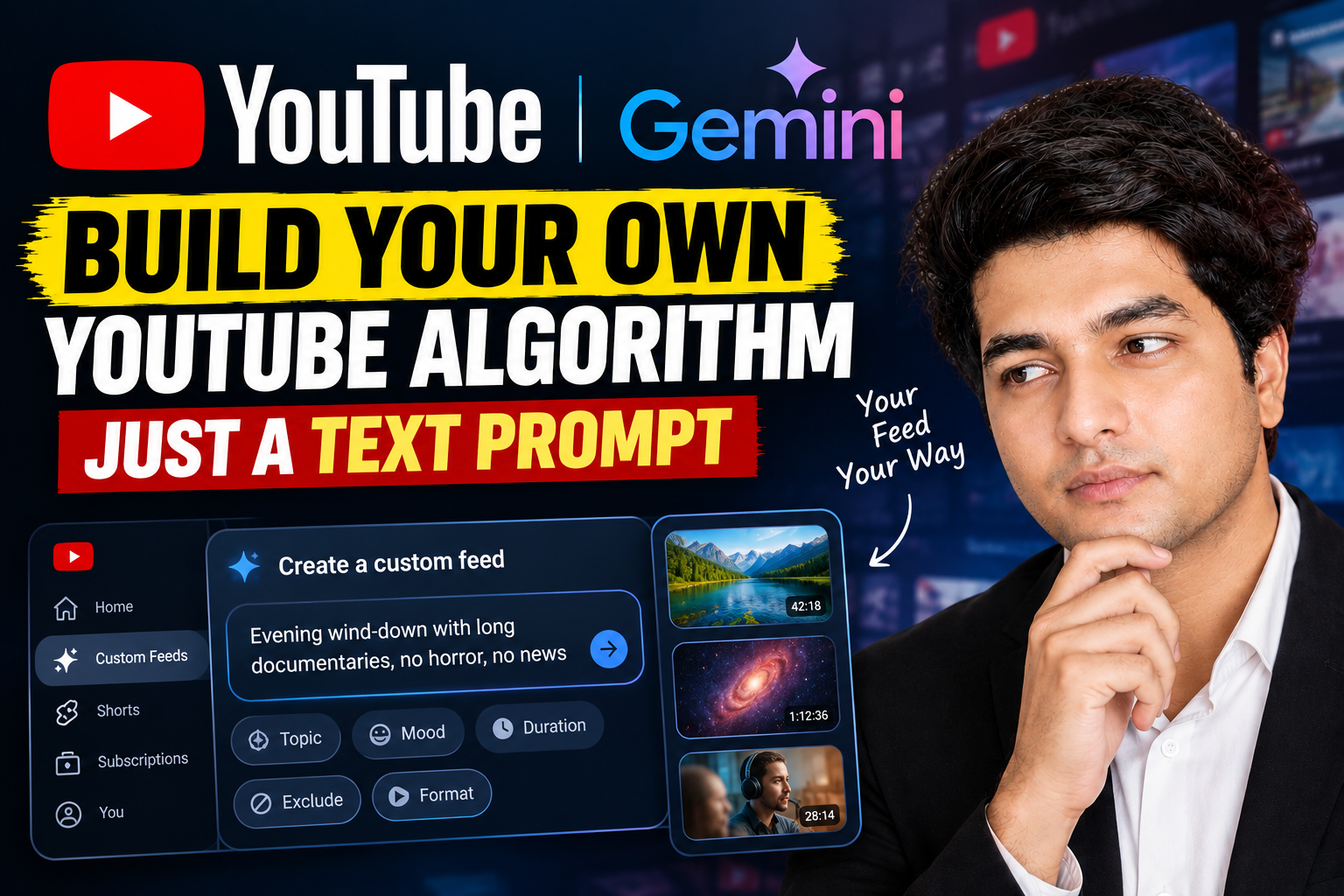
Here's how Custom Feeds works and where it stops:
→ Describe a feed in plain language, like "evening wind-down with long documentaries" or "witty podcasts for a 30-minute commute", and Gemini builds it
→ Each feed lives in its own tab at the top of your homepage, next to your regular Home feed, which stays untouched
→ Prompts can name topics, moods, viewing context, what to prioritize, and, notably, what to exclude
→ The feeds keep refreshing with new videos, so a prompt becomes a standing instruction rather than a one-time search
→ It draws from YouTube's library of 20+ billion videos
→ Launching in the US next month across mobile, web, and TV
It's not full control, though. You're not getting access to the ranking code or recommendation weights. Gemini interprets your request, but YouTube still decides which videos qualify and what content policies apply. What you get is a natural-language control layer on top of the algorithm, not ownership of it.
Several questions are still open: does the prompt text influence ads or your main feed? Is there a cap on how many feeds one account can keep? And how well does Gemini honor an exclusion after weeks of use? Those can't be judged until real people use it.
Here's my take: this is less a feature launch than a change in how recommendation is designed. Recommendation engines have always inferred intent from behavior: what you watched, paused, or skipped. Custom Feeds lets people state intent directly. That's a fundamentally different signal, and it's a hard one for a purely behavior-driven system to replicate.
It also matters for creators. If viewers can specify format, length, and mood, then discoverability shifts toward how clearly a video fits a describable intent, not just how well it holds attention. Titles, descriptions, and content structure may start to matter in new ways.
And YouTube isn't alone. Bluesky, Spotify, Meta, and X have all explored user-directed or AI-assisted feed customization. It's becoming a category trend: the platforms that win may be the ones that let users say what they want instead of guessing from clicks.
Would you actually write a prompt to shape your own feed, or do you prefer the algorithm to just figure you out?
#YouTube #Gemini #AI #SocialMedia #ContentCreators #TechNews
— 𝔖𝔞𝔫𝔡𝔢𝔢𝔭 ℜ𝔞𝔦𝔷𝔞