

The US Just Put a $215 Million Price Tag on Quantum Computing That Actually Works
The Department of Energy isn't funding quantum research anymore — it's funding proof.
The newly launched Quantum Genesis Q Competition targets something the industry has largely avoided committing to: fault-tolerant machines with at least 100 logical qubits, capable of running hundreds of millions of error-corrected operations.
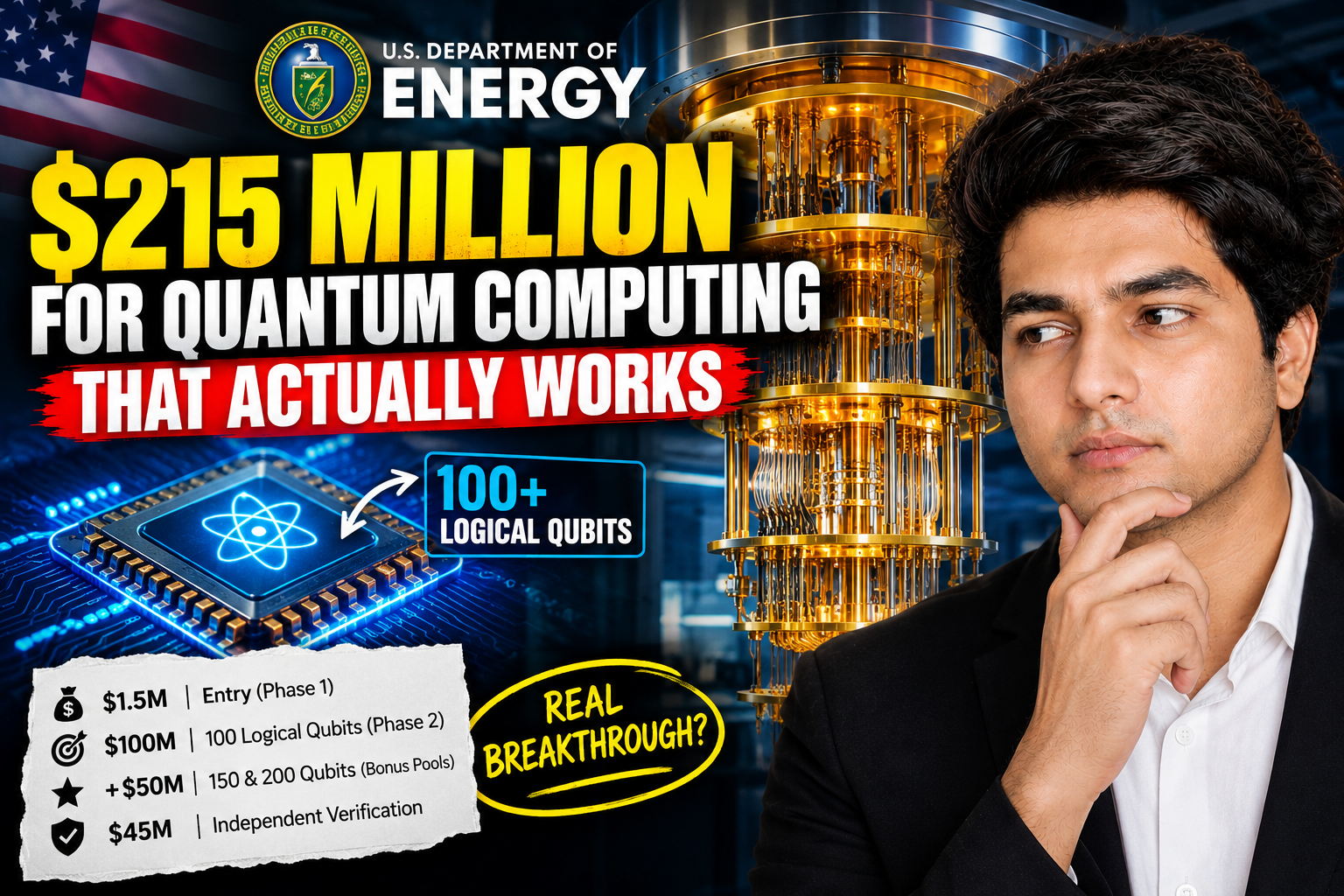
Here's how the money is structured:
→ Phase one: milestone awards up to $1.5 million per participant, just to get in the game
→ Phase two: a $100 million incentive pool for the first systems to hit 100 logical qubits
→ Bonus pools: an extra $50 million each for systems that push to 150 and 200 logical qubits
→ A separate $45 million program lets national labs independently validate and verify every claimed result — hardware, algorithms, controls, the whole stack
→ The full $215M is planned funding, contingent on future congressional appropriations — not money already sitting in an account
The detail that actually matters here is "logical" qubits, not physical ones. Most quantum headlines you've seen — "1,000-qubit chip," "world's largest quantum processor" — are counting raw, error-prone physical qubits. A logical qubit is what you get after stacking many physical qubits together with error correction, so it can actually hold a computation long enough to be useful. That's a far harder, far more honest bar to clear, and it's exactly why most companies haven't been racing to hit it publicly.
Here's my take: this competition is the DOE trying to fix quantum computing's credibility problem. For years, progress has been measured in metrics that don't translate across different hardware approaches — making it nearly impossible to tell real breakthroughs from marketing. By tying real money to a demanding, verifiable milestone, and building in independent testing at national labs, the government is betting that forcing everyone onto the same yardstick will actually accelerate the field faster than more open-ended research grants would.
If a team clears 100 logical qubits under real verification, that's not a lab demo anymore — that's the first credible sign quantum computing is close to solving chemistry, materials science, and physics problems classical computers genuinely can't touch.
Do you think a cash-prize model like this moves science faster than traditional research grants — or does it just reward whoever's already closest to the finish line?
#QuantumComputing #DeepTech #DOE #Innovation #TechNews #ScienceAndTech
— 𝔖𝔞𝔫𝔡𝔢𝔢𝔭 ℜ𝔞𝔦𝔷𝔞