

The U.S. and China Are Now Fighting Over Who "Copied" Whose AI — And It's Not About Chips Anymore
For years, the U.S.-China tech war was fought over hardware — chips, export bans, fab equipment. This week, the fight moved somewhere new: into the models themselves.
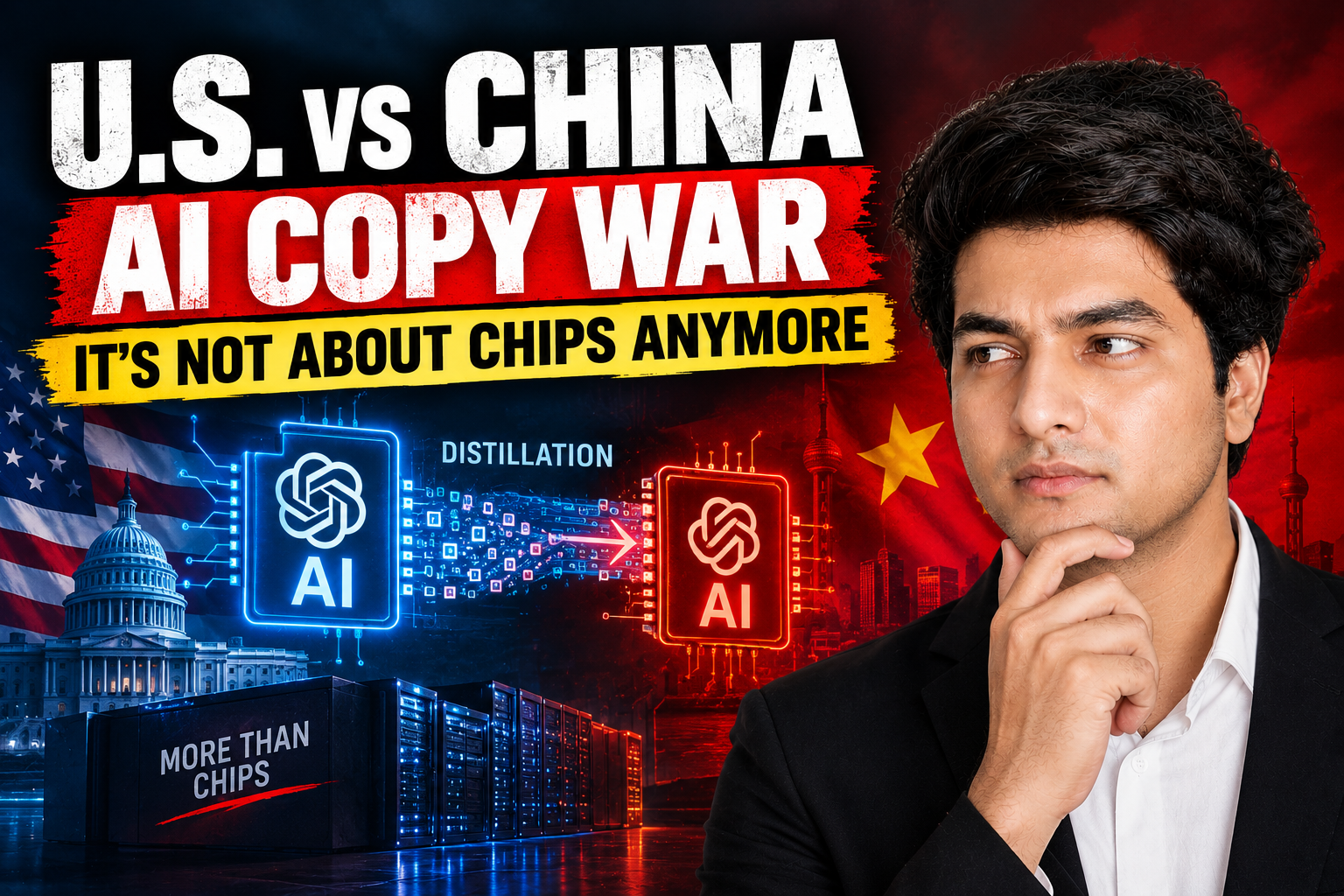
Washington has accused Chinese AI labs of "industrial-scale" distillation — training their own models by extracting knowledge from the outputs of leading American systems. Beijing's Ministry of Commerce didn't just deny it. It called the claims baseless, said distillation is a standard technique used across the global AI industry, and warned it could retaliate if the U.S. uses these accusations to justify further restrictions.
Here's why this dispute is different from the usual chip fights:
→ Model distillation is genuinely common — it's how developers build smaller, cheaper models using a larger model's outputs or internal knowledge. Every major lab uses versions of it.
→ The accusation isn't about the technique itself — it's about whether it was used to extract proprietary capability without authorization, at a scale that erodes the billions frontier labs spend building the original systems.
→ This shifts the battlefield from something physical and controllable (chip exports, fab equipment) to something abstract and much harder to police (training methods, model outputs, algorithms).
→ It also raises the stakes for anyone building on API access — if this escalates, it could shape future restrictions on which models Chinese companies can even query.
My take: hardware export controls work because chips are physical — you can track a shipment, block a sale, audit a fab. Software knowledge doesn't move like that. Once a model is public or accessible via API, proving what a competitor "extracted" from it versus what they built independently becomes almost impossible to litigate cleanly. That's exactly why this fight is more dangerous than the chip war, not less — there's no clean enforcement mechanism, which means it's more likely to spiral into broad, blunt restrictions rather than precise ones.
The chip war was about controlling supply. This one is about controlling knowledge — and knowledge doesn't stay inside borders as easily as silicon does.
Where do you think this heads — tighter API access restrictions, or is this more posturing than policy?
#AI #USChinaTech #ArtificialIntelligence #TechPolicy #ModelDistillation #GeopoliticsOfAI