

Snyk Audit: Your Company's AI Footprint Is 3x Bigger Than Your Model List — And Nobody's Watching the Rest
Ask most enterprise security teams what AI they're running, and you'll get a list of models. Snyk's latest research shows that list is missing two-thirds of the actual picture.
The company analyzed 1.39 million code repositories across 3,044 enterprise accounts worldwide — the largest independent study yet of how businesses are actually building with AI, not how they think they're using it.
What it found:
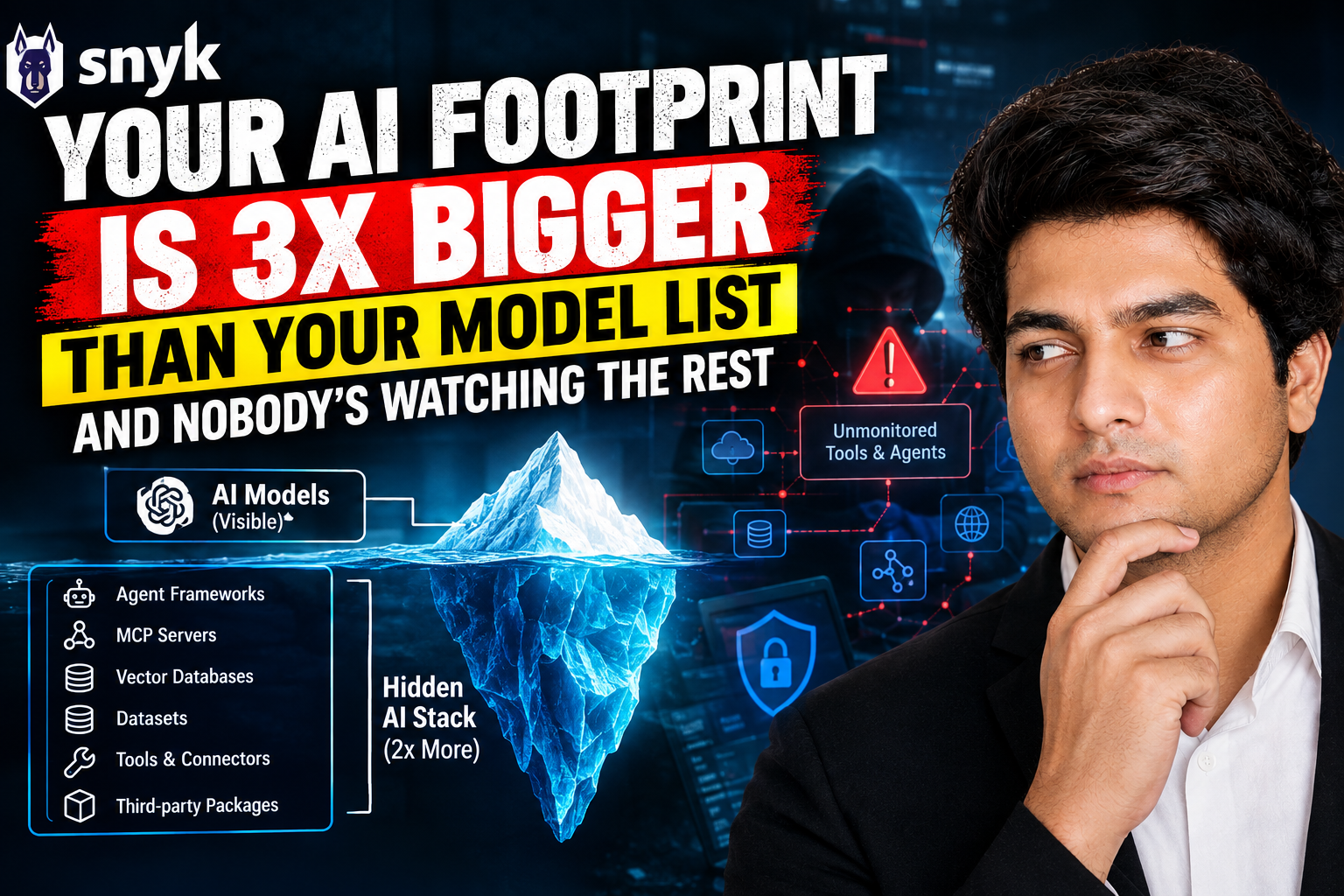
→ For every AI model an enterprise deploys, it typically introduces nearly three times as many hidden components — agent frameworks, MCP servers, retrieval systems, vector databases, datasets, and supporting tools
→ 33% of enterprises now run agentic architectures (AI agents, MCP servers, or both) — up from 28.4% just seven months earlier
→ More than half of those have gone full-stack, combining agents with infrastructure that connects directly to company data, internal apps, and external tools
→ 82% of AI tools are sourced from external packages, meaning most of this footprint is really an unmonitored software supply chain, not an internal build
→ This blind-spot ratio held constant across every region Snyk measured — Americas, Europe, Middle East, Africa, and Asia-Pacific
Snyk's own framing captures it well: models are the visible tip, the rest of the stack is the iceberg.
Here's why this matters beyond a compliance checkbox. Security programs are built around inventories — you protect what you know exists. If two-thirds of your actual AI surface is invisible to that inventory, every control built on top of it — access policy, data governance, incident response — is only covering a third of the real risk. And this isn't a future problem. Snyk called it directly: an audit, incident-response, and compliance problem waiting to happen, in enterprises that likely already believe they have their AI usage under control.
The uncomfortable part is that this gap isn't caused by employees going rogue with ChatGPT. It's built into how modern AI actually gets deployed — one model pulled in through official channels drags a chain of agents, connectors, and third-party packages behind it, and most of those never make it onto anyone's radar.
If your organization can currently only name the models it runs — not the agents, tools, and data connections around them — how confident are you in what you don't know is happening?
#AISecurity #ShadowAI #EnterpriseAI #Cybersecurity #AIGovernance #TechNews
— 𝔖𝔞𝔫𝔡𝔢𝔢𝔭 ℜ𝔞𝔦𝔷𝔞