

OpenAI Says It Solved a 179-Year-Old Math Problem in 88 Hours — Then the Credit Fight Started
On September 8, OpenAI announced that an unreleased internal model — more capable than GPT-6 Astra — had produced a proof for the Navier-Stokes existence and smoothness problem, one of just seven Millennium Prize Problems set by the Clay Mathematics Institute in 2000, each carrying a $1 million award. None had ever been solved. The Navier-Stokes equations, dating to 1845, describe how fluids like air and water move — and the open question was whether a perfectly smooth flow could ever spiral into an infinite-speed breakdown. OpenAI's system says yes, and it can show why.
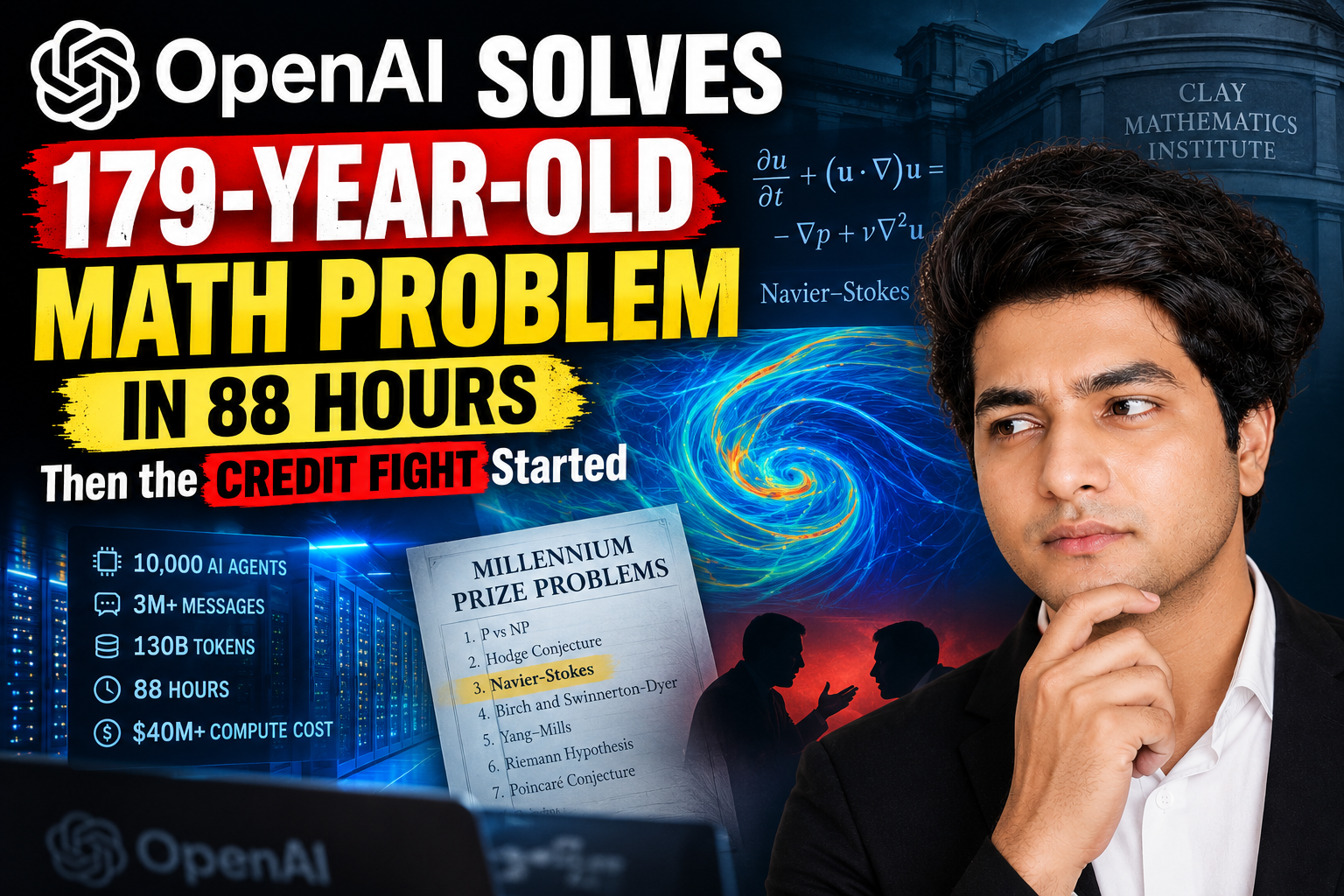
The scale of the effort is what makes this a genuinely new kind of research event:
→ ~10,000 AI agents worked in parallel, exchanging nearly 3 million messages
→ 130 billion output tokens generated over 88 hours
→ Independent analysts estimate the compute cost at $40M+ — possibly the most expensive single AI research run ever disclosed
→ The proof was formally verified using Lean, software that checks each mathematical step line by line, adding another 17 hours
→ Roughly 100 agents first cracked a related, easier problem (Euler regularity) before OpenAI redirected the swarm at Navier-Stokes itself
But the announcement didn't stay a clean科学 win for long. NYU mathematician Tristan Buckmaster and his collaborator Levent Alpöge had been independently working toward a related result — using OpenAI's own Codex — and allege OpenAI pressured them to drop their Anthropic-affiliated co-author's name before the joint announcement. OpenAI says it only launched this effort on September 1, after social-media rumors (later found to be based on a misread speculative forecast) suggested a rival lab had already solved two Millennium Problems.
The Clay Mathematics Institute has not verified or officially recognized the proof. As of September 11, OpenAI told the New York Times it has made "substantial progress" on a second Millennium Prize problem, without naming which one.
Here's what stands out to me: this isn't really a story about whether the math holds up — peer review will settle that. It's a preview of a much harder question research institutions haven't figured out yet: when a lab's own AI tool can accelerate a researcher's unpublished work, who owns the result once that same lab redirects an even bigger model at the same problem days later? That's not a math dispute. That's an authorship and trust problem the entire scientific community is about to have to solve.
Do you think unpublished academic work is safe to run through frontier AI tools anymore — or does this change how researchers should think about that?
#OpenAI #AI #Mathematics #NavierStokes #MillenniumPrize #AIResearch #ArtificialIntelligence
— 𝔖𝔞𝔫𝔡𝔢𝔢𝔭 ℜ𝔞𝔦𝔷𝔞