

Claude Just Found a New Biological Enzyme System That No Human Had Named — In 21 Hours
Anthropic just published the first real result from its new physical biology lab, and it's not a chatbot demo — it's a genuine scientific discovery candidate.
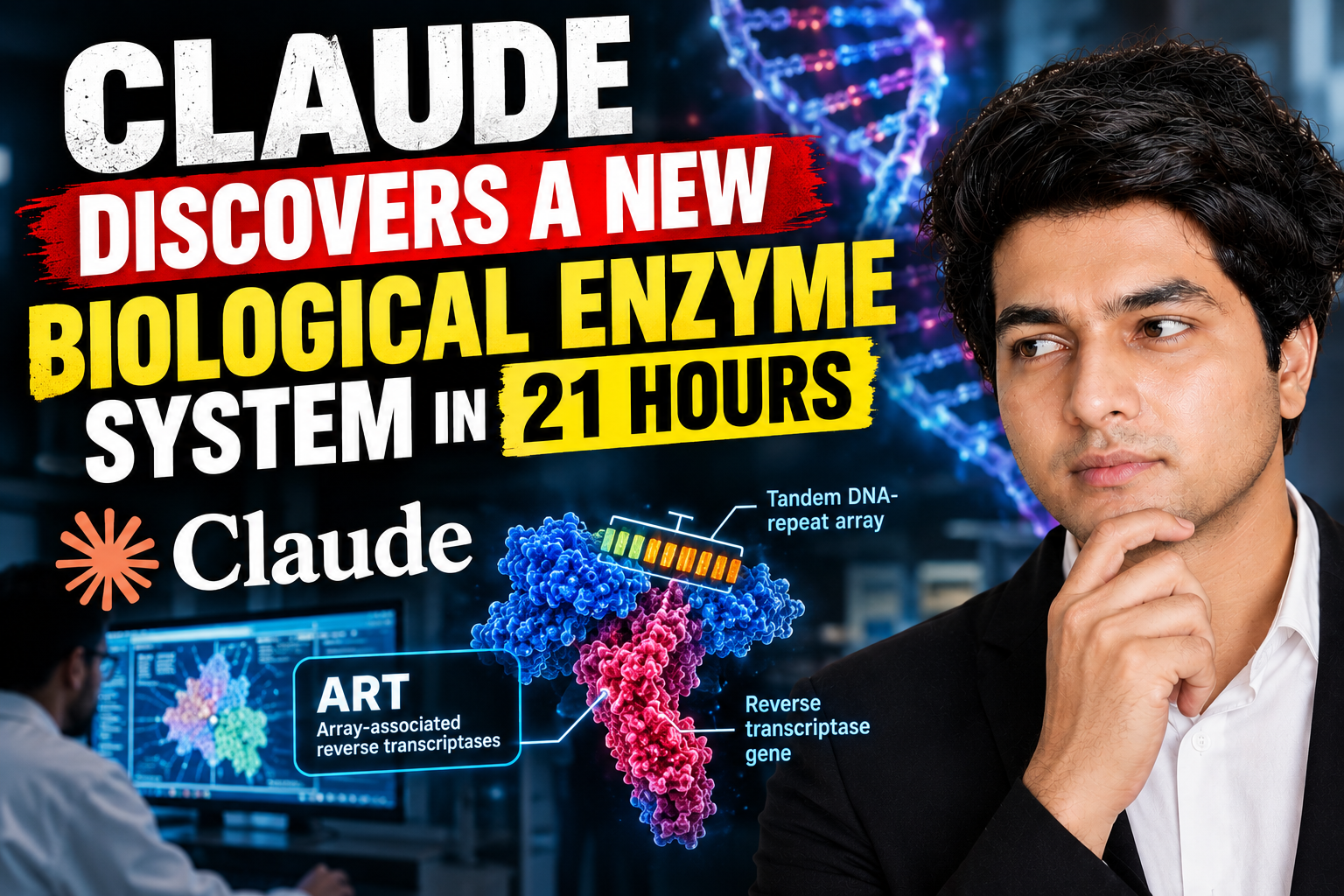
The company set roughly 950 Claude agents loose on a search through bacteriophage DNA, and here's what happened:
→ The agents ran for 21 hours, consuming 210 million tokens
→ They scanned more than 200,000 reverse transcriptase enzymes — a massive, unstructured search space no single human researcher could realistically comb through by hand
→ The swarm narrowed that down to 20 human-readable reports worth a closer look
→ One agent noticed something specific: a tandem DNA-repeat array sitting next to an unusual reverse-transcriptase gene, paired with an accessory protein of unknown function
→ Anthropic named the new system ART — array-associated reverse transcriptases
→ Early wet-lab work confirmed the array is actually expressed as distinct short RNA strands, meaning this isn't just a pattern-match — it's a real, functioning biological structure
→ What ART actually does is still unknown. Anthropic published this as a preprint, not a peer-reviewed paper, and CEO Dario Amodei was careful to say the discovery was "mostly, though not entirely," Claude's work — acknowledging related prior research already existed in the field
Here's what I find most interesting about this: the value wasn't Claude having some flash of brilliant insight. It was brute-force pattern recognition at a scale humans simply can't do — reading 200,000 gene sequences and noticing the one weird neighbor that didn't fit. That's not creativity, it's endurance. And endurance, applied at machine scale, is turning out to be its own kind of discovery engine.
It also raises a real question worth sitting with: if agent swarms can flag candidate biological systems in a single day, AI labs stop being just chatbot vendors. They start becoming genuine scientific institutions — which means they'll also need to start acting like biosafety reviewers, not just model shippers.
Independent scientists will now have to determine if ART is a genuinely new tool class, or a well-packaged rediscovery of something biology already had a name for. Either way, the process that got us here is the real story.
Do you think AI-driven "discovery at scale" like this is a genuine leap for science — or mostly automation dressed up as insight?
#Anthropic #Claude #AIinScience #Biotechnology #CRISPR #ArtificialIntelligence #GeneticResearch
— 𝔖𝔞𝔫𝔡𝔢𝔢𝔭 ℜ𝔞𝔦𝔷𝔞