

Amazon's Strands Labs Just Open-Sourced a Tiny 2-Billion-Parameter Model — And It's Built to Do One Thing Fast
While most AI headlines chase bigger models with more parameters, Amazon-backed Strands Labs just went the opposite direction — and open-sourced it for free.
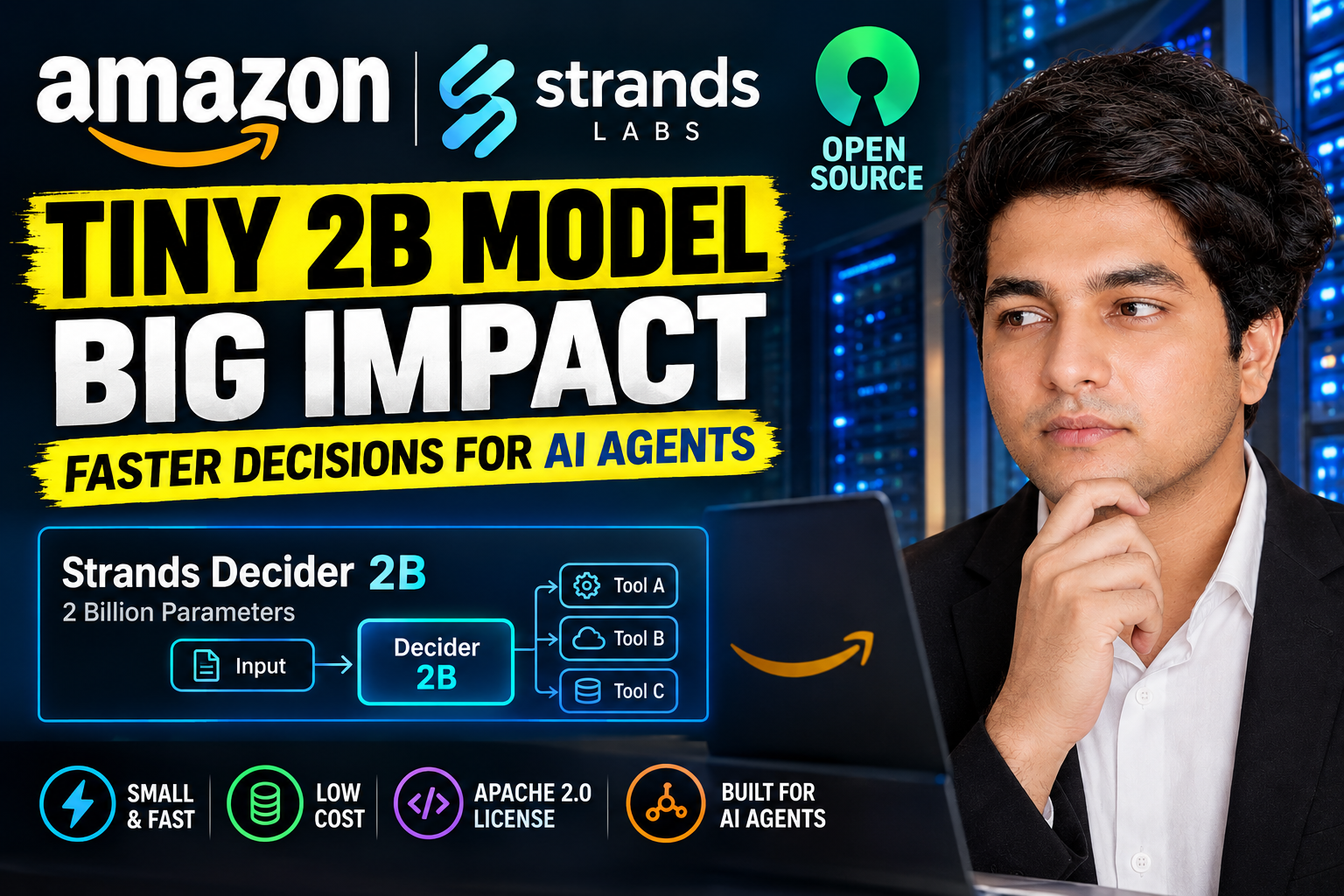
Strands Decider 2B isn't designed to write essays, hold conversations, or generate code. It does one narrow job: make fast decisions inside AI agent workflows.
 Here's what that actually means:
→ Instead of generating open-ended text, Decider chooses between options it's given, or scores an input on a scale — think "pick the right tool," "route this request," or "should this agent's proposed action go ahead, yes or no"
→ At roughly 2 billion parameters, it's a fraction of the size of frontier models like GPT or Claude — small enough to run quickly and cheaply
→ It's released under the Apache 2.0 license, meaning developers can deploy it freely on their own infrastructure, including commercially, with no usage restrictions
→ The underlying idea: today's AI agents often call a massive, expensive model for every single step — even trivial ones — which makes workflows slower and costlier than they need to be
Here's why this matters beyond the spec sheet. As AI agents scale into millions or billions of routine decisions — which tool to use, whether to escalate to a human, whether an output passes a basic check — those tiny decisions add up to real latency and real cost if you're calling a giant reasoning model every time. A small, specialized model sitting as a checkpoint between the big model and the action can handle that traffic far more efficiently, reserving the expensive model for the moments that actually need deep reasoning.
This points to something bigger than one model release: AI agents may not evolve into one giant brain doing everything. They may evolve into a stack — small, fast, specialized models handling routine judgment calls, with large frontier models reserved for genuinely hard problems. That architecture shift could matter more for how affordable and scalable agentic AI becomes than any single benchmark score.
Do you think the future of AI agents looks like one giant model doing everything, or a mix of small and large models working together?
#AI #Amazon #OpenSource #AIAgents #MachineLearning #TechNews
— 𝔖𝔞𝔫𝔡𝔢𝔢𝔭 ℜ𝔞𝔦𝔷𝔞