

A WORD FROM MOSES
There are hundreds of Bible verses that tell us to fear God. There are scores of other verses that tell us to not fear. Fear of God on one hand and do not fear on the other. Hundreds of verses. One verse puts these two instructions side by side. Let’s look at the context leading up to that verse.
The timing of the events in Exodus 19 is only a few months after Yahweh delivered the sons of Israel from Egyptian bondage to bring them to Himself. They were in the wilderness of Sinai. Moses stood as a messenger between Yahweh and Israel. But Yahweh was going to speak directly to the children of Israel and He gave Moses directions as to how the people should prepare themselves and when they should be ready.
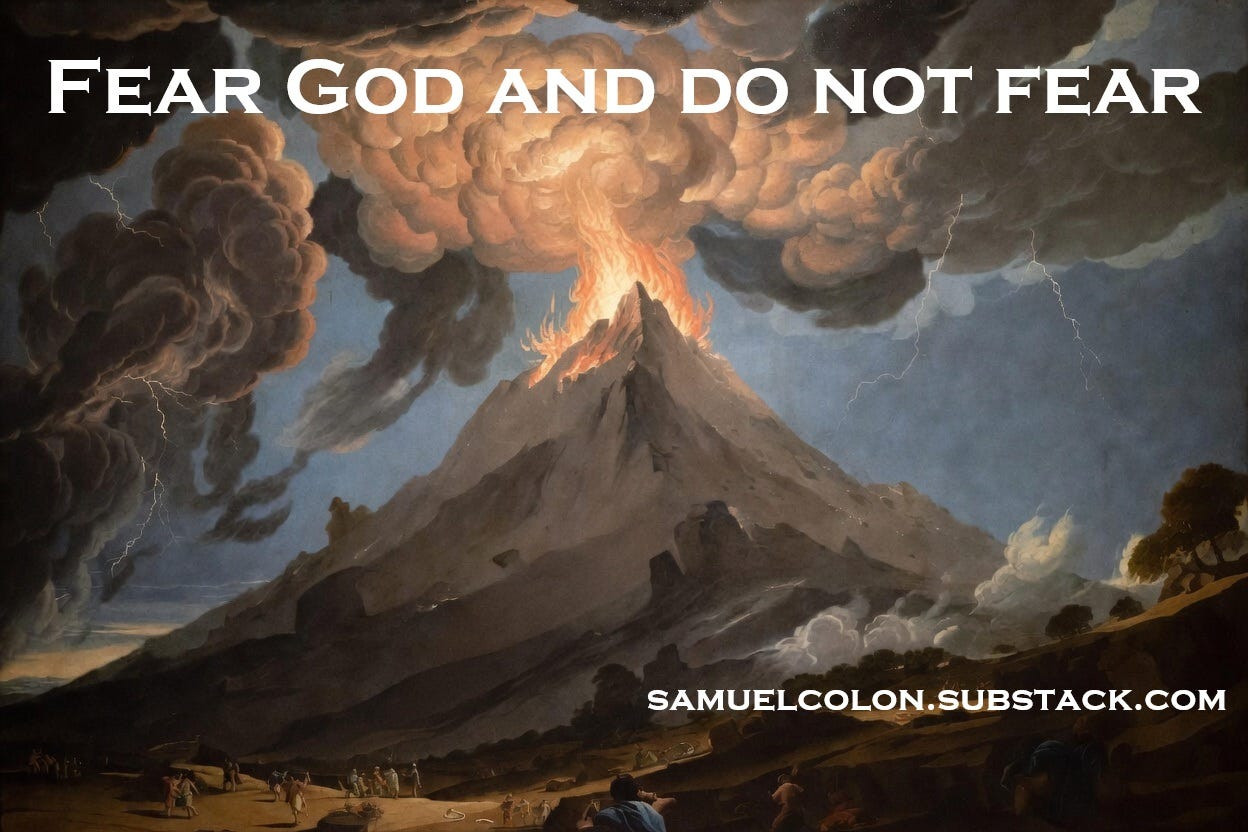
At the appointed time, Mount Sinai was enveloped in a thick cloud, thunder clapped, lightning flashed, and there were blasts of a very loud trumpet sound. The people trembled as Moses brought them to the base of the mountain.
Yahweh descended upon Mount Sinai in fire. Thick smoke ascended from the mountain, and it began to quake. The trumpet sound grew louder and louder. Moses communicates with Yahweh without any sign of being terrified. Then we turn to Exodus 20.
This chapter begins with Yahweh giving to Moses what we refer to as the Ten Commandments or the Ten Words. The mountain is still full of smoke, lightning, thunder, and the sound of trumpet blasts. The people are quivering at the foot of the mountain. They are so afraid that they tell Moses they do not want God to speak to them directly, lest they die. They possess a faithless fear that seeks to keep distance from Yahweh. At this point, Moses speaks the words that put the fear of God alongside the command not to fear.
And Moses said to the people, “Do not fear; for God has come to test you, and that His fear may be before you, so that you may not sin.” (Exodus 20:20, NKJV)
There we have it. Fear God and do not fear.
The fear of the people was a fear consisting of dread and terror. It was the anxiety of a guilty conscience. It was the stressful panic of an offender afraid of justice falling upon his head. This was the fear Adam had after the fall when he responded to Yahweh by saying, “I heard the sound of You in the garden, and I was afraid.” Moses didn’t have this fear. What he did have was the fear of God.
THE FEAR OF GOD
The fear of Yahweh is the beginning of knowledge; Ignorant fools despise wisdom and discipline. (Proverbs 1:7, LSB)
The fear of the Lord is the beginning of knowledge. This fear is essential. It cannot be the fear that Moses commanded to be put away. Rather, it is the fear that Moses possessed which allowed him to freely talk with Yahweh on a mountain engulfed in flames, smoke, thunderclaps, lightning flashes, and the sounds of loud trumpet blasts. No timidity. No terror. No trepidation. Just a man aware of his position as loved by Yahweh. A man of faith who esteemed the reproach of Christ greater riches than the treasures of Egypt, for he looked to the reward (Hebrews 11:24-26). The fear of God is knowledge of who God is. It is knowledge of God’s thoughts toward His people. His thoughts toward us are thoughts of peace and not harm, thoughts to give us a future and a hope (Jeremiah 29:11).
The fear of Yahweh is the beginning of wisdom, and the knowledge of the Holy One is understanding. (Proverbs 9:10, LSB)
The fear of Yahweh is the beginning of wisdom. The knowledge of the Holy One, Yahweh, is understanding. This fear is not one which causes a person to avoid God. This fear draws one to God. It is knowledge that the God who calls all of creation into existence, the God who is true, the God who is just, the God who is holy, the God who will judge all the earth, is the God who loves His people in Jesus Christ. The triune God is perfect in all His perfections. He is love (1 John 4:8) and because He is love, anything claiming to be love that is not grounded in Him cannot be love. The fear of God consists of this love, and it drives out all other fears. It drives out the fear Adam had in the garden. It drives out the fear the children of Israel had at the foot of Mount Sinai. It knows that Jesus, who knew no sin, was made to be sin so that believers might become the righteousness of God in Him (2 Corinthians 5:21). The fear of God’s punishment is gone.
There is no fear in love; but perfect love casts out fear, because fear involves punishment, and the one who fears is not perfected in love. (1 John 4:18, LSB)
The fear of God does not crush us with shame and guilt. It fills us with confidence.
In the fear of the LORD is strong confidence: and his children shall have a place of refuge. (Proverbs 14:26, KJV)
The fear of God is not a fear that causes us to say, “lest we die.” To the contrary, it is a fountain of life.
The fear of the Lord is a fountain of life, to depart from the snares of death. (Proverbs 14:27, KJV)
It does not shorten but rather lengthens our days.
The fear of the Lord prolongs days, but the years of the wicked will be shortened. (Proverbs 10:27, NKJV)
ABRAHAM AND ISAAC
In Genesis 22 we have the well-known story of Abraham offering up his son Isaac. As an aside, Isaac was not a small child when this occurred. We do not know his exact age at the time of the event, but we know that he was old enough to understand a lamb was missing for the sacrifice (22:7-8) and he was strong enough to carry a heavy load of wood up the mountain (22:6). This would, on the low end, perhaps put him in his teenage years. On the upper end, some have seen this event as possibly contemporaneous with his mother’s death. This would put Isaac in his mid to upper thirties. In any case, he isn’t a small child.
Yahweh says to Abraham, “Take now your son, your only son Isaac, whom you love, and go to the land of Moriah, and offer him there as a burnt offering on one of the mountains of which I shall tell you” (22:2). This is Isaac who is the son of promise. This is Isaac, the miracle child born to Sarah when she was ninety or ninety-one years old (Genesis 17:17).
This is Isaac who willingly let himself be bound and laid upon the altar (22:9). This is Isaac, the son obeying his father, prefiguring the obedience of Jesus obeying His Father even unto death. Isaac did not fear the knife raised above him in the hand of Abraham because Isaac feared God. Jacob, the son of Isaac, knew his father feared Yahweh. Jacob tells his father-in-law Laban of it:
Unless the God of my father, the God of Abraham and the Fear of Isaac, had been with me, surely now you would have sent me away empty-handed. God has seen my affliction and the labor of my hands, and rebuked you last night. (Genesis 31:42, NKJV).
Neither was Abraham afraid of the knife he held above the son whom he loved. The Angel of Yahweh calls to Abraham and tells him to stop. Tells him not to do anything to Isaac. And says so for a specific reason. Abraham feared of God.
And He said, “Do not stretch out your hand against the boy, and do nothing to him; for now I know that you fear God, since you have not withheld your son, your only one, from Me.” (Genesis 22:12, LSB)
The details are multitudinous but let’s look at just one more. At the beginning of this event God says to Abraham, “Take now your son, your only son Isaac, whom you love,” and at the end, the Angel of Yahweh says to Abraham, “for now I know that you fear God, since you have not withheld your son, your only son, from Me.” Notice the slight difference. Both declarations begin with ‘your son, your only son,’ but the last part changes. The initial declaration ends with the phrase regarding the son ‘whom you love’. This phrase is absent when the Angel of Yahweh tells Abraham to stop. It is replaced with the phrase, ‘from Me.’ The implication being that Abraham loved Isaac, the son of promise, but his greatest love was ‘Me,’ meaning Yahweh, the promise-giver and promise-keeper. His greatest love was Yahweh whom Abraham feared. To fear God is to love Him because He first loved us (1 John 4:19).
JESUS
Jesus is our perfect example of the fear of God. Isaiah 11 tells us of the rod or shoot that will spring from the stem of Jesse, the father of David. It is a messianic passage that tells us the Spirit of Yahweh will rest on the Messiah. It describes the Spirit as the Spirit of wisdom, understanding, counsel, might, and the fear of Yahweh. In fact, the Messiah will delight in the fear of Yahweh.
Then a shoot will spring from the stem of Jesse, and a branch from his roots will bear fruit. The Spirit of Yahweh will rest on Him, the spirit of wisdom and understanding, the spirit of counsel and might, the spirit of knowledge and the fear of Yahweh. And He will delight in the fear of Yahweh … (Isaiah 11:1-3a, LSB)
The fear of God is something to delight in. It is fellowship, communion, with Yahweh. The Son delights in it. We also, all who believe in the Son, sit at God’s table and delight. We are all adopted sons. This adoption entails a great many things. Among them is the removal of slavery and ungodly fear.
For you have not received a spirit of slavery leading to fear again, but you have received the Spirit of adoption as sons by whom we cry out, “Abba! Father!” (Romans 8:15, LSB)
When the virgin Mary is blessed with the revelation that she would bear the Christ of God, she believes and gives utterance, magnifying the Lord. In part, she speaks of the fear of God.
For He who is mighty has done great things for me, and holy is His name. And his mercy is on those who fear him from generation to generation. (Luke 1:49-50, NKJV)
Mary’s words echo the Psalms.
But the lovingkindness of Yahweh is from everlasting to everlasting on those who fear Him, and His righteousness to children’s children. (Psalm 103:17, LSB)
Fear that is not the fear of God causes one to distance himself from Jesus. When the Lord entered the country of the Gadarenes and delivered a man possessed by many demons the people were “afraid” (Luke 8:35). They were “seized with great fear.” They asked Jesus “to depart from them” (Luke 8:37). And He did.
Contrast that with the fear of God that rejoices in miracles, signs, and wonders. It happened on one day that Jesus entered with His disciples into a city called Nain. As they neared the city gates there was a large funeral procession. The dead man was the only son of a woman who was a widow. Jesus had compassion on her and tells her not to weep. Then he touched the open coffin, stopping the procession. He then says, “Young man, I say to you, arise.” The man who was dead is made alive and begins to speak. Jesus presents him to his mother. Fear came upon the people. But not fear like that of the Gadarenes. Here is what Scripture says of the fear of the people of Nain.
Then fear came upon all, and they glorified God, saying, “A great prophet has risen up among us”; and, “God has visited His people. (Luke 7:16, NKJV)
The fear of God draws us to the God who loves us. It teaches us to trust God who is our help and shield.
You who fear Yahweh, trust in Yahweh; He is their help and their shield. (Psalm 115:11, LSB)
The great and precious promises that belong to us believers are bound up in the fear of God.
Oh, taste and see that the Lord is good; blessed is the man who trusts in Him! Oh, fear the Lord, you His saints! There is no want to those who fear Him. The young lions lack and suffer hunger; but those who seek the Lord shall not lack any good thing. Come, you children, listen to me; I will teach you the fear of the Lord. (Psalm 34:8-11, NKJV)
To fear God is to have faith in Him. It is to know that God is a consuming fire. The Holy One who judges the wicked and unbelieving yet transforms those who are given His Spirt to the image of Christ from glory to glory. Moses feared God but One greater than Moses is here.
And we have such trust through Christ toward God. Not that we are sufficient of ourselves to think of anything as being from ourselves, but our sufficiency is from God, who also made us sufficient as ministers of the new covenant, not of the letter but of the Spirit; for the letter kills, but the Spirit gives life.
But if the ministry of death, written and engraved on stones, was glorious, so that the children of Israel could not look steadily at the face of Moses because of the glory of his countenance, which glory was passing away, how will the ministry of the Spirit not be more glorious? For if the ministry of condemnation had glory, the ministry of righteousness exceeds much more in glory. For even what was made glorious had no glory in this respect, because of the glory that excels. For if what is passing away was glorious, what remains is much more glorious.
Therefore, since we have such hope, we use great boldness of speech— unlike Moses, who put a veil over his face so that the children of Israel could not look steadily at the end of what was passing away. But their minds were blinded. For until this day the same veil remains unlifted in the reading of the Old Testament, because the veil is taken away in Christ. But even to this day, when Moses is read, a veil lies on their heart. Nevertheless when one turns to the Lord, the veil is taken away. Now the Lord is the Spirit; and where the Spirit of the Lord is, there is liberty. But we all, with unveiled face, beholding as in a mirror the glory of the Lord, are being transformed into the same image from glory to glory, just as by the Spirit of the Lord. (2 Corinthians 3:4-18, NKJV)
Moses spoke to God face to face as a man speaks to his friend (Exodus 33:11). A friend is someone who loves us and someone whom we love. This is us as believers. Jesus loves us, laid down His life for us, and calls us friends.
As the Father loved Me, I also have loved you; abide in My love. If you keep My commandments, you will abide in My love, just as I have kept My Father’s commandments and abide in His love.
These things I have spoken to you, that My joy may remain in you, and that your joy may be full. This is My commandment, that you love one another as I have loved you. Greater love has no one than this, than to lay down one’s life for his friends. You are My friends if you do whatever I command you. No longer do I call you servants, for a servant does not know what his master is doing; but I have called you friends, for all things that I heard from My Father I have made known to you. (John 15:9-15, NKJV)
CONCLUDING THE MATTER
Let us hear the conclusion of the whole matter: Fear God and keep His commandments, for this is man’s all. (Ecclesiastes 12:13)
Fear God. Love God because He first loved you (1 John 4:19). Jesus is our hope, so we use great boldness of speech unlike Moses who veiled his face (2 Corinthians 3:12-13). We reign in life through Jesus Christ (Romans 5:17). Jesus has made us adopted sons of the Father (Ephesians 1:5) and because we are sons, we are heirs of God through Christ (Galatians 4:7). Christ secured victory and authority, and because we are in Him, victory and authority belong to us. Jesus is Lord of all, and in Him, we are lord of all. The heir grows up into becoming master of the estate. The mature heir is lord of all.
Now I say, that the heir, as long as he is a child, differeth nothing from a servant, though he be lord of all; but is under tutors and governors until the time appointed of the father. Even so we, when we were children, were in bondage under the elements of the world: but when the fulness of the time was come, God sent forth his Son, made of a woman, made under the law, to redeem them that were under the law, that we might receive the adoption of sons. And because ye are sons, God hath sent forth the Spirit of his Son into your hearts, crying, Abba, Father. Wherefore thou art no more a servant, but a son; and if a son, then an heir of God through Christ. (Galatians 4:1-7, KJV)
Heaven calls us to fear God.
Then I saw another angel flying in the midst of heaven, having the everlasting gospel to preach to those who dwell on the earth—to every nation, tribe, tongue, and people— saying with a loud voice, “Fear God and give glory to Him, for the hour of His judgment has come; and worship Him who made heaven and earth, the sea and springs of water.” (Revelation 14:6-7, NKJV)
Fear God and give glory to Him. Glorify the Father in the Son by asking for greater works to be done in the name of Jesus. Our friendship with Jesus means we do what he commands (John 15:14). We do what he tells us to do, and He tells us to do greater works in His name. He promises that when we ask anything in His name, He will do it.
Most assuredly, I say to you, he who believes in Me, the works that I do he will do also; and greater works than these he will do, because I go to My Father. And whatever you ask in My name, that I will do, that the Father may be glorified in the Son. If you ask anything in My name, I will do it. (John 14:12-14)
Let us fear God and give glory to Him by the faith which does greater works. We are not those who fear death at the foot of the mountain. We believe in the Son and have everlasting life (John 3:36). We are sons and daughters. We are heirs with Jesus. We are friends of God. Let us worship Him who made heaven and earth, the sea and springs of water; Him who bore our griefs, carried our sorrows, was pierced for our transgressions, crushed for our iniquities, and chastised for our peace, that we might receive salvation and healing (Isaiah 53).
Fear God and do not fear.
But I will show you whom you should fear: Fear Him who, after He has killed, has power to cast into hell; yes, I say to you, fear Him! Are not five sparrows sold for two copper coins? And not one of them is forgotten before God. But the very hairs of your head are all numbered. Do not fear therefore; you are of more value than many sparrows…
But seek the kingdom of God, and all these things shall be added to you. Do not fear, little flock, for it is your Father’s good pleasure to give you the kingdom. (Luke 12:5-7; 31-32)