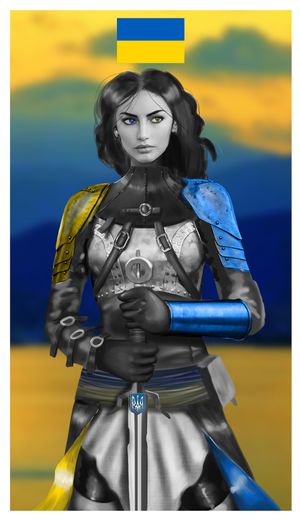

27 April, 5784 5th Age
Dr. Shannon Avery is a sífralogist (a scholar who studies the Sidhe and the history of Tir Na N’Og) and professor of folklore and Celtic Studies at Trinity College, Dublin. She is also a fellow of the El’Sira, a 5000 year-old society devoted to scholarship of all things Fae. She is considered the foremost expert on the life and reign of Rhiannon Sionne Angbarad, current High Queen of Tir Na N’Og and the Sidhe Nation in Adess A’shur.
This interview appears in full in the most recent volume of the El’Sira journal Cruianniau (the meeting place); the version here has been edited for length and for security reasons.
Part One…
Avery: Thank you for doing this.
RSA: Well, thank you. I hate doing pressers, as you know, so—
Avery: I won’t be too much of a journalist.
RSA: (laughs) Good! That’s a relief.
Avery: So, something like our own little version of the Screwtape Letters?
RSA: That works.
…
Avery: I know what you really want to get into is the so-called RSA Doctrine.
RSA: Yeah, I didn’t name it. Someone else came up with that. Kind of lazy writing if you ask me.
Avery: What would you call it?
RSA: Something catchier and more descriptive. Something that would scare people a little, I think. The Don’t Fuck With the Fae Doctrine? (laughs)
Avery: More descriptive would be helpful, especially for people who don’t know the history of Fae involvement in the human world. Or maybe you could explain how your approach differs from the approaches of earlier Queens, with regard to Fae/human relations?
RSA: Well, without getting too deep into Third Age history—I was working on a book about that, specifically the shift to Doubhlynian Druidism beginning in the Third Age and everything that followed from that, when ruzzia launched its full scale invasion of Ukraine in February 2022—
Avery: So, it’s safe to say that Fae history had a strong influence on Sidhe Nation’s response to that.
RSA: Certainly, though the book took a back seat for a while because of that, too. But focusing on the Fifth Age, the first official policy on Fae/human relations was the Arhynrod Doctrine. Another not very creative name, since it was developed by Rhiannon Arhynrod. Basically, it said that the Fae would take a strict non-interventionist approach to humanity, except in situations where Sidhe Nation interests were at risk.
Avery: It wasn’t very clear on what exactly was meant by “Fae interests” or by “at risk.”
RSA: No, it wasn’t. And so different Queens have interpreted it differently over the last 3000 years. Arhyrod herself broke her own rule several times, and Queen Meave’s exploits in the human world are famous in poem and song. And of course, Rhiannon Atan is probably the most famous case of a Queen ignoring the rule that we’d only get involved in human affairs when it concerned the interests of the entire Tribe, not for personal reasons.
Avery: She meddled in human politics on behalf of a human lover.
RSA: Yes, and she got herself executed for it. Well, not just that, but you know, that’s another story. But it did have a chilling effect. The Fae, not just Queens and Lords, but from all strata of society, started to feel like it wasn’t worth it to help humans. That it wouldn’t, or couldn’t make any difference anyway, and it could have blow-back on the health of Fae society.
Avery: Fae started to feel like it was best to leave humans to whatever fate they designed for themselves. And this was, well not the beginning, but the beginning of the political prominence of the Vásh Dubh faction.
RSA: Exactly. (laughs) You know, for the last few months—I’ve been working with several activist groups to get aid to Ukraine passed in the United States—for the past few months, I’ve heard a lot of people feeling sorry for [Speaker of the U.S. House of Representatives] Mike Johnson. “He’s in a very tough political situation,” they said. Well, if he thinks that’s a tough political situation, he ought to try having my job for a day. I’ve got people in Tir Na N’Og—the Vásh Dubh is the most vocal faction but there are others—who still use terms like “bandari vermin” to describe humans and call for them to be exterminated before they can “infect” any more of the Universe. They call the RSA Doctrine “Her Little Experiment” and say that it has already failed. That some small portion of humans are fighting for the survival of their species, this doesn’t prove humanity is salvageable; in fact, it proves the opposite, they claim, because it’s impossible for humans not to see what’s going on now—fascism and genocide and destruction—and still the majority of them are apathetic. So, that shows humanity is fundamentally flawed, that they should be “put down” for their own good, if not for ours. And then on the other end, I have people who are angry that I’m doing more to help Ukraine, the Syrians, the Israelis and the Palestinians, the people in Mali and Nigeria who are being overrun by Wagner-trained terrorists. So, yeah, difficult political position, to say the least.
Avery: And the worst that will happen to Johnson is that he’ll lose his job.
RSA: Right. I mean, my people could do a version of “vacate the chair” to me, but if that succeeded, they wouldn’t just let me take my toys and go home.
Avery: Historically, people who are “vacated” from their positions of power in Tir Na N’Og face a pyre after that.
RSA: Right. So, the stakes are a bit higher on my side of the veil, too. [editor’s note: Sidhe refer to the separation between their world and the human world as “the veil”]
…
Avery: How does the RSA Doctrine change earlier policy, and what prompted the change?
RSA: (laughs) Well, as to the second question, you have no doubt heard rumors.
Avery: Similar rumors were floating around when the Elfrida got involved in the Balkans Wars in the 1990s.
RSA: Yeah, those found a lot more purchase back then, in part because I had only been Queen for a short time. People didn’t really know me, and they were suspicious of my loyalties, not to mention my skills. But now, it’s a lot more obvious that, even under the old Arhyrod Doctrine, we had to get involved in Ukraine. [Editor’s Note: Unlike every other ruler of Tir Na N’Og before her, Rhiannon Sionne grew up and spent most of her youth in Adess A’shur living among humans.]
Avery: For humans who aren’t familiar with sífralogy—
RSA: Well, again without getting into all the history of the Third and Fourth Ages, the short answer is: there are a lot Fae in Ukraine. Fear Laithi [offspring of parents from two different species, normally Fae and human], Tinnari [Fae that have been cast out of Tir Na N’Og for criminal behavior], and of course the Rusalki [one of the 13 Karui or Tribes of the Sidhe] have always had close relations with humans, so there is trade and resource sharing and common cultural elements. We couldn’t just sit back and watch our Cousins be destroyed, even if there wasn’t already a larger war against ruscist fascism being waged. If Ukraine had been attacked by, say, Turkey or Poland, we’d have come to Ukraine’s aid just because they are kith and kin. And because they were attacked by ruzzia, whom we were already fighting a sort of shadow information war against, the decision to involve ourselves in Ukraine was obviously the right one.
Avery: But you didn’t need a new doctrine or fundamental shift in policy regarding humans to do that. Why the change?
RSA: Partly, it had been coming for a long time. Or since I’ve been Queen anyway. I guess you can blame me for that. The old policies were based on the arguments of people who thought like the Vásh Dubh, people who saw humans as either vermin to be exterminated or chattel to be exploited. And a certain degree of “Tir Na N’Og First!” if you’ll pardon the paraphrase. (laughs). But First Dimensional Physics, ya know. We’re all part of the whole, and all the Whole Herself, so what happens to humans, what happens in Adess A’shur, those things affect the entire Universe, and we can’t ignore that. The creation of humanity was done with a certain recklessness, a departure from the usual Fae habit of thinking everything through for eons before making a decision. (laughs). But seriously, we shouldn’t destroy humanity with the same recklessness. Law of Unintended Consequences, ya know?
Avery: But it’s not like that’s always been the case, that the majority of Fae wanted either to destroy humans or to ignore them completely, maybe even unto standing by and watching while they destroyed themselves.
RSA: Yes, the Fae have ancestral memory, so we all remember El’Adin. [Editor’s Note: El’Adin refers to a late Forth Age project to help humans evolve and learn to live peacefully with each other; it failed spectacularly: see Shannon Avery’s book “The Queen’s Rune and Other Tales of the Sidhe”] Which was largely what gave rise to the Arhyrod Doctrine in the first place. But it’s been nearly 6000 years, so maybe it’s time to try again? And—you asked about what inspired the doctrinal change—it was the Ukrainians themselves. There’s a saying in Sinti, roughly translated as: Great acts of courage bring mighty powers to your aid. The messaging—I call it ruscist pragmatic nihilism—this fascist idea that we all live in a “post-truth” world, that you can’t ever really know what’s true, moreover there is NO SUCH THING as knowable truth, is a relatively (no pun intended) new feature of authoritarian regimes. At least, that it would be articulated so clearly. It’s a direct result of the arc of history bending toward democracy and equality, I think. A few thousand years ago, without scientific method, people just assumed the world was unknowable, that they were helpless to create their own circumstances, so it was best to simply obey a ruler, some demi-god or monarch. That was only way to survive. But then some scientists came along and said, no, you CAN know the truth. It takes work, but anyone can learn to do it. You don’t have to be born of a god or have some special powers. And that was the start of democracy, of We the People.
Avery: Americans like to think they invented that.
RSA: (laughs) Yeah, but they didn’t. The ancient Greeks understood this. The Celtic Empire had a version of it 2000 years ago.
Avery: The Iroquois Nations in North America. Even the Romans, sort of.
RSA: It’s an idea that’s been nibbling at the edges of the zeitgeist for millennia. That one can learn the truth, or at least that some knowable truth exists. And when you realize that, you realize you aren’t helpless. That whoever you are, it is possible for you to contribute to creating the world you want to live in. But fascists and authoritarians want you to believe that’s not true, that the world is unknowable and you are helpless. Because then you have no choice but to obey them. They are only ones who will save you. It’s “I alone can fix it.” And if you believe that, then you’re willing—you’re eager!—to give up every last bit of self-agency, every last freedom, just to feel safe.
Avery: So, would it be fair to say that the RSA Doctrine is focused on empowerment?
RSA: Yes, exactly. I think there’s sort of a version of the virgin/whore dichotomy in Fae thinking about humans. Humans are either vermin who need to be exterminated, or they are maidens in towers who need rescuing. The RSA Doctrine is about creating a new narrative, in both Adess A’shur and in Tir Na N’Og. That humans can save themselves. Early in spring of 2022, I started talking publicly about how the Sidhe don’t have heroes anymore. We don’t put up monuments—well, we don’t do that anyway—but we don’t have memorials to the Great Heroes of the Fifth Age or anything like that. Not that there haven’t been important contributions to the worlds made by individual Fae during the last 6000 years. It’s just that we don’t really need heroes anymore. Because somewhere along the way, we learned that an ounce of prevention is worth a pound of cure, so to speak. That if everyone—every single person living in a place and time—gives a little bit for the good of their community, their nation, their species, then we don’t need some super-immortal-type demi-god hero with supernatural powers. Or to paraphrase the Merlyn Pirell, we can all be heroes. And that’s what I saw in Ukraine. I saw old men standing in front of tanks and toddlers selling lemonade to buy socks for the soldiers.
Avery: And old women taking out ruzzian drones with pickle jars.
RSA: Yes! I saw human beings who weren’t going to wait around for the cavalry to come save them. They were, to a person, doing whatever they could to save each other, to save themselves. And that’s the difference with the RSA Doctrine. We aren’t going to only get involved where our own interests are concerned anymore. We aren’t going to try to make humanity over in our image either, though. I was one of the first to say “Nothing about Ukraine without Ukraine,” and now it’s starting to penetrate the thinking even in America, where they love to play the savior and then think that gives them the right to dictate how the people they “saved” should live.
Avery: So, you’re not trying to annex Ukraine and make it part of Tir Na N’Og?
RSA: (laughs) No, though I’ve been accused of that on both sides of the veil. Empress of the Universe is not a job I want. I barely want the job I have!
Avery: Your job has gotten much more complicated and intense over the last two years.
RSA: Yeah. But that’s the point. I could have just called up the Elfrida to help Ukraine and argued it was line with the old doctrine. But when I saw Ukrainians deciding to be their own heroes, and millions of others around the world being inspired by that and starting to feel empowered by it and to reject the cultish programming of ruzzian pragmatic nihilism, I felt hope for humanity for the first time in a very long time. I think quite a lot of Fae did. So, the RSA Doctrine was born. It’s not just in Ukraine. All over the world, humans are waking up and deciding to take back their power. Deciding they have the power to save themselves, to create a better world for themselves. And anywhere in the world they are doing that, we’re going to go have their backs.
End of Part One.