
My aim in the wake of my mother's death is to forge connections, to find the way forward. But when I share this, people think it's part of a grief journey. But I don't feel like I'm grieving at all, and I don't know how to explain that to anyone. I don't feel guilty or lost or confused or any of that. It's not a grief journey. It's me saying, "I can live my life fully now. What do I do next?"
I've had people reach out to me to see if I need support or counseling. How do I say, "No, thank you. I'm fine. I'm not grieving my mother at all." Who would believe such a thing? I'm reminded of The Stranger by Albert Camus where a man is judged for not crying at his mother's funeral. (At least, I think that's how it went. That's all I can remember about the novel.)
Yes, I wept when my mother died. Yes, I cried before I helped push her body into the cremation chamber. Both these instances felt like an expression of a higher energy, a connection with the divine. My mother was going home, and I was helping her.
The other day I saw a post on social media where someone shared a photo of themselves with their mother, saying something like, "I miss her every day."
While I relate to the feeling of missing someone, I can't relate to the feeling of missing my mother. Do I miss my mother? I don't think so. I don't think she ever really left, for one thing.
If I grieved, it happened years ago.
My mother has always been an alcoholic. She continued to drink even while on chemo. She surprised me by apologizing for it in the days before her death. She said, "I had to drink because I couldn't handle how I was feeling."
When I was little, Mama drank whiskey. She worked a full-time job, but in the evenings, she drank, and she talked about suicide all the time. (I think this is why my brother Miles felt he had permission to shoot himself when he was 27.)
When I was a teenager and a young adult, without knowing it, I grieved what never existed. I had spent my childhood trying to save my mother, trying to protect her from herself, trying to talk her out of killing herself. When she tried to physically harm herself, I used my body as a shield.
Miles could not handle our mother, so he changed his number frequently. I took on the responsibility of looking after her. When she drank, she became verbally and sometimes physically abusive, though her small stature prevented her from actually hurting me. Despite not always remembering what happened the next day, I think she felt guilty but didn't know how to cope with it, so she hid her glass and drank in her room by herself.
Some years ago, due to a lot of inner work, I let go of any anger or resentments. I knew she couldn't help it. My mother had a difficult life. Because I was able to fully let go, I was able to serve as her death doula.
That's why, by the time she apologized prior to her death, I hadn't expected it, nor had I needed it. I forgave her so many years ago that none of it mattered anymore.
I spent many hours meditating beside her, accompanying her on the journey. To do this for someone is a great honor.
In her final weeks, she'd been working on a poem, adding to it. I had seen earlier drafts, but not the completed piece.
Here are the final lines:
"I will laugh while I cry because my heart is broken for an unhappy son; and my heart is healing for my beautiful daughter, Rosa, and for every person's kindness. Truly spoken with all my love."
I see her soul, and it is beautiful, luminous.
We are more than our bodies, our lives here on earth.
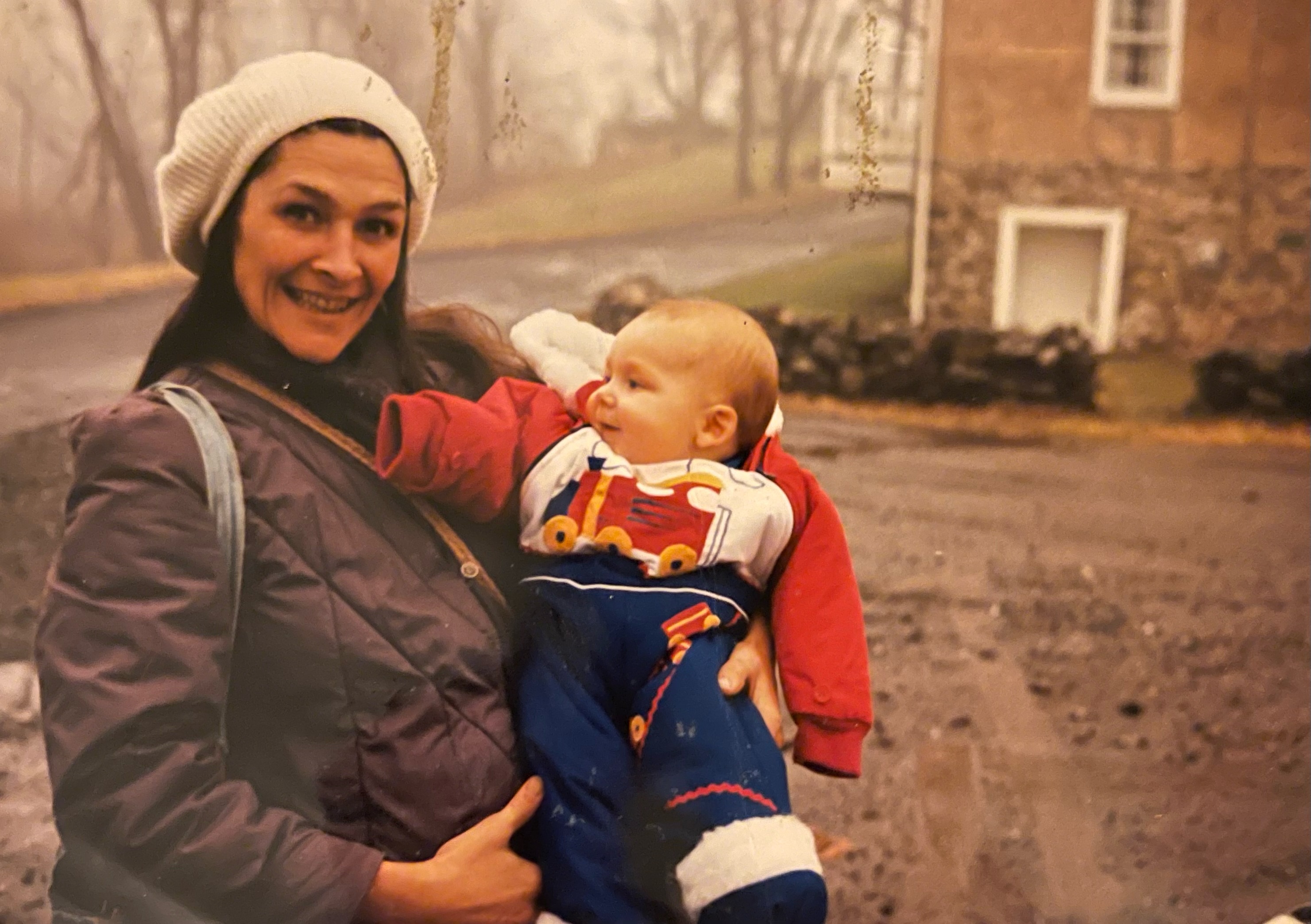
Here's a photo of my mother holding my brother Miles. They are together now.