

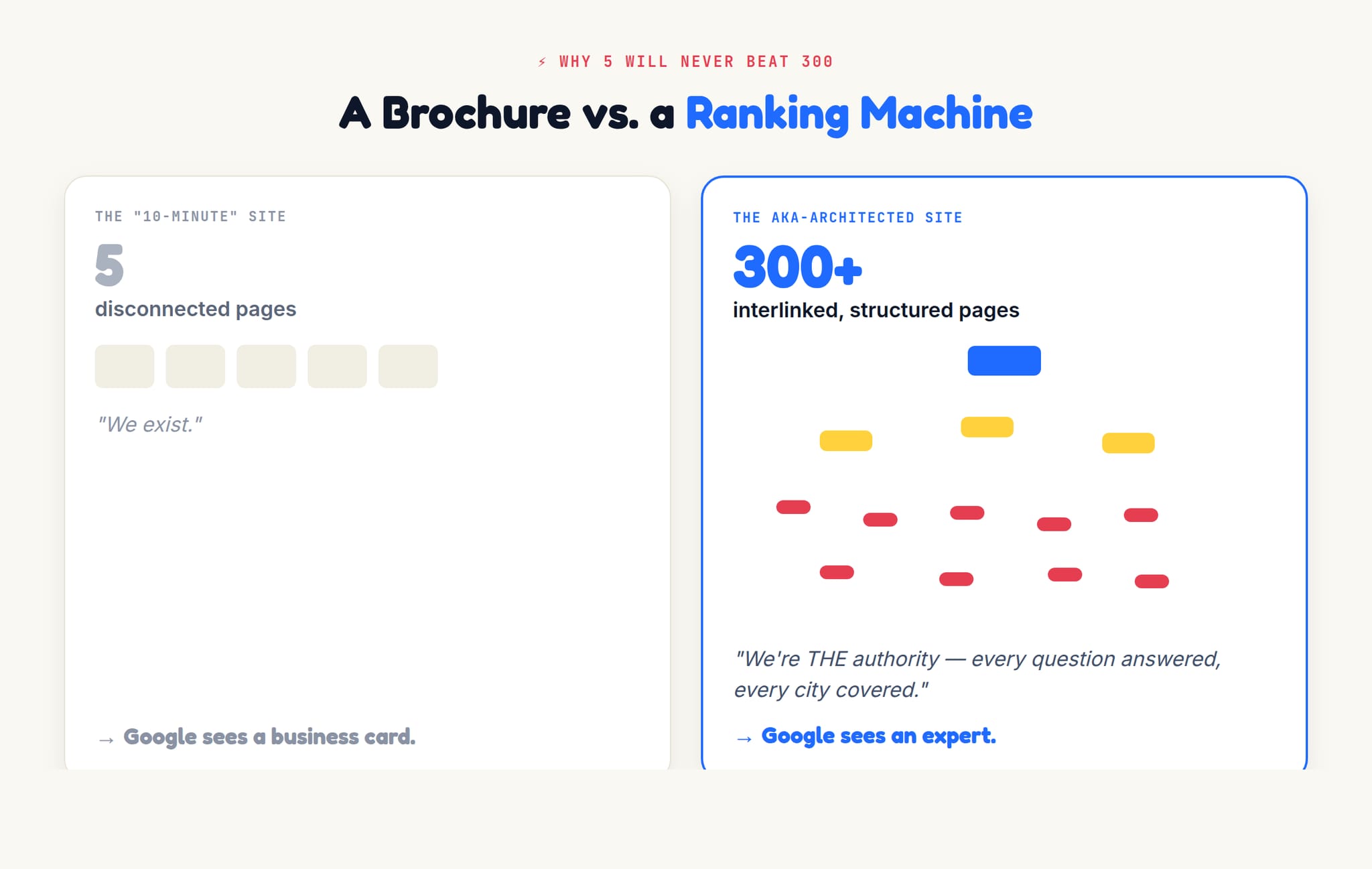
A few days ago I said your AI website will never rank ...not because of AI, but because of the one thing every "build it in 10 minutes" tool skips: architecture. A lot of you asked the obvious follow-up: okay, so what does that architecture actually look like?
This is the answer. It's a little more technical than my usual posts. That's on purpose. because this is the part nobody explains.
Google doesn't rank pages. It ranks topical authority.
Here's the mental model shift. Google isn't asking "is this page good?" It's asking "is this site the authority on this subject?" It answers that by reading your whole site as a structure ... how completely you cover a topic, how your pages connect, how deep the expertise goes. A single great page is a data point. A network of interlinked pages that covers every angle of a subject is a signal Google can't ignore.
That's why volume alone fails too. Stamping out 200 disconnected pages isn't authority ...it's a bigger pile of noise. Structure is what turns pages into authority. That structure has a shape, and it's the AKA SEO wireframe.
The AKA SEO wireframe: Authority → Knowledge → Answer
Three layers, each doing a specific job.
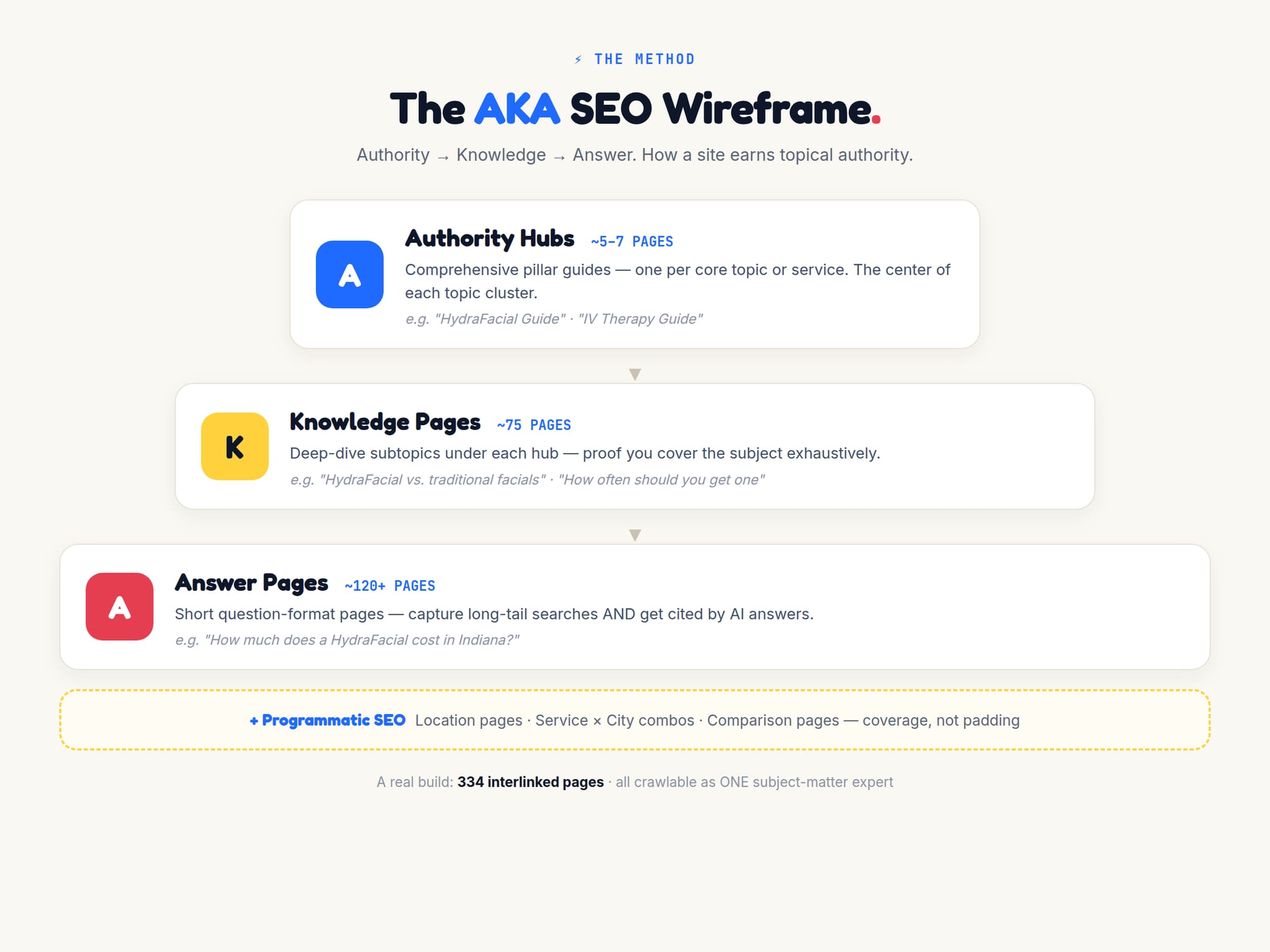
1. Authority Hubs — your pillar pages, one per core topic or service. For a med spa: a HydraFacial guide, a Body Sculpting guide, an IV Therapy guide. These are comprehensive, the "everything about this" page Google treats as the center of a topic cluster.
2. Knowledge Pages — the deep-dive subtopics that live under each hub. Not "HydraFacial" again, but "HydraFacial vs. traditional facials," "how often should you get a HydraFacial," "HydraFacial for acne-prone skin." Each one proves you've covered the subject exhaustively . which is exactly what topical authority means.
3. Answer Pages — short, question-format pages targeting the exact things people (and now AI assistants) ask: "how much does a HydraFacial cost in Indiana?" These capture long-tail searches and are the format most likely to get cited by ChatGPT and Google's AI answers.
Then you layer in programmatic SEO: location pages (your city + every nearby one), service-plus-city combinations, and comparison pages (you vs. the alternative). That's how a real authority site gets to 200–300 pages — not padding, coverage.
The part everyone skips: the wiring
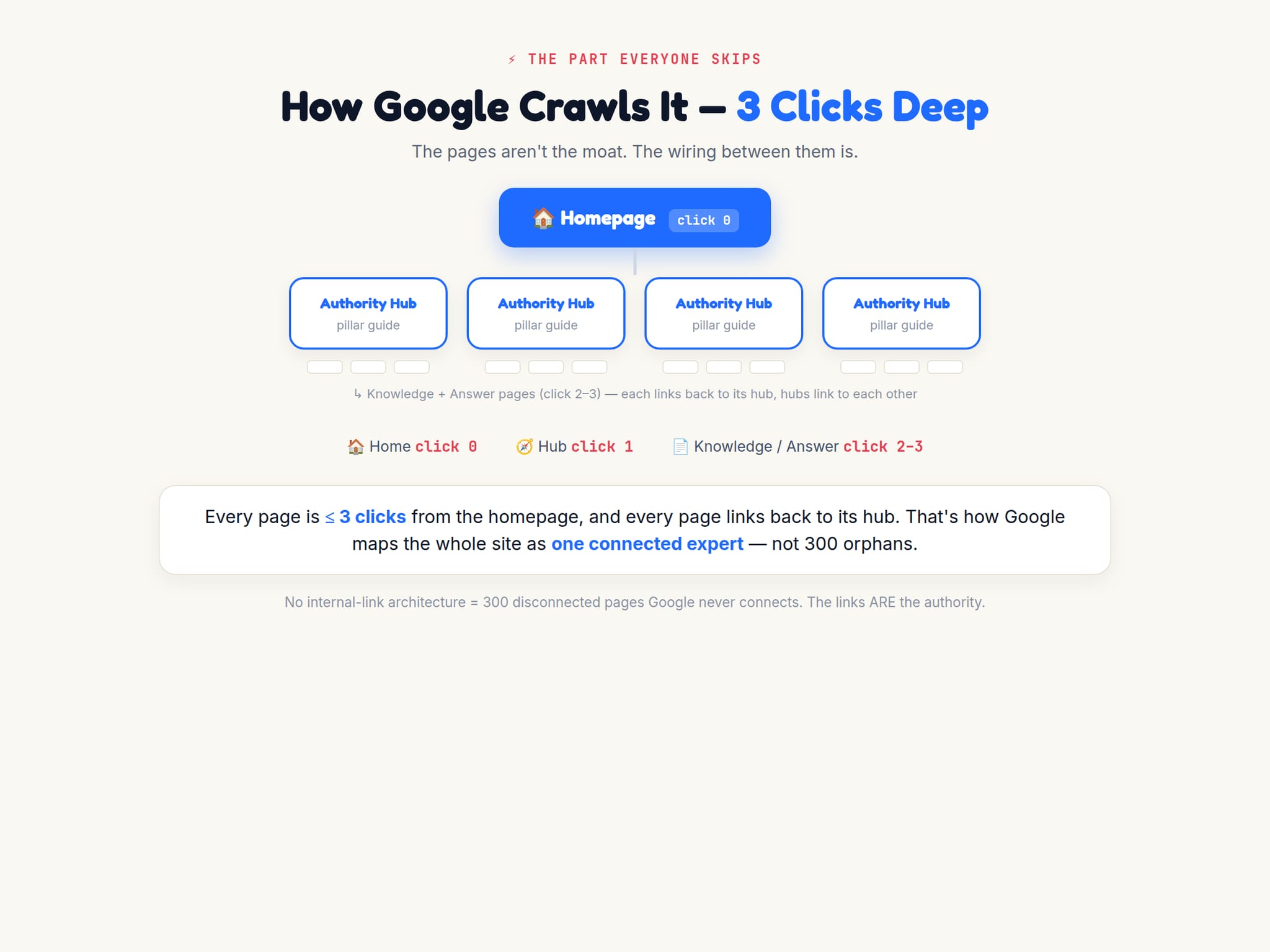
Here's where most "AI sites" die. Building the pages is only half of it. The pages have to be interlinked — every knowledge and answer page links back to its hub, hubs link to each other, and the homepage links to all of them — so Google can crawl the entire site in about 3 clicks and map your expertise as one connected thing. No internal-link architecture, and you've just got 300 orphans. The links are the authority.
What it looks like, real
I generated one of these for a med spa in Crown Point, IN: 334 pages — 5 treatment-authority hubs, ~75 knowledge pages, ~124 answer pages, 18 location pages, 90 service+location pages, plus FAQ and comparison pages. All mapped, all interlinked, all built to be crawled as a single subject-matter expert. That's the difference between a brochure and a ranking machine.
See your own Authority Map — free.
Enter your niche and your city, and you'll get this exact architecture mapped for your business, on the AKA wireframe, as a PDF. No email wall, no catch. 👉 https://sonic.saasperity.com/authority-map
It's the fastest way to see why you're not ranking... and exactly what to fix.
And if you'd rather not build it yourself ... that's what Sonic does: 200–300 brand-aligned pages, architected to your map, in about 90 minutes. I'm taking a small founding cohort of agency owners through it right now, and Cohort 2 closes June 7. Want in?
Reply "Invite" and I'll send you an invite code before the doors close.
Don't just build fast. Build right.
— Rabih