
You may have heard about one of Canada’s best known musical plays, Billy Bishop Goes to War. It tells the story of legendary WW1 flying ace, Victoria Cross recipient, and Canadian hero, Billy Bishop.
But you need to know about his wife, too: the outstanding Margaret Eaton Bishop.
Margaret took an idea built on the tradition of signature quilts as fundraisers. It’s a relatively humble sounding thing, and a huge undertaking. I feel like knowing what she did might inspire people to pick up the mantle and continue to do good for others.
During WW1, the Red Cross printed pamphlets and instructions for how to create a signature quilt as a war effort fundraiser. On widely distributed pattern pages, the instructions included some lofty goals, including leveraging a signature quilt, where $1000 would outfit 126 hospital beds with sheets and blankets, or organize a field ambulance. This isn’t like the motorized ambulance outfitted with cutting edge gear and extensively trained paramedics we see pulling up to emergencies today. A field ambulance (or field hospital) was a was a temporary assembly of canvas tents with poles and guy wires handy to trip you up so you could land unceremoniously on a dirt floor. A field ambulance was an elaborate staging area where medics could stabilize injured soldiers before transporting them to sturdier and better equipped hospital spaces.
Canadians rallied and paid dimes and quarters to have their names added to Red Cross quilts. The early ones were often signed with indelible ink, but sometimes, and particularly by WW2, pieces of fabric were signed in pencil so that a volunteer could embroider the names of contributors in red thread. Imagine the time it would take to embroider a few hundred signatures! Once the embroidery was complete, and the quilting finished, raffle tickets were sold to make additional money.
My favourite of all the signature quilts has a ton of history associated with it, and highlights a big part of the reason for me getting involved in this project to ship the surviving Canadian made WW2 quilts from a private collection to have them highlighted and shared in Canadian museums.
Let me introduce you to how Mrs. Bishop went to war.
The Eaton’s Empire was founded Timothy Eaton, who eventually had a granddaughter who became Margaret Eaton Bishop. Margaret married her long time sweetheart Billy Bishop in 1917. Billy was a WW1 flying ace, and recipient of the Victoria Cross. He has been immortalized in poetry, museums, books, airports, and one particularly fabulous musical called Billy Bishop Goes to War.
By 1939, Canada was in the throes of the Second World War, and Margaret Bishop was an active member of the Air Force Wives Association in Ottawa. She had a great idea for a special signature quilt that would make an enormous impact. To help put her idea into some context it’ll help you to know that absolutely everyone was trying to raise money for every facet of the war, and resources were scarce. People were constantly being asked to contribute to charity, because the government had no way to pay for any of it. Taxes were barely a thing in Canada, and hardly anyone was paying them anyway.
As a war hero Billy travelled throughout Canada during WW2 recruiting, and was also back and forth to Britain where he could visit with his friend Winston Churchill, and pop into some of the entertainment being provided to the troops.
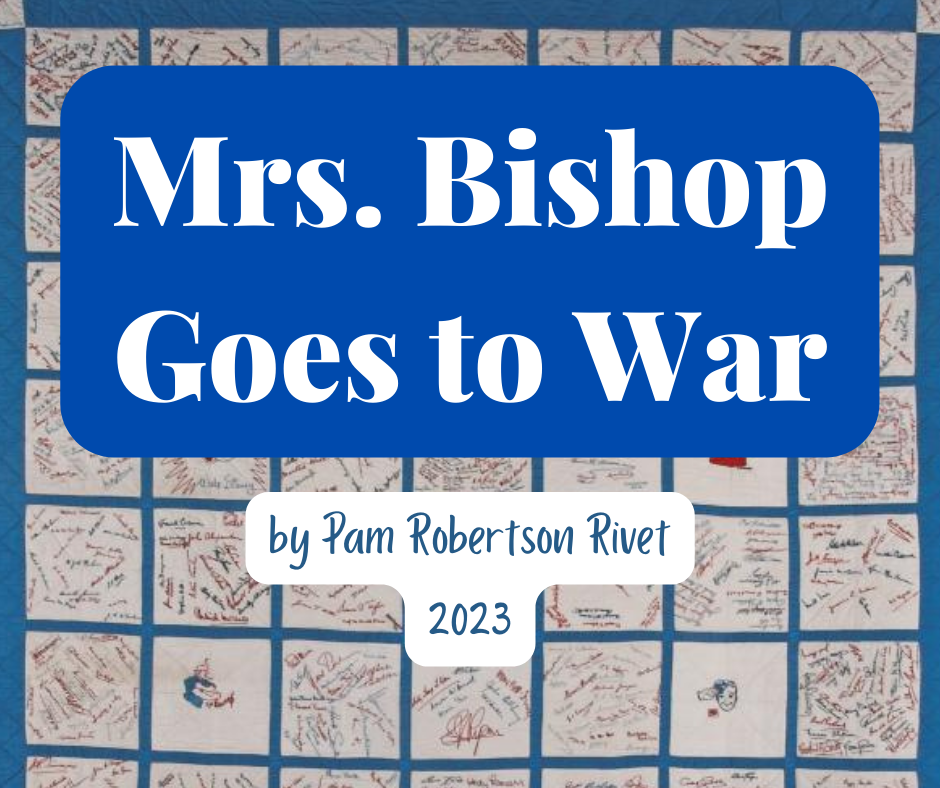
Margaret leveraged Billy’s travel schedule as well as her name as a member of the Eaton’s dynasty. Of the 1,100 signatures on what became known as “Mrs. Bishop’s Famous Names Quilt”, are those of Winston Churchill, his wife Clementine, Canadian Prime Minister William Lion Mackenzie King, as well as dozens of politicians, members of the service, and celebrities Judy Garland, Lucille Ball, Bob Hope, Spencer Tracy, and Walt Disney. To look at these signatures now is a fascinating foray into who was doing what, and where.
Margaret Eaton embroidered the Royal Canadian Air Force emblem in the centre block, and supervised the Ottawa volunteers of the Air Force Officers’ Wives Association as they stitched signatures with blue and red embroidery thread on a white background to create a stunning red, white, and blue quilt. The quilt was put together and the quilting undertaken by nuns at the Good Shepherd in Ottawa, who included exquisite replicas of pilot wings under a crown along the borders of the quilt.
The energy this quilt generated was enormous. Newspaper advertisements at the time touted a travelling quilt with thousands of signatures as people got more and more excited about it. One ad declared there were 2,000 signatures and another quoted 5,000. Tickets on the finished quilt were sold at events all over Canada, while newspaper snippets from across the country advertised the ticket sales as twenty-five cents each, or five tickets for a dollar, in a campaign that was two years long.
When it was finally raffled off in April 1943, Mrs. Bishop’s Famous Names Quilt had raised $12,000 in aid of charities supported by the Air Force Officers’ Wives Association.
In 2023 dollars, that would be just over $210,000.
The winner of the raffled quilt was a visionary, too, at least in my imaginings. Mrs. K. Molt-Wengel of Pointe du Bois, Manitoba was the winner, and she sold tickets to people who came to view the quilt in her home. Smart! In 1955 she donated the quilt to a museum, where it remains part of the permanent collection in the Centre for Craft in Winnipeg, Manitoba.
Incredible.
Margaret Bishop’s signature quilt is one to remember, and can stand as a reminder to us of the incredible work done to raise money in those times, and in similar fashion to how we raise money now, and also make quilts and things to provide comfort. It’s also a credit to people who leverage their celebrity status to help do good things, contributing to a legacy of strong Canadians who take action, even when it is twenty-five cents at a time. They put one foot in front of the other.
After thought:
I will be making presentations about this project, and sharing a few highly coveted photos of the Famous Names Quilt as we raise money to ship some of the surviving WW2 quilts from Britain to Canadian museums. In addition to contributions of any size, we are collecting $10 signatures to create a new signature quilt, that you can be part of! If you’d like to contribute, contact me through [email protected] . You can also find us on Instagram/QuiltingLegacy and Facebook/groups/QuiltingLegacy or visit https://www.buymeacoffee.com/rivetingstudios to keep up on all the news!
© Pam Robertson Rivet, 2023