

A different story
・Between analog and digital
J.C. and I.G. installed a British-made animation production software called Animo, which came out at the dawn of digital animation.
Most other production companies used a Japanese-made software called RETAS.
RETAS was easy to handle finished (celluloid painted) material data, and moreover, it was easy to install because it was a Japanese-made software.
Animo is a software that is rather specialized in shadows.
This was a major reason why we later asked I.G to produce "FLCL."
It was a big advantage that the production team and the director knew the Animo system at least once when we were processing the post-drawing process digitally.
J.C. was a studio that was originally so enthusiastic that the photography department built a huge shooting studio in the basement.
Therefore, they must have been one of the first studios to install Animo.
Anno wanted to use it because it allows you to zoom without limit, which you can't do with film.
That's why in the opening scene, the characters are zoomed in so much.
The characters are lined up side by side and then zoomed out, and the logo is also zoomed out.
Also, with analog filming, it was impossible to shoot a shot of the characters spinning and flying out of the sky with just the materials. The material would be the maximum size for hand-drawing.
Even if you use a method called "enlargement image*," in which you shoot a large, enlarged drawing, there is a limit to how much you can transfer to animation cels.
On the other hand, with digital photography, as long as the material is made, digital zooming can be done one by one.
We used this technique in the opening as much as we could.
This was an attempt to use techniques unique to digital filming, which was the latest technology available at the time.
You can tell the "Attention**" before the opening is also created with great enthusiasm. Anno created it with no compromise.
In the first place, in 1997, the flashing effect in "Pokemon" caused light sensitivity attacks among the viewers. Because of such an incident, the TV station asked us to add a warning (attention) before watching the TV show.
It was a time when all the production companies were trying to figure out how to add it (laughs).
Initially, only the works of King Records did something unique, perhaps as a result of Anno's suggestion to add it before the opening.
I don't know if they were inspired by that, but everyone in the other studios started adding unique “Attention” (laughs).
*A method of shooting a video by zooming in and out on a large original image.
**A warning at the beginning of an anime show, such as "When watching TV, please light the room and keep distance from the TV".
・Digital and Backgrounds
At that time, drawing backgrounds digitally and processing CGI were still in a transitional period and had not yet stabilized. But since GAINAX was making computer games and Anno liked new things, they were quick to do new things such as processing materials digitally or digitally processing celluloid drawings once they were scanned and changing the color tones.
But we still had to print it out and have it done, so it was a two-step process.
For "Kare Kano," only the opening is shot fully digitally, but the background is hand-drawn.
So we still had to have the large backgrounds drawn with poster paint and then scan and digitize them as needed.
The reason for this is that we have to put the celluloid pictures on top to check them.
Instead of the digitalization part of processing photos taken with a digital camera, we printed out the videotaped images and handed them to the background team (art staff) and asked them to draw the image as shown, or developed the images taken with a camera on photographic paper and showed them as they were as reference materials.
So, the art staff was making a great deal of effort. It looks like an enlarged photocopy, but actually it was a hand drawn picture (laughs).
By taking this extra step, we were able to bring the audience into the world of animation.
They drew by hand based on photographs taken on location, and then processed them digitally and added photographic processing. I think that technique had a great influence on later animation art.
In "Kare Kano," the Shōjo manga-like white, undrawn backgrounds, powa powa-ish*** image expression, and well-drawn, realistic background art were all expressed through analog photography on 16mm film.
I am excited to see how much of this can be confirmed on this digitally remastered Blu-ray disc.
***a Japanese word that does not exist in the dictionary as far as I checked. It is assumed to mean "fluffy," "floating," or "unstable.
・・
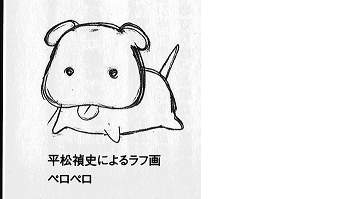
Rough sketch by Tadashi Hiramatsu Pero Pero
・・