

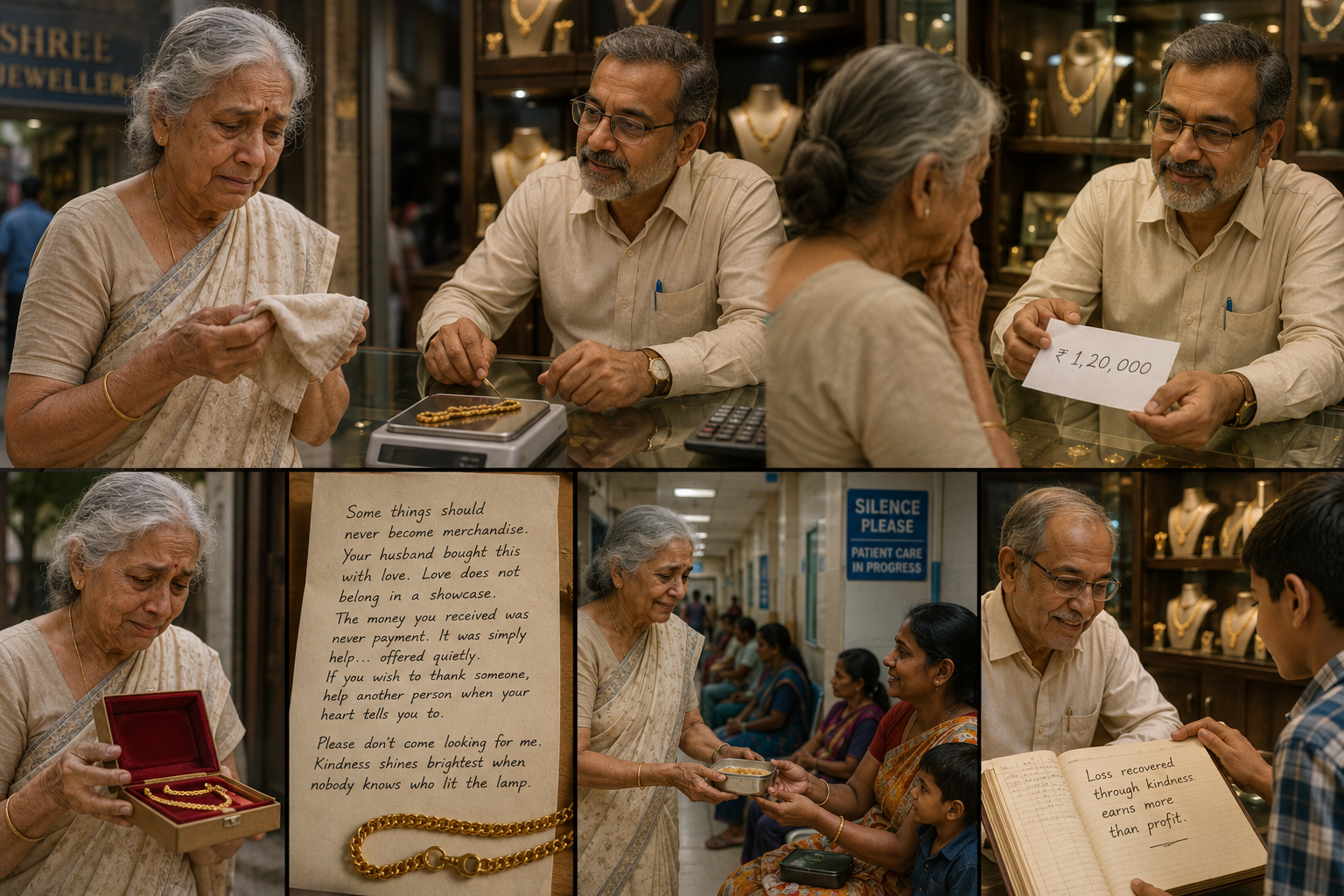
With unsteady fingers, the elderly woman carefully unfolded a worn cotton cloth. Within it lay a simple gold necklace. It was neither heavy nor adorned with precious gems, not the sort of jewelry that would draw attention. Yet, to her, it held immeasurable worth.
Her deceased husband had purchased it forty-three years prior, having diligently saved for nearly eight months. On their wedding anniversary, he had placed it around her neck, whispering with a shy smile, "It's not extravagant, but even when I'm gone, you'll know of my love for you."
From that day, she had never removed it – not for the births of their children, not during celebrations, and not even after her husband passed away. It remained the last tangible link to him. Now, she gazed at it through tear-filled eyes. "I have no alternative," she murmured to herself.
The hospital had given her only three days. Without immediate surgical intervention, her younger sister's life was at risk. The medical expenses were far beyond what an elderly widow subsisting on a small pension could possibly afford. She had already borrowed funds from neighbors, sold her old sewing machine, and pawned her silver utensils. Nothing remained. Only the necklace.
The jewelry establishment was situated at a bustling market corner. Bright lights glinted from polished glass, illuminating rows of sparkling necklaces in the display cases. She hesitated outside. Everyone entering appeared prosperous. Young couples laughed while selecting engagement rings; parents bought earrings for their daughters. She gripped the small cloth more tightly, then slowly stepped inside.
The cool air conditioning felt foreign against her aged skin. A young sales assistant briefly glanced at her modest sari before turning back to another customer. Only the elderly owner observed her anxiety. He approached her with a gentle smile. "Madam," he said softly, "how may I assist you?"
She found herself unable to respond immediately, her throat tightening. Finally, she unfolded the cloth and presented the necklace to him. "I... I wish to sell it." Her voice faltered on the last word.
The jeweler carefully examined the necklace, then her face. His experienced eyes could discern sorrow more readily than the value of gold. "May I inquire why?"
She lowered her head. "My sister is hospitalized. I require funds. Please... whatever its worth."
The jeweler weighed the necklace. The digital scale emitted a beep. He assessed its purity. By commercial standards, it wasn't particularly valuable. Years of continuous wear had slightly diminished its resale price. But as he held it, he noticed something unique: the clasp had been mended by hand many years ago. Someone had repaired it with care, rather than replacing it – people only fix things they cannot bear to lose. He gently asked, "Was this a gift?"
She smiled through her tears. "My husband." Just two words, yet they conveyed a lifetime of meaning.
For a prolonged moment, neither spoke. Outside, traffic continued, customers negotiated, coins clinked, and phones rang. But within that small corner of the shop, the silence communicated everything. The jeweler remembered his own mother. She too had once sold her wedding bracelets to cover his school fees. He had watched her conceal her tears behind a smile, a memory he had never forgotten.
He wrote a sum on a small piece of paper – it was nearly four times the necklace's actual worth. The old woman gazed at it in disbelief. "There must be a mistake."
"There isn't," he calmly replied.
"But..."
"It is today's market rate."
She appeared uncertain. "I've sold jewelry before. I know this isn't possible."
The jeweler offered a small smile. "Gold prices can fluctuate unexpectedly."
She nodded slowly, still unconvinced, yet desperation allowed little room for further questions. She accepted the money with trembling hands, thanking him repeatedly. Before departing, she looked once more at the necklace lying on the counter. For a moment, it felt like bidding farewell to her husband all over again. Then, she quietly left.
The surgery was successful, and her sister recovered. Weeks passed, and life gradually resumed its normal pace. However, each morning, her hand instinctively reached for the empty space around her neck. Each time, the absence caused a pang of sorrow. She never regretted saving her sister, but grief can accommodate multiple sorrows.
Nearly two months later, a knock came at her door. A delivery person stood outside. "I have a package for you." She frowned. "There must be an error."
"It bears your name."
Inside the small package was a velvet jewelry box. Her hands trembled as she opened it. The gold necklace lay within, exactly as she remembered it: the mended clasp, the tiny scratch near the pendant loop – everything. Beneath it rested a folded note.
"Some possessions should never be mere commodities."
"Your husband purchased this with love."
"Love does not belong in a display case."
"The money you received was never payment."
"It was simply assistance, offered discreetly."
"If you wish to express gratitude, extend help to another when your heart prompts you."
"Please do not attempt to find me."
"Kindness shines brightest when its source remains unknown."
She reread the note, again and again, until the words blurred through her tears. For the first time since entering the jewelry shop, she wept freely – not from loss, but from the realization that compassion still existed in a world that often seemed too preoccupied to notice silent suffering. She held the necklace against her heart. It felt warm, almost alive, almost like home.
Months later, the elderly woman began visiting the government hospital every Thursday. She could not contribute money, as she herself had very little. Instead, she brought homemade food for families waiting outside intensive care units. She comforted frightened children and sat beside lonely elderly patients whose relatives lived too far to visit. Sometimes, she simply listened; sometimes, that was enough.
When people thanked her, she smiled and remarked, "Someone once reminded me that kindness multiplies only when we share it." No one understood her meaning, and she never elaborated.
Years later, after the jeweler had retired, his grandson discovered an old ledger while organizing the shop. Most pages listed transactions, but one page contained only a single handwritten sentence: "Loss compensated through kindness yields more than financial gain." There was no customer name, no amount, no explanation – just those words.
The grandson inquired about its meaning. The old jeweler smiled gently. "Some accounts," he said, "are settled by the heart, not by currency."
The monetary value of gold changes daily. Markets fluctuate. Jewelry is acquired and sold countless times. But compassion holds no market price. It cannot be weighed on a scale or secured within a vault. And unlike gold, the more it is bestowed, the richer the giver becomes.
Perhaps that is why the old woman never recalled the exact sum of money she received. She remembered only the profound feeling – the feeling that, on the darkest day of her life, a stranger had quietly safeguarded not only her dignity but also the last precious memory of the man she loved.
Sometimes, the most beautiful acts of generosity are those that leave no signature, only hope. And hope, unlike gold, never depreciates.