
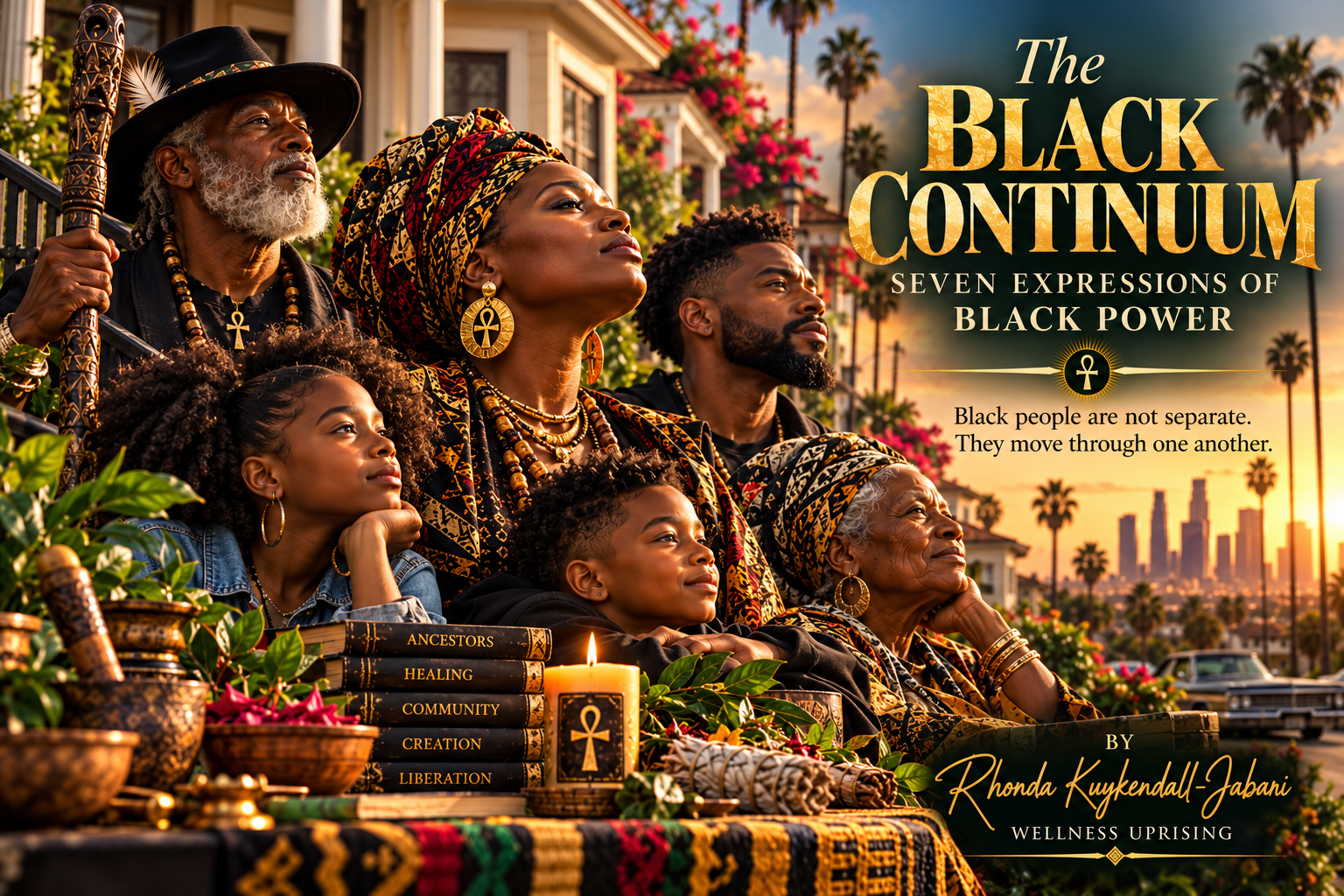
 Black people are not separate. They move through one another.
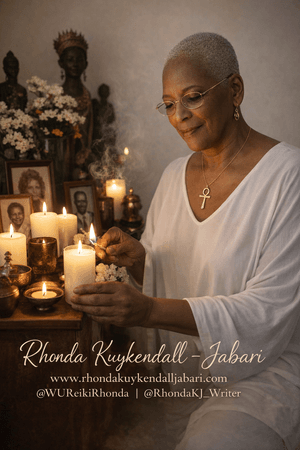
I am an empathic Black woman, born and raised in Los Angeles, a third-generation healer, a conjure woman, a Reiki Master Teacher, and an unapologetic student of Spirit. I come from people who understood that healing was not always found in a doctor's office, wisdom was not always acquired in a classroom, and God was never confined to the walls of a church. My grandfather worked the land, preached the Word, and listened to what the earth had to say. My mother was a nurse who understood that intuition could reveal what clinical observation sometimes missed. And I have spent more than two decades working with energy, honoring the ancestors, teaching Reiki, and witnessing the extraordinary capacity of human beings to transform their circumstances.
So when I speak about Black power, I am not speaking from a distance. I am speaking from inheritance, experience, observation, and practice.
I am speaking as a woman who knows what it means to carry the prayers of people whose names I may never know. As someone who has watched Black women turn kitchens into sanctuaries, ordinary gatherings into healing circles, and whatever resources were available into something that could nourish an entire community. I have witnessed our capacity to laugh in the middle of trouble, create beauty where none was offered, and claim one another as family without a drop of shared blood.
And I have come to believe that these expressions of Black power are not separate gifts. They are interconnected. Each one nourishes, informs, and strengthens the others.
Our spirituality inspires our creativity. Our creativity shapes culture. Our culture preserves memory. Our survival gives us experiences to transform. Our ability to transform strengthens the communities we build. And those communities carry our collective inheritance into the next generation.
Black people are not separate. They move through one another.
I do not mean that we are a monolith. Far from it. Our diversity of thought, belief, expression, and experience is part of our richness. Nor am I suggesting that our humanity depends upon possessing supernatural abilities or demonstrating extraordinary resilience.
I am talking about something both sacred and profoundly practical: the ways Black people have cultivated, preserved, and transmitted knowledge, creativity, spiritual understanding, and collective care across generations.
I recognize seven expressions of this power. Not seven isolated characteristics, but seven interconnected currents moving through a living inheritance.
I call it the Black Continuum.
And I believe it deserves to be examined, celebrated, and consciously carried forward.
1. We Receive the Light: The Power of Awareness
Let's begin with melanin. Melanin is a remarkable biological pigment that absorbs ultraviolet radiation and contributes to the beautiful spectrum of human skin tones. Another form, neuromelanin, exists in specific regions of the human brain, although its biological functions are still being investigated.
Science has not established that melanin produces heightened spiritual perception or gives Black people exclusive access to Divine consciousness. I make that distinction because I believe spiritual inquiry and scientific integrity can coexist
But as a Reiki Master Teacher, I am fascinated by the relationship between light, consciousness, and awareness. In spiritual traditions, light has long represented illumination, wisdom, revelation, and the ability to perceive what lies beyond ordinary appearances
I wonder what might change if we began discussing Black bodies not primarily through the historical lens of exploitation, oppression, and medical disparity, but through reverence for their beauty, complexity, and capacity to experience the sacred
Our bodies are not simply vessels that have endured history. They are living instruments through which we experience sensation, intuition, emotion, creativity, and connection.
I see light as an invitation to awareness. And awareness as the beginning of spiritual connection.
2. We Cultivate the Sacred: The Power of Spiritual Expression
Give us a drum, a voice, a floor to stomp, a kitchen table, an altar, or a quiet room. We will find a way to reach Spirit. And when Black voices rise together in prayer, there is a sacred resonance—a collective vibration believed to shift spiritual frequencies, transcending the physical world and carrying our petitions directly into the presence of God.
Throughout the African diaspora, Black people have developed, preserved, adapted, and reinvented extraordinary forms of spiritual expression. African traditional religions, ancestral reverence, conjure, the Black church, gospel music, prayer circles, communal healing ceremonies, and contemporary energy practices represent only a portion of that inheritance.
Our spiritual histories are not interchangeable. They emerge from distinct cultures, philosophies, and relationships with the Divine. Yet many demonstrate a remarkable capacity to make the sacred accessible within ordinary life.
A kitchen becomes a sanctuary. A song becomes a prayer. A gathering becomes a healing circle. A grandmother's whispered blessing becomes something her grandchildren carry long after she has joined the ancestors.
Consider the spiritual creativity required of enslaved Africans who were separated from their homelands, denied religious freedom, and often forbidden to practice ancestral traditions openly. Some preserved sacred knowledge through secrecy. Others adapted practices to unfamiliar circumstances. Still others developed new expressions of faith that carried elements of African spiritual understanding into entirely different religious environments.
Their spiritual lives were not passive responses to suffering. They were acts of preservation, adaptation, and creation. And that creative impulse did not remain confined to religious practice. It found its way into our music, language, movement, literature, and art.
Spirit became expression. Expression became culture.
3. We Make Worlds: The Power of Cultural Creation
Imagine the world without Black creativity. Remove the blues, jazz, gospel, rock and roll, soul, funk, hip-hop, and house music. Remove the countless dance forms, linguistic innovations, literary traditions, fashion movements, culinary practices, and artistic expressions shaped by Black communities. What remains would be a profoundly different cultural landscape.
Black creativity has repeatedly moved beyond the communities where it originated and influenced how people around the world sing, dance, dress, speak, cook, celebrate, and understand themselves. And some of our most enduring contributions emerged under circumstances of extraordinary restriction.
Necessity encouraged invention. Memory inspired recipes. Rhythm carried stories. Adornment communicated identity. Language became a tool of belonging, resistance, humor, and reinvention.
But I want to challenge the familiar idea that Black genius exists because of deprivation. Our creativity does not require suffering to flourish. Black people create in joy, abundance, curiosity, celebration, love, and freedom. What history demonstrates is that deprivation has frequently failed to extinguish our imagination. Even when resources were limited, the capacity to envision something different remained.
We made something beautiful from what was available, but we also imagined possibilities beyond what was immediately before us. And sometimes the world adopted our creations while neglecting, minimizing, or erasing the people who produced them. Nevertheless, those contributions became part of humanity's shared cultural inheritance.
We do not merely participate in culture. We continually help shape what culture becomes.
4. We Remain: The Power of Survival
Enslavement.
Colonization.
Segregation.
Displacement.
Systemic violence.
Erasure.
Each word represents generations of lived experience, interrupted possibilities, and deliberate efforts to control Black lives and diminish Black humanity.
Families were separated. Names were changed. Languages were suppressed. Communities were destroyed. Histories were distorted. Opportunities were denied. And still, generation after generation, Black people continued to build lives.
We established schools, churches, businesses, mutual aid societies, neighborhoods, artistic institutions, and movements for human dignity.
We raised children. Preserved memories. Passed down knowledge. Practiced faith. Loved one another.
We remain.
But survival is not the same as freedom, and resilience must never become an excuse for continued injustice.
I reject the notion that Black people should be expected to endure extraordinary suffering simply because history demonstrates our ability to do so. We deserve rest without guilt. Joy without justification. Safety without negotiation. Prosperity without apology.
Our survival is worthy of recognition, but our humanity deserves more than admiration for how much pain we can withstand. And yet, survival does produce something.
It leaves experience, memory, knowledge, and sometimes wounds that travel through families and communities. The question becomes what we do with what remains.
That brings me to an expression of Black power that resonates deeply with my work as a ritualist and healer.
5. We Practice Alchemy: The Power of Transformation
Alchemy is the art of transformation.
In its spiritual expression, it is the process of working with what exists and creating the conditions for something different to emerge. Black history offers countless examples of this process. We have made music from sorrow. Food from scarcity. Art from struggle. Movements from injustice. Wisdom from wounds. Purpose from pain.
Consider the extraordinary history of Black foodways. Ingredients that were inexpensive, overlooked, or made available through systems of inequality became the foundation of culinary traditions rich in flavor, technique, memory, and meaning.
Recipes traveled through generations. Knowledge was preserved through observation rather than written instruction. A pinch of this. A handful of that. Cook it until it looks right.
What began as nourishment also became a language of love, hospitality, celebration, and remembrance.
The same transformative impulse appears in music. The blues gave artistic expression to complex human experiences. Gospel carried spiritual longing and collective hope. Hip-hop transformed neighborhood experiences, technological improvisation, and creative experimentation into a global cultural movement.
These examples reveal something important about transformation. The original circumstances do not determine the final meaning of what we create.
Psychology describes one related process as post-traumatic growth, in which some individuals experience positive psychological changes while struggling with the aftermath of trauma.
But growth is neither automatic nor an obligation. Suffering can leave lasting harm, and no one should be required to turn their wounds into public inspiration. As a healing practitioner, I believe this distinction is essential. We do not need to romanticize pain to recognize transformation.
We do not pretend suffering was necessary. We refuse to let suffering be the only thing that remains.
That is the alchemy I recognize. And its greatest expressions often emerge when transformation becomes a shared experience rather than a solitary achievement.
6. We Claim Each Other: The Power of Chosen Kinship
Auntie.
Unc.
Sis.
Brotha.
Cousin.
In Black communities, these titles frequently extend far beyond biological relationships. They are expressions of recognition, affection, responsibility, and belonging.
Scholars describe such relationships as fictive kinship: family-like bonds between people who are not necessarily connected through blood or marriage. But there is nothing fictitious about the love, labor, and responsibility these relationships can involve.
The neighbor who watches your children. The elder who makes certain everyone has eaten. The friend who becomes your sister through decades of shared experience. The community member who offers transportation, shelter, guidance, or encouragement when it is needed most. These relationships have helped sustain Black communities through economic hardship, displacement, discrimination, and the ordinary uncertainties of life. But they are also expressions of joy.
Sometimes family forms because people simply recognize something familiar and beautiful in one another. We gather around kitchen tables, at cookouts, in beauty shops, at family reunions, in churches, healing circles, and community celebrations. We exchange stories. We laugh. We correct one another. We share resources. We remember those who came before us. And through those interactions, we transmit far more than information.
We pass along ways of being. How to prepare a particular dish. How to recognize a certain song. How to honor an elder. How to make room for someone who needs a place to belong. How to show up when somebody's world falls apart.
We recognize. We gather. We protect. We remember.
And in doing so, we build communities capable of carrying cultural memory beyond the limits of any single lifetime. We call each other home.
7. We Carry the Testimony: The Power of Ancestral Continuity
I am a third-generation healer. My maternal grandfather was a farmer, preacher, and dowser. My mother was a nurse whose professional knowledge was accompanied by a powerful intuitive understanding of the people she cared for. And I have spent much of my adult life working with Reiki, ritual, spiritual education, and community healing.
Three generations. Different practices. Different circumstances. Yet a recognizable thread runs through them. The desire to understand what cannot always be seen, to respond to suffering with care, and to use knowledge in service to others.
That is one expression of ancestral continuity. And it helps explain why I believe our greatest inheritance is not simply the ability to survive. It is the capacity to carry something forward.
Every generation receives a collection of experiences, traditions, stories, beliefs, wounds, talents, and possibilities. Some are preserved. Some are questioned. Some must be released. Others are transformed into something that better serves the people who come next.
For those of us whose spiritual understanding includes the language of covenant, this continuity can carry profound religious meaning. We may interpret our continued existence as testimony to Divine presence and an enduring relationship with the sacred. That is a statement of faith, not a scientific conclusion or a belief shared by every Black person.
But within my own spiritual understanding, it speaks to something deeply meaningful. Not that our ancestors were spared suffering. Not that every prayer was answered as they hoped. Not that every generation experienced justice. But that their lives, labor, love, and knowledge continue to influence the world through us. Their existence was not erased by death. Their contributions did not end when their physical lives ended. Something continued.
In the songs.
In the recipes.
In the prayers.
In the healing practices.
In the stories.
In the people.
We carry the testimony. And what we carry becomes part of what future generations will inherit.
The Black Continuum: One Living Inheritance
When I consider these seven expressions together, I no longer see a list of remarkable attributes. I see a continuum.
Light invites awareness.
Awareness opens the possibility of spiritual connection.
Spiritual connection inspires creativity.
Creativity shapes culture.
Culture preserves memory.
Survival carries memory through adversity.
Alchemy transforms experience into new possibilities.
Kinship creates communities capable of protecting and transmitting what has been learned.
And those communities carry the testimony forward. Not as a perfectly ordered sequence, but as an interconnected cycle that continually renews itself. Each expression influences the others.
Our spiritual practices inspire artistic expression. Our artistic traditions preserve ancestral memory. Our communities nurture creativity. Our shared histories inform how we understand suffering, healing, and possibility. And our descendants receive an inheritance that they will interpret, reshape, and eventually pass forward.
This is what I mean by the Black Continuum. It is not a claim that Black people possess seven supernatural abilities unavailable to anyone else. Nor is it a suggestion that every Black person shares the same beliefs, experiences, or relationship with ancestry. It is my recognition of a remarkable cultural and spiritual inheritance, one shaped by centuries of creativity, adaptation, community building, and the determination to remain fully human in circumstances that too often denied that humanity.
As a Reiki Master Teacher, author, and ritualist, I see this continuum reflected in my own work.
I receive knowledge.
I examine it.
I practice it.
I transform it.
And I share what I have learned with others.
The work does not end with me. It continues through the people I teach, the communities I serve, the books I write, and the conversations those offerings inspire.
That is how living traditions endure. And that is why I believe our power cannot be understood solely through what we have survived.
We must also recognize what we have imagined, created, protected, transformed, and contributed. We must honor not only the ancestors who endured, but those who laughed, loved, celebrated, dreamed, invented, and insisted upon the fullness of their humanity. We must recognize the sacredness of ordinary Black life, not just the extraordinary achievements that attract public attention. And we must remember that inheritance is not simply something we receive. It is something we are responsible for shaping.
Black people are not separate. They move through one another.
Through memory.
Through culture.
Through community.
Through the work of generations.
Through the visible and invisible threads connecting those who came before us with those who have yet to arrive.
We are not merely the descendants of people who survived. We are also the descendants of people who created worlds. And we are still creating.
WE REMAIN.