

Start two stopwatches. One rings at a million seconds. The other rings at a billion seconds. You'll hear the first alarm in under twelve days. The second takes nearly thirty-two years. The words million and billion differ by one letter in English, but the quantities are a thousand times apart. Once you've felt that gap, a headline about billions reads differently.
Large numbers get easier when you can do three things. Read them in groups, rewrite them in a form that fits the question, and check what the number measures. We'll use those skills to decode a ten-digit number, switch between millions and crores, and see how rounding can turn 999,500 into 1,000,000. Keep a scrap of paper handy for the five-question challenge at the end.
Read the commas, then read the number
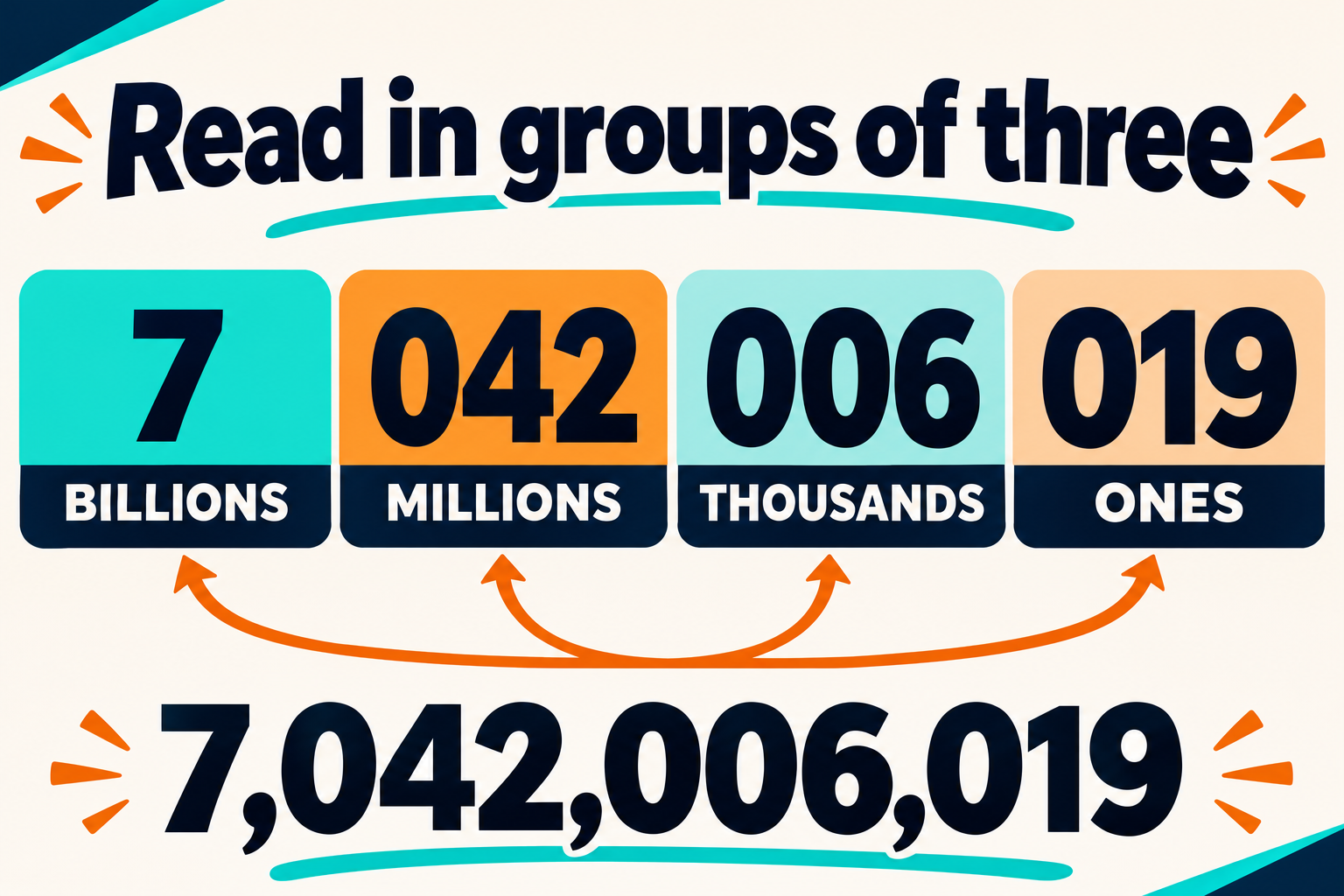
Suppose you see 7042006019 in a document. Start at the right and mark groups of three digits. You get 7 | 042 | 006 | 019. In the international grouping used here, the rightmost group is the ones period, followed by thousands, millions, and billions as you move left. To say the number aloud, go in the other direction and read each group with its label. The full number is seven billion, forty-two million, six thousand, nineteen.
Notice how the zeros work. The group 006 means six thousand because it sits in the thousands period. The group 019 means nineteen because it sits at the far right. If an entire group is zero, skip its name when you speak. Write 3,000,005 with all its digits, then say three million five. Say three million five thousand and you're describing 3,005,000, a different amount. For more examples of reading numbers aloud and interpreting scaled labels, explore RevisionTown's number vocabulary guide.
When you're writing a number from words, make a slot for every group before filling it in. For eight billion, thirteen million, sixty, write 8 | 013 | 000 | 060. Every group after the first needs three digits, even if the spoken number skips a group. This works in reverse too. With each comma you cross while reading from left to right, the group name moves down one rung. If your words land on the wrong unit at the end, go back and check the groups.
How much bigger is a billion?
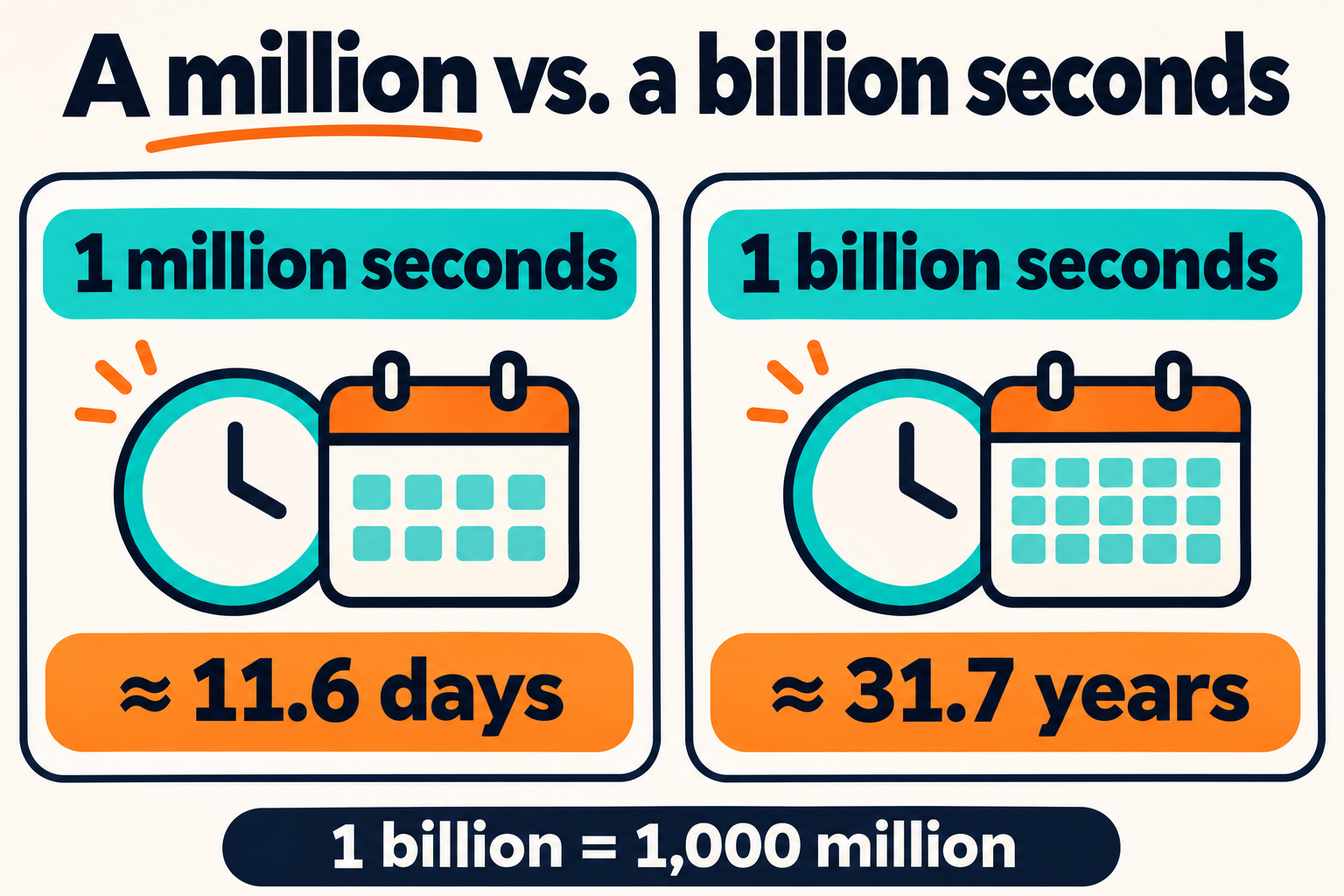
Here's the place-value ladder in the short scale used throughout this guide. One thousand is 1,000 or 10³. One million is 1,000,000 or 10⁶. One billion is 1,000,000,000 or 10⁹. One trillion is 1,000,000,000,000 or 10¹². Each jump on that list multiplies the previous value by 1,000. So a billion is a thousand million, and a trillion is a thousand billion.
You can check the stopwatch example with a quick division. A day has 24 × 60 × 60 = 86,400 seconds. Divide a million by that number and you get about 11.6 days. A billion seconds gives about 11,574 days, or approximately 31.7 years using 365.25 days per year for the estimate. If you want to see the thousandfold difference directly, compare both quantities in days. Converting one to years simply makes the longer wait easier to picture.
Try the same thinking with video views. A hypothetical channel has 900 million total views. It needs 100 million more to reach one billion. At a steady rate of one million views a day, that would take 100 days. By contrast, a channel at 990 million would need 10 days at the same rate. Both totals are under a billion, but the distances from the target are quite different. When you see a milestone, ask how far away it is in units you can use.
Where lakhs and crores fit
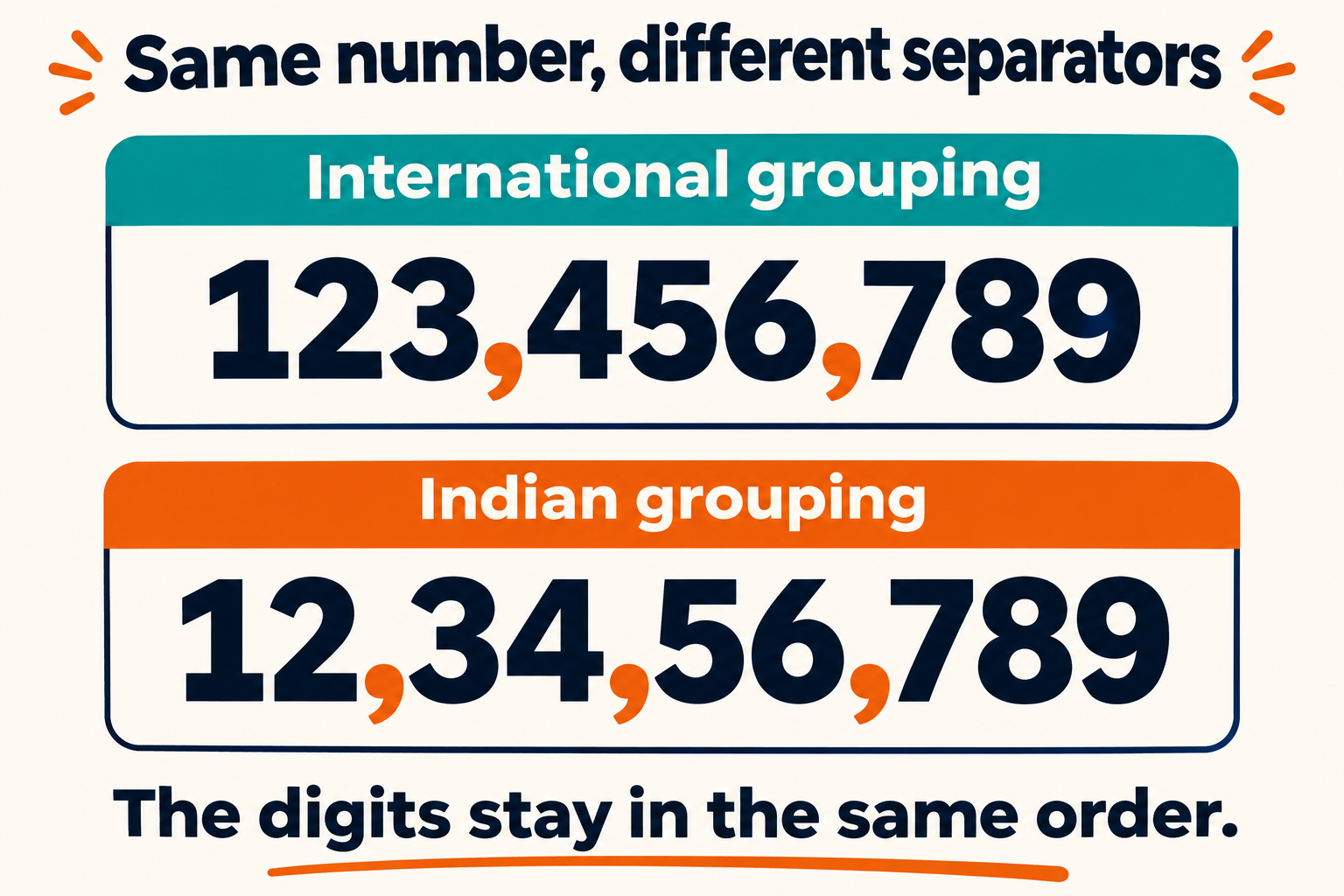
The same number can have commas in different positions. In international grouping, 123,456,789 has three digits per group. In Indian grouping, it becomes 12,34,56,789. The rightmost group of three stays together. After that, make groups of two going left. Either way, the digits stay in the same order and the number has the same value.
One lakh is 100,000, and one crore is 10,000,000. It follows that 10 lakh = 1 million, 1 crore = 10 million, and 100 crore = 1 billion. If a report says a project cost ₹2.4 crore, multiply 2.4 by 10 million to get ₹24 million. This rewrites the scale while keeping the currency in rupees. When a report switches from rupees to dollars, that introduces a separate conversion.
Here is a mental check that works even if you forget the comma placement. A crore contains one hundred lakh. For example, 3.25 crore = 3 crore + 25 lakh, which makes 32.5 million or 32,500,000. You can also multiply 3.25 by 10 to go straight from crores to millions. For a comparison across two reports, write both figures in the same unit before deciding which is larger.
Scientific notation turns a row of zeros into one exponent
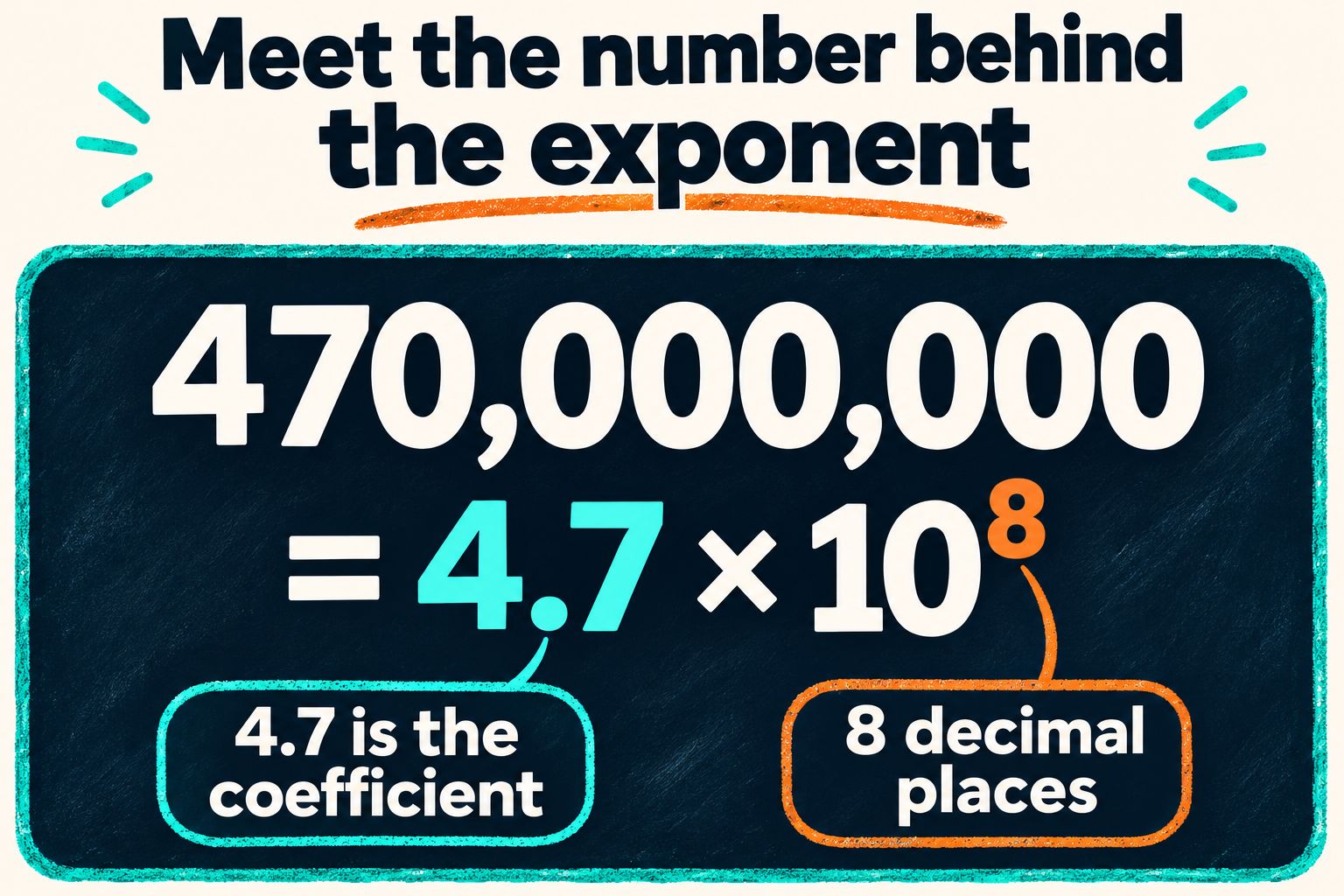
To write 470,000,000 in scientific notation, imagine a decimal point at the end. Move it left until one nonzero digit remains before it. That gives 4.7 after eight moves, so 470,000,000 = 4.7 × 10⁸. The number 4.7 is the coefficient. For a positive number in scientific notation, that coefficient must be at least 1 and less than 10. The exponent 8 tells you to multiply by 10 eight times, which moves the decimal point eight places to the right when you expand the number again. RevisionTown's scientific notation converter
Here's a common test question. 47 × 10⁷ has the same value as 4.7 × 10⁸. Moving the decimal point in 47 one place left makes the coefficient ten times smaller, so increasing the exponent by one balances the change. The second expression is in normalized scientific notation because its coefficient is between 1 and 10. A calculator may display it as 4.7E8. The E is part of the display shorthand for multiplying by a power of ten.
You can compare large positive values in scientific notation by looking at the exponent first, provided both expressions are normalized. 1.1 × 10⁹ exceeds 9.9 × 10⁸ because the first is in the billions and the second is below a billion. If the exponents match, compare the coefficients. For example, 6.7 × 10⁸ exceeds 6.2 × 10⁸. When multiplying in this form, multiply the coefficients and add the exponents. (3 × 10⁵) × (4 × 10⁶) = 12 × 10¹¹ = 1.2 × 10¹². RevisionTown's scientific calculator and exponent rules
Compare numbers without writing out every zero
How big is 750 million next to 1.2 billion? Rewrite 1.2 billion as 1,200 million. Now the difference is 450 million, and the larger number is 1.6 times the smaller. You could write both values in full and subtract, but the common unit keeps the arithmetic shorter and easier to check.
For positive whole numbers written without leading zeros, the number with more digits is larger. If the digit counts match, compare from the left and stop at the first differing digit. Take 8,095,250 and 8,105,205. Both have eight million, but the thousands groups are 095 and 105. The second value is larger even though its final group, 205, is smaller than 250. In a spreadsheet or a printed table, right-aligning whole numbers with the same units helps keep equivalent places in line.
Round to answer the question you're actually asking
To round 7,842,615 to the nearest million, identify the millions digit and check the digit immediately to its right. The next digit is 8, so the result is 8,000,000. To round the same number to the nearest hundred thousand, keep the 8 in that place and check the next digit, 4. The result is 7,800,000. Both results are correct for their stated levels of precision. RevisionTown's guide to rounding numbers
Sometimes rounding carries through more than one place. Round 999,500 to the nearest thousand using the usual classroom rule that a halfway value rounds up for positive numbers. The result is 1,000,000. The original count is still 500 below a million. That difference matters when the question is whether you've crossed a threshold. If you're estimating and feel close to a cutoff, check the original figure before making the call.
Use rounded numbers for a fast sense check. Suppose three venues record 487,200, 298,600, and 205,400 visits. To the nearest hundred thousand, those are about 500,000, 300,000, and 200,000, for roughly one million in all. Add the original numbers to get 991,200. An exact sum near the estimate is plausible. If your sum is 9.9 million, the estimate tells you to look for an extra digit. RevisionTown's worked examples on estimation
Read the units before you trust the headline
Imagine a chart with a vertical axis marked “Revenue in millions of dollars.” A bar labelled 4.8 represents $4,800,000. If a second chart reports revenue in thousands, a bar labelled 900 represents $900,000. The bar labels alone might make 900 seem bigger. The axis tells you each label's scale, which is what makes the comparison meaningful.
Check what the values count and over what period. Two mock city reports might list 24 million rides and 4 million riders in the same year. The first number counts trips, so one rider can contribute many rides. If the two figures cover the same population and period, dividing gives an average of six rides per rider. The trip count, rider count, and average answer different questions. An accurate number paired with a vague label can still leave the reader with the wrong impression.
Take the five-question challenge
1. Write nine billion, four million, seventy-two in digits using international grouping.
2. Put 6.8 crore into millions.
3. Rewrite 82,300,000 in scientific notation.
4. Which is larger, 0.95 billion or 952 million? How far apart are they?
5. Round 4,963,801 to the nearest hundred thousand.
Answers you can check in your head
1. 9,004,000,072. The thousands group gets three zeros and the ones group needs a leading zero.
2. 68 million. Each crore is ten million, so multiply 6.8 by ten.
3. 8.23 × 10⁷. Move the decimal point seven places to leave one digit before it.
4. 952 million, by 2 million. Convert 0.95 billion to 950 million before subtracting.
5. 5,000,000. The ten-thousands digit is 6. Rounding up from the 9 in the hundred-thousands place carries into the millions place.
Next time a big number makes you scroll back and count the zeros, give it a unit you can picture. Read it in groups, put both numbers on the same scale, or translate a long string of digits into one power of ten. Then say out loud what the number counts. You should be able to explain both its size and its meaning before reaching for a calculator.