
Welcome to this Friday’s edition. Throughout the week, we’ve been exploring the strategy and history of the institution that has dominated the market. Today, we’ll look at the only obstacle that actually prevents these strategies from being applied: our own brains. If you’re successful in your field, you’re probably used to solving problems rather than avoiding them. When something goes wrong in business, you roll up your sleeves, reorganize processes, and save the day. This approach has made you who you are and built what you have. But as soon as you apply this mindset to the financial markets, it becomes your greatest enemy. The reason is a phenomenon for which Daniel Kahneman and Amos Tversky won the Nobel Prize in Economics—Prospect Theory
The pain of loss vs. the joy of gain
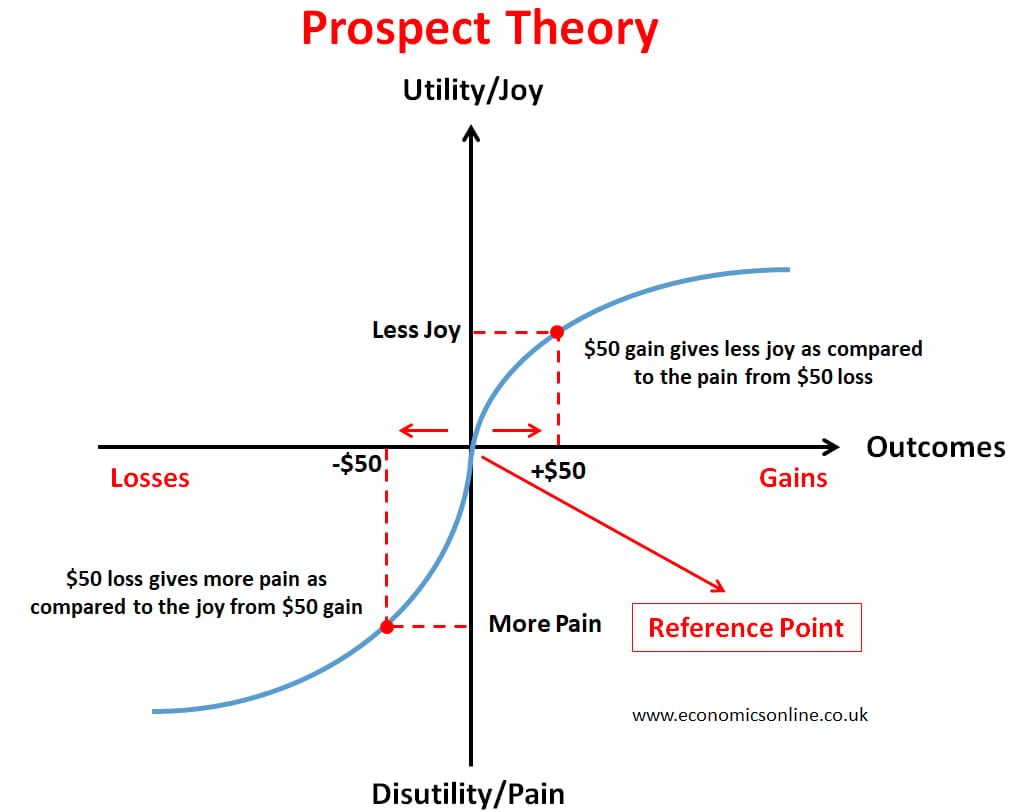
Scientists have empirically proven that people do not evaluate gains and losses rationally. The psychological pain of loss is roughly twice as strong as the joy of a gain of the same amount. Losing 100,000 crowns hurts the ego much more than a gain of 100,000 crowns brings pleasure. We are evolutionarily programmed to have an aversion to loss, because in prehistoric times, the loss of resources meant death. Today, it doesn’t mean death, but it does mean a blow to our ego.
https://share.google/DweD3Cwezp9pAnIRH
How does this work in practice?
This cognitive bias causes even highly intelligent people to make two fatal mistakes in investing and trading that are sure to ruin any attempt to build a passive income stream:
Holding Losing Positions (Hope Instead of Strategy)
When the market turns downward, the brain refuses to accept the loss, because that would confirm a mistake. Instead of rationally closing the position, you start hoping and praying. “I don’t even care about a profit anymore; once it gets back to zero, I’ll sell it.” This locks your capital into a dead trade and exposes you to the risk of a catastrophic loss.
Taking profits too early (Fear of success)
When an investment is in the black, loss aversion kicks in again. You start to fear that you’ll lose those unrealized gains. That’s why the position is sold quickly to lock in the profit.
The result? The system generates small gains and huge losses. The math works relentlessly against the investor—or, at this point, the speculator.
What approach should we take?
On Wednesday, I wrote about the Goldman Sachs story. The reason institutions survive is that they have no ego. If you want to build a sustainable income stream, you need to start approaching your portfolio with the same cold-blooded detachment.
Redefining the concept of loss: In business, you pay rent, salaries, marketing, and other expenses. In trading and investing, a losing trade is, in theory, one such operating expense. It is not a failure of intellect; it is a necessary cost of doing business in an uncertain environment. It is the price you pay for potential expected returns.
You can’t turn off emotions, but you can work around them. Always enter the market with a predefined plan specifying exactly where you’ll close the position if you’re wrong (Stop-Loss). If you hit that limit, the market must act on your behalf. No discussion, no emotions, and no negotiating with your own ego.
In conclusion
Take an honest look at your current portfolio or business projects. Are you holding onto certain assets or initiatives simply because your ego refuses to accept a loss? True financial sovereignty doesn’t start with always being right. It starts with accepting that you’re wrong. In the words of investment legend Warren Buffett: “You only need to make a few good decisions, as long as you don’t make too many bad ones.”
I wish you a peaceful weekend and a clear head.
Tomáš Balý - RENTA.