

When I was a kid in Israel, sometimes someone would do something strange, annoying, or completely random.
Naturally, another kid would ask:
“Why did you do that?”
And every now and then, instead of an explanation, the answer would come:
“כדי שיהיה לך מה לשאול.”
“So you’d have something to ask.”
As a child, it was just sass.
As an adult, I forgot about it.
Until a few days ago, when I suddenly heard a little voice from my past. An elementary school classroom. A kid in mid-comeback. The memory returned right on time, now that I understand its significance.
Curiosity Is Suddenly a Market Skill
In a closed meeting of industry leaders, something was stated very clearly: The most valuable skill in today’s job market is curiosity.
Cultural elements shape us. And yet, how many of us can explain to colleagues abroad where we learned how to be the way we are?
How to be… well, Israeli.
Not that anyone is trying to export rudeness or the inability to stand in line. But when innovation is in high demand, suddenly other cultural traits get attention.
And just to be clear: neither rudeness nor line-cutting are required for producing more ideas.
So what is?
Questions.
The “Invisible” Nature of Culture:
If you grew up in a culture that answers questions with questions, you don’t see it as “psychology” - you just see it as “how people talk.” It’s like a fish trying to notice water.
After October 7th, I worked on a documentary about antisemitism.
I tried to understand why Jews are hated. Well no, that part wasn’t even the most interesting. Stranger danger, as they say. What I didn’t understand was the need to express it. Keep your thoughts to yourself, honestly.
A Greek man I once spoke with for two minutes felt the need to inform me that Jews “have no culture.”
“Funny you say that, sir,” I told him. “Who wrote the Bible the Greeks like so much?”
Maybe I lack imagination, but I can’t picture him saying something like that if I were something else. Maybe Italian. Maybe.
There are narratives, myths, psychological patterns. Ugly, but traceable.
Anyway, I knew this wasn’t just ordinary bigotry. This one is elite-driven.
That part, in a strange way, I could map. Elites don’t like other elites, or groups that threaten their power, and Jews…
Tend to do both.
Fair.
That part I could understand.
What I couldn’t understand was the other side:
Why do Jews so often do well?
Jews are ~0.2 % of the world population and yet:
~22 % of all Nobel Prize winners
~26 % of Nobel laureates in science fields
~27 % of Fields Medal (top mathematics award)
~31 % of Turing Award winners (computer science)
In 1930s Germany, Jews were ~33 % of mathematics professors while <1 % of the population.
Why?
For every explanation I found, I could think of cultures that did everything attributed to Jewish success, and did it better.
Jewish mothers don’t push their kids more than Asian mothers, probably less.
Israelis and Jews are not the best students in school; I studied in enough mixed classrooms to know that. Not in discipline, not in grades.
IQ? The statistics don’t really add up, and even if they did, IQ alone doesn’t explain behavior at scale.
The only idea that partially made sense was that Jews tend to show up when opportunity appears.
But nobody goes around saying,
“You must attend every event.”
So why do they?
Two Years Later
It took me two years.
Two years of sensing that something cultural was happening beneath the surface. Something subtle, behavioral, almost invisible.
October 7th, two years later. Midnight. On my way home from a Sukkot dinner.
Out of nowhere, in a moment of frustration, I said out loud:
“I just wish people asked more questions.”
That sentence opened a Pandora’s box.
Or maybe the Pandora’s box was the way our minds had been closed.
Either way, Curiosity.
That thought opened a door I haven’t closed since.
In Jewish tradition, the act of questioning is often more important than the answer itself.
If a child asks “Why is the sky blue?” and the parent doesn’t know, “So you’d have something to ask” is the ultimate “checkmate” to stop the cycle of “Why?” without shutting down the mechanism.
Every question is the beginning of something:
A conscious choice.
An insight.
A discovery path.
And there are two elements that determine how far that path goes:
Quality - what kinds of questions you know how to ask.
Quantity - whether you ask at all.
The quality part is a discipline in itself. Knowing what questions to ask has, at times, reshaped entire eras of scientific discovery. The Renaissance, for example, was not only about new answers, but about new ways of questioning. But that, too, is a discussion for another time.
Before we talk about what to ask, we have to talk about something more basic. The ability to ask at all. Kids ask questions constantly. Endless, annoying, pointless questions.
But if they keep asking and repeatedly get shut down, they begin to ask less and less and less…
Until they stop altogether. And rarely start again.
Habits are habits, after all.
So what?
“So you’d have something to ask.”
That particular brand of witty, slightly evasive deflection is most famously associated with Jewish culture and humor, It is often used as a playful “non-answer” to a question that either has no clear answer, is considered trivial, or is being asked by a child who is being particularly inquisitive.
Note to self: I need to hang out with kids more.
Why this response?
It refuses to answer - without punishing the question.
Similar Cultural Contexts
While this style is strongly associated with Jewish wit, you can find similar “circular” or mystery-preserving responses elsewhere.
The Socratic tradition, for example, takes a more academic form but shares the same underlying idea: the question itself is the vehicle for growth.
The “Question for a Question” Trope: It leans into the classic stereotype (and cultural reality) of answering a question with another question, or in this case, a meta-commentary on the question itself.
The Social Architecture of the “Non-Answer”
Children learn conversational norms long before they learn philosophy.
If questions are treated as:
annoying → people stop asking
threatening → people hide curiosity
disrespectful → people perform agreement
But if questions are treated as:
part of the game
socially safe
playful
Curiosity survives.
A field guide to identifying bridges, walls, and kill-switches.
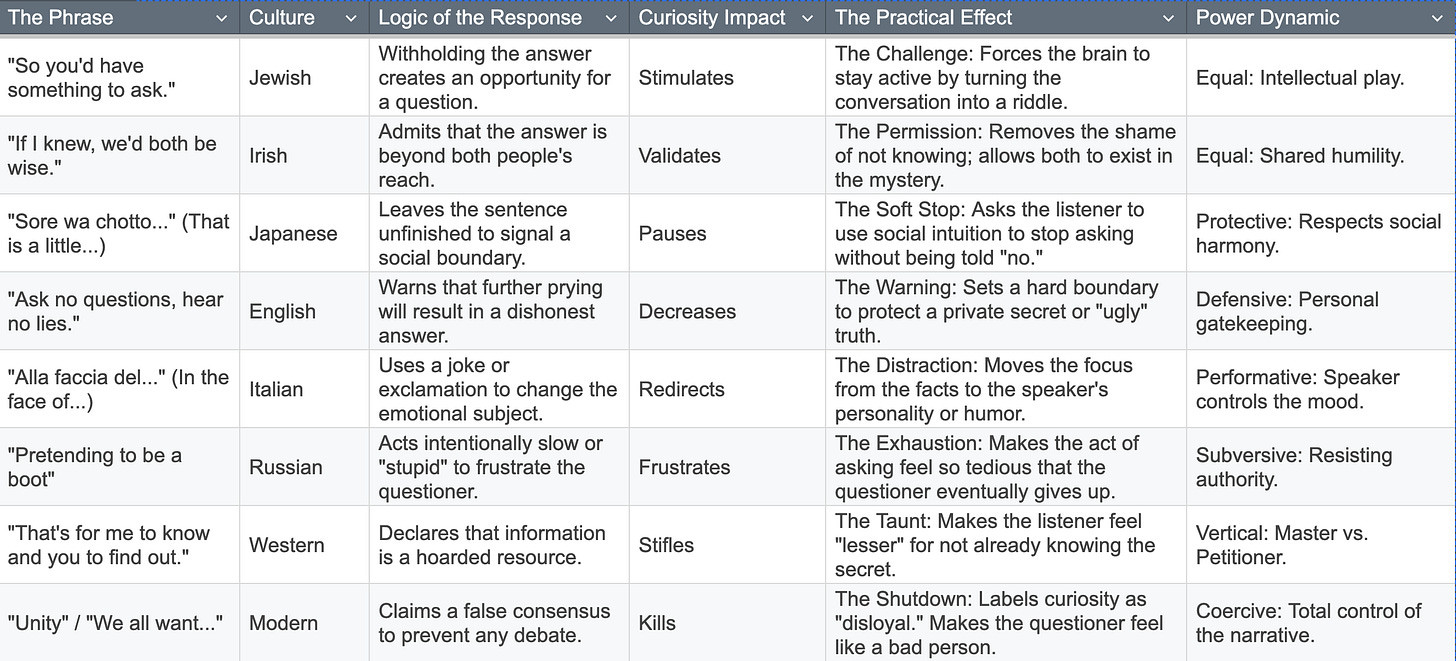
Most societies have standard tools for closing curiosity:
“Because I said so.” → authority over inquiry
“None of your business.” → boundary over dialogue
“Just stop asking.” → punishment for curiosity
These responses treat questions as threats.
An identity-shattering level of threat.
Kids don’t write cultural theory.
They don’t design educational systems.
Yet they carry the consequences.
And in recent decades, systems that punish dissent have become the norm.
That’s it. A straight fall onto concrete.
Identity shatters on impact. The pieces scatter everywhere.
And who is supposed to gather them?
The ones who were never allowed to ask?
Luckily, when you belong to a civilization that spans several millennia, someone, somewhere, has already encountered the same problem.
In the Passover Haggadah, the traditional text read every year at Passover, there are four kinds of children. One of them does not know how to ask a question at all. And the instruction given to the parent is striking: you must open the conversation for him. You must help him begin.